



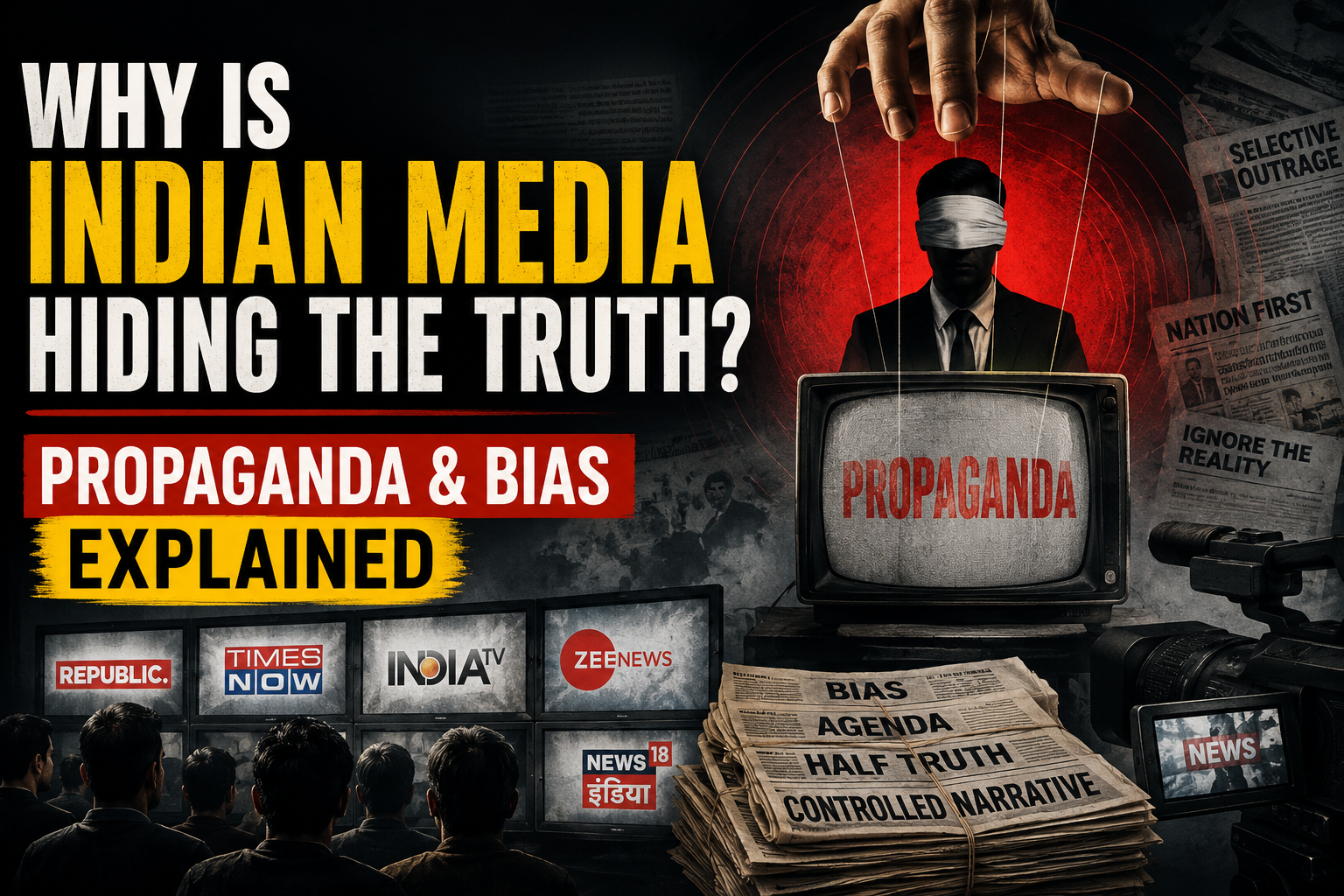
Why Is Indian Media Hiding the Truth? The paradox of the world’s largest democracy is becoming impossible to ignore. India boasts a massive media ecosystem with hundreds of news channels, thousands of print publications, and an exploding digital news landscape. However, a growing consensus among international watchdogs, independent experts, and domestic critics suggests a grim reality: a significant portion of the mainstream press has severely compromised its journalistic integrity. The burning question on the minds of many citizens is: why is the Indian media hiding the truth, and why are major networks actively participating in Indian media propaganda?
To understand this dramatic shift in the journalism landscape, one must look beyond individual news anchors and examine the systemic, financial, and political transformations that have gripped the industry over the past decade. For readers who want to stay informed about critical societal shifts and reliable updates, you can also read our latest coverage in the news section on Jivan Jarurat.
The Plunge in India’s Press Freedom Rankings
Over the past several years leading into 2026, India’s ranking on the global stage regarding journalistic freedom has experienced a steep and alarming decline.
What Global Watchdogs Are Reporting
According to annual reports by Reporters Without Borders (RSF), India’s position on the World Press Freedom Index has consistently hovered near the bottom tier of 180 evaluated countries. In recent assessments, RSF has gone so far as to describe the situation in the Indian media landscape as an “unofficial state of emergency.” Unlike the formal Emergency of 1975-1977 where the press was legally gagged, today’s censorship is described as invisible but highly effective. The metrics for political, legal, and economic safety for journalists have dropped significantly.
The Government’s Official Stance
The Indian government has vehemently and consistently rejected these international rankings. Officials argue that organizations like RSF rely on questionable, non-transparent methodologies with incredibly low sample sizes. Authorities point out that the fundamental right to freedom of speech and expression is firmly protected under Article 19 of the Indian Constitution. Furthermore, state representatives often dismiss these critical global indices as western-driven propaganda meant to tarnish India’s image. Despite these official reassurances, the on-the-ground reality for reporters paints a different picture.

The Rise of Corporate Media Consolidation
To fully grasp why Indian media hiding truth allegations have gained such massive traction, one must follow the money and look at who owns the newsrooms.
The Shift from Journalism to Business Interests
Historically, many of India’s news organizations were run by families or trusts dedicated primarily to journalism. Today, there has been a massive consolidation of media ownership by a handful of powerful multinational business conglomerates. When massive corporate entities—with vast, multi-billion-dollar interests in sectors like telecom, energy, infrastructure, and retail—acquire major media networks, a direct conflict of interest is born.
Economic Incentives Over Adversarial Reporting
These mega-conglomerates rely heavily on favorable government policies, massive state contracts, and regulatory approvals to thrive. Consequently, media organizations owned by these business interests have a built-in economic incentive to discourage adversarial reporting against the ruling political establishment. This corporate consolidation places a heavy, suffocating blanket over editorial independence. Editors and journalists are often forced into self-censorship, shifting their focus away from holding power accountable, and instead prioritizing the protection of their corporate parent’s bottom line and political relationships.

Financial Dependency on Government Advertising
Beyond corporate ownership, another massive factor contributing to government bias in media is the fundamental financial model of the Indian news industry. Running a 24/7 national television news channel or a large-scale daily print publication requires immense, continuous capital.
The Weaponization of Ad Revenue
Why Is Indian Media Hiding the Truth? Both state and central governments are among the absolute largest advertisers in the country. They spend thousands of crores annually on campaigns promoting state welfare schemes and political achievements. By heavily controlling the distribution of these advertising funds, political authorities can exert immense pressure on media outlets.
News organizations that dare to publish highly critical reports risk having their government ad revenues slashed overnight—a move that can instantly bankrupt a publication. To ensure a steady flow of income and survival, many mainstream outlets choose to toe the line. They amplify government achievements while actively downplaying, ignoring, or completely hiding critical issues like unemployment crises, inflation, rural distress, or civil rights violations.

The “Godi Media” Phenomenon and Hyper-Nationalism
The shift toward an overwhelmingly pro-government narrative has given rise to the colloquial, highly critical term “Godi media”—a phrase translating roughly to “lapdog media.” This term is widely utilized by citizens and opposition figures to describe news channels that have entirely abandoned objective journalism.
Sensationalism as a Distraction Tactic
Instead of questioning policymakers on prime-time television, mainstream debates are now frequently characterized by sensationalism, jingoism, and aggressive, polarizing rhetoric. These channels often target opposition figures, dissenting activists, or minority communities. By keeping the public enraged, divided, and highly emotional over religious or hyper-nationalistic issues, these media networks successfully divert public attention away from pressing governance and economic failures.
This strategy mirrors the propaganda technique of the “Big Lie”—repeating unverified or heavily skewed narratives relentlessly until the general public accepts them as undeniable truth.
Intimidation and Harassment of Independent Voices
While the mainstream broadcast and print media have largely fallen into line, a fierce battle for the truth is being fought in the digital space. Independent digital platforms and freelance journalists who continue to report the truth often face severe, life-altering repercussions.
Raids, Arrests, and Legal Battles
Journalists attempting to operate outside the Indian media propaganda sphere frequently face institutional harassment. In recent years, numerous reporters critical of the government have been subjected to arbitrary detentions, sudden travel bans, and severe charges under stringent, non-bailable anti-terror laws like the Unlawful Activities Prevention Act (UAPA). Financial investigation agencies have routinely raided the offices of independent news portals, seizing electronic devices, freezing bank accounts, and arresting top editors under allegations of financial impropriety or foreign funding violations.

Coordinated Online Smear Campaigns
Beyond state-sponsored legal harassment, independent journalists—especially women—are routinely subjected to highly coordinated hate and smear campaigns by political IT cells on social media. These cyber-harassment tactics aim to discredit the reporters’ work, spread deepfakes, and create an incredibly unsafe environment for free speech. When the cost of speaking the truth involves the threat of jail time, physical harm, or severe character assassination, a chilling effect ripples through the entire journalistic community.
The Impact on Democracy and Public Trust
A biased and heavily controlled media environment is not just a niche problem for journalists; it is a direct, existential threat to the democratic fabric of the nation. When the media stops functioning as the critical fourth pillar of democracy, citizens are deprived of the factual, unbiased information they desperately need to make informed voting decisions.
A Growing Crisis of Credibility
Audiences are increasingly aware of these dramatic shifts. There is a mounting crisis of credibility, where viewers rightfully perceive legacy news organizations as mere public relations arms of political parties. This severe lack of trust is driving citizens toward alternative, independent digital news platforms, podcasts, and unverified social media channels for their information.
While alternative media offers a lifeline for the truth, the lack of regulation on social platforms also opens the floodgates to fake news and deepfakes, further complicating the public’s ability to discern fact from fiction. If you find yourself overwhelmed by the daily barrage of toxic news, reading about healthy lifestyle habits on Jivan Jarurat can offer tips on managing digital stress and mental well-being.

Can the Indian Media Reclaim Its Independence?
The allegations that mainstream networks are hiding the truth are not baseless rumors; they are rooted in highly verifiable patterns of corporate consolidation, financial dependency on the state, and systematic legal intimidation. For India to maintain and strengthen its status as a vibrant, functioning democracy, a robust and fiercely independent press is absolutely non-negotiable.
Breaking free from the suffocating grip of government propaganda will require massive structural reforms. This includes implementing strict regulations on cross-media ownership, creating highly transparent and automated government advertising policies, and fostering a unified pushback from citizens who demand reliable, unbiased, and fearless journalism. Until the public demands better, the screens will likely continue to broadcast the narratives the powerful want them to see.
13. Frequently Asked Questions
Q1: Why is India’s ranking low on the World Press Freedom Index?
India’s ranking has fallen due to increased legal harassment of journalists, the concentration of media ownership in the hands of a few pro-government corporations, and the lack of physical and digital safety for independent reporters.
Q2: What does the term “Godi media” mean?
“Godi media” translates to “lapdog media.” It is a critical term used by the public to describe mainstream Indian news channels that act as mouthpieces for the ruling government rather than practicing objective, questioning journalism.
Q3: How does corporate ownership affect news in India?
Large business conglomerates own many major news networks. Because these corporations rely on government contracts and favorable policies for their primary businesses, they pressure their media outlets to report favorably on the government, leading to widespread self-censorship.
Q4: Are independent journalists in India facing legal threats?
Yes, numerous independent journalists and digital news outlets have faced arbitrary arrests, travel bans, and raids by financial investigative agencies, often charged under strict anti-terror or sedition laws for their critical reporting.
Q5: How does the government financially influence the media?
The government is one of the largest advertisers in India. By threatening to pull massive advertising budgets from critical newspapers and TV channels, the state can financially coerce media organizations into adopting a pro-government editorial stance.
14. Key Takeaways
- Declining Freedom: India’s rank on global press freedom indices has plummeted, reflecting a severe environment of censorship and an “unofficial state of emergency” for journalists.
- Corporate Control: The massive consolidation of media ownership by billionaires prioritizes corporate business interests and political alliances over adversarial, fact-based reporting.
- Financial Coercion: Heavy dependency on government advertising revenue forces many legacy news outlets to self-censor and heavily amplify state propaganda to survive financially.
- Targeting the Truth: Independent journalists who dare to question authorities frequently face draconian legal harassment, institutional raids, and coordinated online smear campaigns.


