
NASA New Telescope for Exoplanets: The Search for Alien Life
Introduction: The Ultimate Quest to Find Alien Life
For centuries, humanity has stared up at the night sky and asked one profound question: Are we entirely alone in the universe? Until recently, this was a question left to philosophers and science fiction writers. However, modern technology is finally catching up to our curiosity. Today, scientists are officially preparing to build a NASA new telescope for exoplanets that could definitively answer this question.
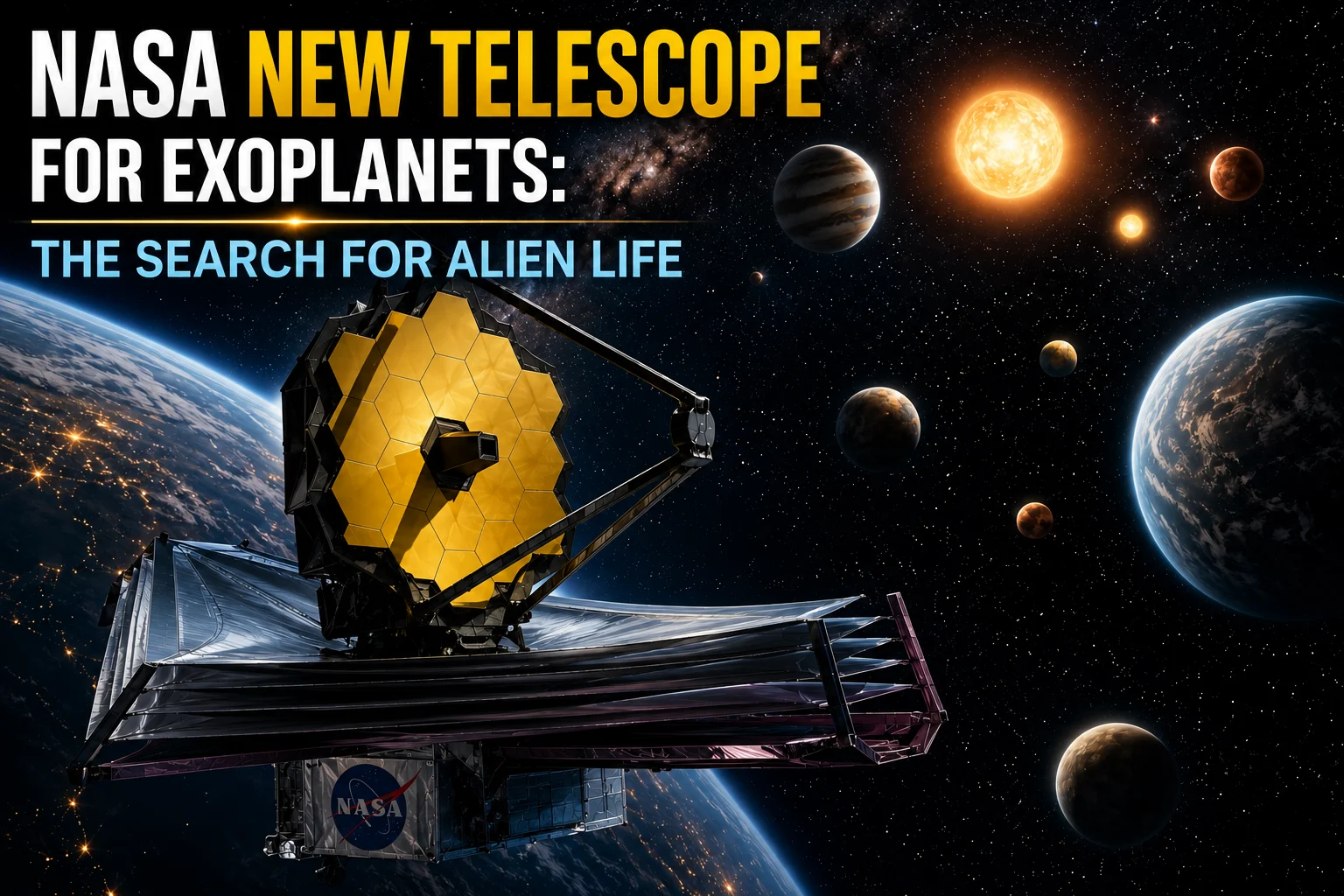
Known officially as the Habitable Worlds Observatory (HWO), this ambitious project represents the next giant leap in space exploration. While current instruments like the James Webb Space Telescope (JWST) are doing an incredible job studying the cosmos, they were not explicitly designed to photograph small, rocky, Earth-like planets. Therefore, NASA is shifting its focus toward a new flagship mission.
This NASA new telescope for exoplanets is specifically engineered to provide clear visibility of near solar system planets. By studying the atmospheres of these distant worlds, astronomers hope to detect the chemical signatures of biological life. In this comprehensive guide, we will explore how this extraordinary machine works, what it hopes to find, and how it will forever change our understanding of the universe.
What is the Habitable Worlds Observatory (HWO)?
The Habitable Worlds Observatory (HWO) is NASA’s upcoming flagship astrophysics mission. It is a massive space-based observatory designed with one primary goal in mind: finding habitable, Earth-like planets beyond our solar system.
The concept for HWO was heavily influenced by the National Academies’ Astro2020 decadal survey. This survey acts as a roadmap for the astronomical community, highlighting the most important scientific goals for the next ten years. The survey concluded that finding life on other planets should be NASA’s top priority. Consequently, HWO was born.
Unlike telescopes that orbit close to Earth, HWO will be stationed at Lagrange Point 2 (L2). This is a gravitationally stable orbit located approximately 1.5 million kilometers away from our planet. From this cold, dark vantage point, the observatory can operate continuously without the interference of Earth’s heat or light.
Why We Need a NASA New Telescope for Exoplanets
You might be wondering why NASA needs to spend billions of dollars on a new telescope when we already have the Hubble and James Webb Space Telescopes. The simple answer is that finding another Earth requires highly specialized equipment.
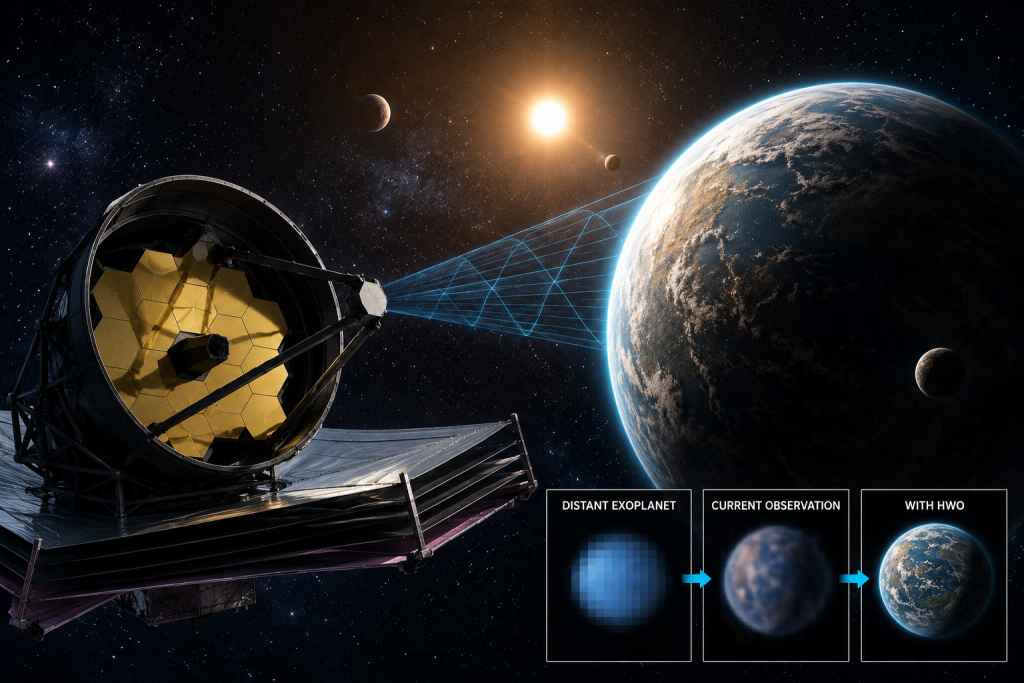
Currently, astronomers mostly find exoplanets using the “transit method.” When a planet crosses in front of its host star, it blocks a tiny fraction of the star’s light. By measuring this dip in brightness, scientists can confirm a planet’s existence. However, this method only tells us the planet’s size and orbit. It rarely gives us a clear picture of what the planet actually looks like.
To truly understand if a world is habitable, we need direct imaging. We need to capture the faint light reflecting off the planet’s atmosphere. Because our current telescopes are not optimized for this exact task, building a NASA new telescope for exoplanets is an absolute necessity.
The Challenge of Seeing Near Solar System Planets
Directly observing near solar system planets is arguably the hardest optical challenge in human history. To understand why, imagine trying to see a tiny firefly buzzing around a powerful lighthouse spotlight from several miles away.
Stars are incredibly bright, while the planets orbiting them are incredibly dim. In fact, an Earth-like planet orbiting a Sun-like star is about 10 billion times fainter than the star itself. When a telescope points at a distant star system, the overwhelming glare of the star completely washes out any planets nearby.
Furthermore, these planets orbit very close to their stars from our perspective. Separating the planet’s faint glimmer from the star’s blinding light requires unprecedented precision. This is why standard lenses and mirrors simply are not enough for the job.
How HWO Will Provide Clear Visibility of Exoplanets
To overcome these massive challenges, the Habitable Worlds Observatory will rely on groundbreaking, next-generation technologies. NASA is currently funding several aerospace companies, including BAE Systems, Lockheed Martin, and Northrop Grumman, to mature these critical systems.
The Ultra-Precise Coronagraph
The most important piece of technology on HWO is the coronagraph. A coronagraph is an instrument placed inside the telescope that acts like an artificial eclipse. It uses a series of physical masks and advanced optics to physically block out the blinding light of a host star.
While coronagraphs exist on older telescopes, the one built for HWO will be exponentially more powerful. It must suppress starlight by a factor of 10 billion. Once the star’s light is blocked, the faint, reflected light from near solar system planets will finally become visible to the telescope’s sensors.
Unprecedented Spacecraft Stability
Even with a perfect coronagraph, the mission will fail if the spacecraft shakes or vibrates. When you are trying to block out a star to see a speck of light billions of miles away, even the tiniest movement ruins the image.
Therefore, HWO is being designed to be the most stable spacecraft ever constructed. According to NASA engineers, it will be roughly 100 times more stable than JWST. The instrument payload is expected to wobble no more than the width of a single hydrogen atom during long observations.
Micro-Mirrors and Multi-Object Spectroscopy
Once the telescope captures the faint light from a planet, it must analyze it using a spectrograph. HWO will utilize advanced micro-mirrors and multi-object spectroscopy. This technology acts like a high-tech prism, splitting the planet’s light into a rainbow of distinct colors.
By studying these colors, scientists can read a planet’s atmosphere like a barcode. Missing lines in the spectrum tell astronomers exactly which gases are present in the air of that distant world.
Comparing NASA’s Great Observatories
To fully appreciate the leap forward that HWO represents, it is helpful to compare it to other famous space observatories.
| Telescope Name | Primary Focus | Location in Space | Launch Era | Exoplanet Capability |
| Hubble | Visible & UV Light | Low Earth Orbit | 1990s | Very limited; mainly transit studies. |
| James Webb (JWST) | Infrared Light | Lagrange Point 2 | 2020s | Excellent for giant gas planets; limited for Earths. |
| Roman Space Telescope | Dark Energy & Wide-Field | Lagrange Point 2 | Mid-2020s | Will test advanced coronagraph tech. |
| Habitable Worlds (HWO) | UV, Visible, Infrared | Lagrange Point 2 | 2040s | Direct imaging of Earth-like planets. |
As the table shows, HWO will be the first observatory specifically fine-tuned to capture direct images of rocky, temperate planets.
The Role of the Nancy Grace Roman Space Telescope
Before HWO can launch, NASA needs to test its theories in actual space conditions. This is where the Nancy Grace Roman Space Telescope comes in. Scheduled to launch before the end of this decade, the Roman telescope is primarily designed to study dark energy and dark matter.
However, it also carries a critical secondary payload: the Coronagraph Instrument (CGI). This instrument is a technology demonstrator. It will test the complex light-blocking masks and deformable mirrors needed to photograph planets. The lessons learned from the Roman Space Telescope will directly shape the final design of the NASA new telescope for exoplanets.
What Are Scientists Looking For? (Biosignatures)
Once the Habitable Worlds Observatory provides clear visibility of near solar system planets, what exactly are scientists hoping to find? The ultimate goal is to discover “biosignatures”—chemical evidence that biological life is altering a planet’s atmosphere.
Oxygen and Methane Signs
On Earth, our atmosphere is filled with oxygen primarily because plants and photosynthetic bacteria constantly produce it. Without life, oxygen quickly reacts with other elements and disappears from the air.
If HWO detects large amounts of oxygen on a distant rocky planet, it is a strong hint that something biological is producing it. Furthermore, if the telescope detects oxygen alongside methane, the case for life becomes incredibly strong. In a normal chemical environment, oxygen and methane destroy each other. Finding them together means they are constantly being replenished, likely by living organisms.
Liquid Water in the Goldilocks Zone
Before looking for oxygen, astronomers first look for water. The target planets for HWO will all reside in the “Habitable Zone” or “Goldilocks Zone” of their stars. This is the orbital region where a planet is neither too hot nor too cold, allowing liquid water to pool on its surface. By analyzing atmospheric light, HWO will search for signs of water vapor, clouds, and potentially vast oceans.
Timeline: When Will This Telescope Launch?
Building a spacecraft that operates with atomic precision takes time. Currently, HWO is in the very early stages of development under NASA’s Great Observatory Maturation Program (GOMAP).
In early 2026, NASA awarded multi-million-dollar contracts to major aerospace companies to begin developing the ultra-stable optics and coronagraphs required. Over the next decade, these technologies will be tested on smaller platforms, including CubeSats and sounding rockets.
Following the launch and operation of the Roman Space Telescope, HWO will enter its final design and construction phases. While timelines in space exploration frequently shift, the current projected launch date for the Habitable Worlds Observatory is in the early 2040s.
Benefits and Challenges of the HWO Mission
Like all ambitious endeavors, the mission to build this incredible observatory comes with distinct pros and cons.
Benefits:
- Answering the Ultimate Question: HWO has a legitimate chance to prove that humanity is not alone in the universe.
- Technological Spin-offs: The ultra-precise optics and stabilizing technologies developed for this telescope will likely lead to advancements in medical imaging, laser communication, and manufacturing on Earth.
- Understanding Our Origins: By studying a wide variety of planetary systems, we will learn more about how our own solar system formed.
Challenges:
- Immense Costs: Flagship space telescopes cost many billions of dollars, requiring sustained funding from the government over multiple decades.
- Long Timelines: Because the launch is slated for the 2040s, many of the scientists who started the project will retire before it ever flies.
- Zero Room for Error: Sitting 1.5 million kilometers away, the telescope will be incredibly difficult to repair if something goes wrong, though NASA is designing HWO to be serviceable by future robotic missions.