

Investors across the country are closely monitoring their portfolios, repeatedly asking a critical question: why market is down today? The Indian equity market, encompassing the primary benchmark indices, has experienced a severe jolt, breaking its recent streak of steady gains. A sharp sell-off has wiped out significant investor wealth in a matter of hours, sending shockwaves through Dalal Street and leaving retail investors searching for answers.
To comprehend why the share market is down today, one must look beyond domestic borders. The global economy is heavily interconnected, and Indian equities are highly sensitive to international developments. The steep decline in the sensex nifty stock market indices was not triggered by a single localized economic failure, but rather a perfect storm of geopolitical friction, soaring energy costs, and sudden spikes in market volatility.
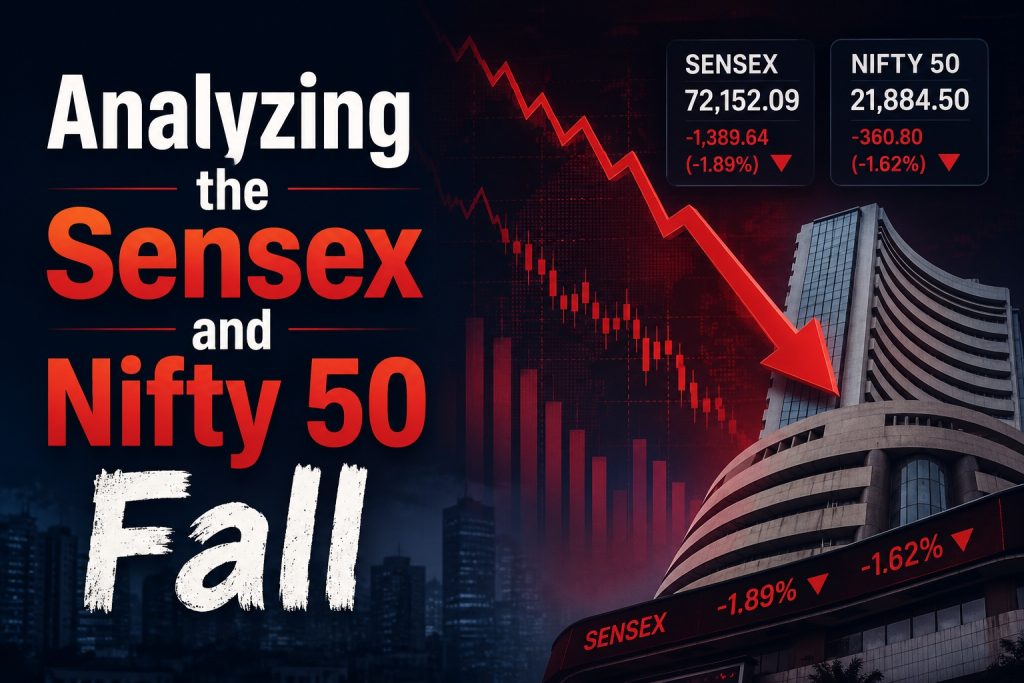
Analyzing the Sensex and Nifty 50 Fall
The bloodbath on Dalal Street was highlighted by alarming numbers across both major exchanges. The BSE Sensex tumbled dramatically by over 1,677 points, translating to a steep decline of roughly 2.15%, ultimately settling near the 76,503 mark. Parallel to this, the NSE Nifty 50 witnessed an equally brutal trading session. Dropping by more than 516 points, the broad-market index slipped completely below the crucial psychological support level of 24,000, closing around 23,882.
When analyzing the stock market nifty today, it becomes evident that the selling pressure was heavily broad-based. It was not restricted to a single underperforming sector; instead, a massive wave of liquidation swept through financial services, public sector banks, consumer goods, and information technology stocks. If you are tracking the sensex bse stock market today, the sheer volume of declines drastically outpaced the advances, signaling a dominant bearish grip on the overall market landscape.
Top Reasons: Why is the Stock Market Down Today?
To accurately answer why stock market is down today, we have to dissect several macroeconomic and geopolitical factors that simultaneously impacted investor sentiment. Here are the primary drivers behind the recent market crash.
1. Escalating US-Iran Geopolitical Tensions
The foremost reason explaining why market is falling today revolves around the sudden escalation of hostilities in the Middle East. Recent reports confirmed that the United States initiated fresh military strikes against Iranian targets, while US leadership stated that prior interim peace negotiations were effectively over.
This alarming development has severely destabilized the region. Global financial markets absolutely abhor uncertainty, and the threat of a full-blown conflict immediately prompted institutional investors to pull capital out of riskier assets, such as emerging market equities, and move them into safe-haven assets like physical gold and the US Dollar. The Indian share market today reacted exactly as expected during global military crises—with widespread panic selling.
2. Surging Crude Oil Prices Impacting the Economy
Directly linked to the Middle East tensions is the rapid surge in global crude oil prices. Brent crude witnessed a sharp upward spike, climbing nearly 4% to 6% to approach the highly uncomfortable $79 to $80 per barrel mark. Because India imports more than 80% of its crude oil requirements, this is a massive macroeconomic red flag for the domestic economy.
High crude oil prices artificially inflate India’s import bill, which can widen the current account deficit (CAD) and weaken the Rupee. Furthermore, costly oil directly translates to higher transportation and fuel prices domestically. This cascades into broader inflation across logistics, manufacturing, and consumer goods. When inflation fears rise, corporate profit margins are threatened, which stands as a major reason explaining why nifty down today.
3. A Massive Spike in the India VIX (Volatility Index)
The India VIX, often referred to as the “fear gauge” of the Indian stock market, recorded a shocking surge of over 26%, jumping past the 14.68 mark in a single session. This was the largest single-day jump witnessed in over a year.
A rapidly rising VIX indicates that traders are expecting extreme volatility and wild price swings in the near future. When the fear gauge spikes this aggressively, institutional investors often reduce their exposure to equities to mitigate portfolio risk. This technical indicator perfectly encapsulates the deeply nervous sentiment currently driving the market news today.
4. Weak Cues from Global Equity Markets
The Indian share market does not operate in a vacuum. Wall Street indices experienced highly volatile and negative sessions, with the Dow Jones Industrial Average dropping significantly following the geopolitical news. European markets, including the UK’s FTSE and France’s CAC, ended deep in the red.
Asian peers, such as the Japanese Nikkei and the Hang Seng, also traded with distinct weakness. When global institutional investors face losses in primary Western markets, they typically initiate sell-offs in emerging markets like India to maintain their overall liquidity, contributing heavily to the drag on the share market news headlines.
5. Sectoral Drags and Financial Liquidation
During times of global distress, highly liquid sectors face the maximum brunt of sell-offs. The broad-based sectoral decline was prominently visible in banking and IT stocks. Financials hold the maximum weightage in the Nifty 50, so any concentrated selling pressure here disproportionately pulls down the entire index. Furthermore, a depreciating Indian Rupee—which fell sharply against the US Dollar to 95.55—added salt to the wound, making Indian equities temporarily less attractive to foreign capital.

Historical Context: How Indian Markets React to Global Crisis
Whenever investors ask why the market is crashing, looking at historical data provides immense clarity. Historically, the Indian equity market has shown temporary, sharp vulnerability to Middle Eastern conflicts because of the direct threat to global oil supply chains. However, these massive, panic-driven sell-offs are usually short-lived provided the conflict does not turn into a prolonged, multi-nation war.
In the past, instances of sudden geopolitical strikes resulted in an immediate 2% to 4% index drop, followed by a slow consolidation phase. Once the panic subsides and crude oil prices stabilize, domestic institutional buyers (DIIs) usually step in to buy fundamentally strong companies at discounted valuations. The inherent strength of the Indian corporate earnings cycle and robust domestic consumption act as powerful long-term shock absorbers.
Navigating Your Finances During a Market Downturn
Watching your stock portfolio flash red can be highly stressful and intimidating. It is essential to maintain a clear head and avoid panic selling your fundamentally strong investments. Market corrections are a natural, unavoidable part of the global economic cycle.
To stay consistently updated on developing macroeconomic trends and crucial current events, you can bookmark our comprehensive news section on Jivan Jarurat. We cover the latest updates that directly impact your financial landscape.
Furthermore, financial stress can frequently take a heavy toll on your physical and mental well-being. It is just as important to take care of your body during volatile times. You can also read our guide on healthy lifestyle habits at Jivan Jarurat Health Tips. And if you simply need to disconnect from the relentless stock market news and recharge your mind, feel free to explore our lighter content in the entertainment category.
Will the Share Market Recover Soon?
While the immediate answer to why market down today is deeply rooted in geopolitical friction, the medium-to-long-term outlook for the Indian economy remains fundamentally robust.
For technical traders focusing on the Nifty 50, the 23,800 level is currently acting as a crucial immediate support zone. If the index fails to hold this zone, we might see a further slide. Conversely, on the upside, the 24,000 to 24,200 zone will now act as a formidable resistance. The Sensex, similarly, has strong support near the 76,000 psychological mark.
The complete recovery of the benchmark indices will heavily depend on how the situation in the Middle East unfolds. If crude oil breaches the $100 per barrel mark, the markets might face sustained pressure. Conversely, if diplomatic dialogues resume and energy prices stabilize, the Sensex and Nifty could easily retrace their recent losses and march back toward their bullish trajectory.
- 5 Frequently Asked Questions with Answers
1. Why is the stock market down today?
The stock market is facing severe downward pressure primarily due to escalating geopolitical tensions between the US and Iran. This uncertainty has rattled global markets, causing a panic sell-off among investors who are moving their money to safer assets.
2. How does crude oil affect the Nifty 50 and Sensex?
India imports a vast majority of its crude oil. When global oil prices surge (as they recently approached $80 per barrel), it dramatically increases India’s import costs, weakens the Rupee, and threatens to raise domestic inflation, which negatively impacts corporate profitability and stock valuations.
3. What is the India VIX, and why did it spike?
The India VIX is a volatility index that measures the market’s expectation of volatility over the near term. A massive spike (jumping over 26% recently) indicates extreme fear and uncertainty among stock market traders, which typically correlates directly with a falling stock market.
4. Should I sell my shares when the market is falling today?
Market experts generally advise against panic selling during geopolitical-induced crashes. Fundamentally strong companies tend to recover over time. It is often recommended to view significant, sudden dips as a potential value-buying opportunity rather than a time to exit the market completely.
5. Why are banking and IT stocks falling so heavily?
Banking and IT sectors carry the highest weightage in benchmark indices like the Nifty 50 and Sensex. When foreign and institutional investors decide to pull money out of the broader market to reduce their risk exposure, these highly liquid, high-weightage sectors face the brunt of the heavy selling volume.
- Key Takeaways
- Geopolitical Turmoil: Fresh US-Iran conflicts and the breakdown of ceasefire negotiations have severely damaged global investor sentiment, triggering massive sell-offs.
- Energy Costs Escalating: A sharp 4% to 6% jump in Brent crude oil prices poses significant inflation and import bill risks for the Indian economy.
- Volatility Surges: The India VIX spiked by a staggering 26%, indicating extreme fear, uncertainty, and a lack of confidence among traders.
- Major Index Impact: The BSE Sensex plunged by over 1,600 points, while the NSE Nifty 50 dropped heavily below the crucial 24,000 support level, led by heavy selling in the banking and IT sectors.