
Assam Flood Emergency 2026: 68 Dead, Over 5 Lakh Affected

The Assam flood emergency has once again exposed the vulnerability of India’s northeastern region to extreme monsoon weather[1]. As of late July 2026, the devastating deluge has claimed 68 lives and upended the existence of over 5.24 lakh residents[1][2]. Heavy and relentless rainfall triggered flash floods, breaching embankments and submerging hundreds of villages across the state[3][4].
Although official reports from the Assam State Disaster Management Authority (ASDMA) indicate a marginal improvement as water levels begin to recede in specific areas, the crisis is far from over[2][5]. Entire communities remain cut off, vast tracts of agricultural land are ruined, and thousands of families are currently taking refuge in temporary shelters, unsure of what remains of their homes[3][6].
This disaster highlights not just a recurring natural phenomenon, but a severe humanitarian crisis that requires immediate intervention, robust rescue strategies, and sustained long-term rehabilitation[1][7].
The Worst-Hit Districts Bearing the Brunt
While floods have impacted multiple areas across the state, five districts have borne the maximum brunt of the destruction: Charaideo, Sivasagar, Golaghat, Jorhat, and Nagaon[2][6].
Currently, Charaideo is the most severely affected district, with nearly 1.88 lakh individuals grappling with the catastrophic impact of the rising waters[6]. Sivasagar follows closely, with over 1.5 lakh people affected[2]. In these regions, floodwaters entered residential areas with terrifying speed, leaving residents with barely enough time to escape[6][8].
Most major rivers in the Brahmaputra and Barak basins are finally showing a receding trend[2]. However, the Dhansiri River at Numaligarh in Golaghat district continues to flow perilously above the danger mark, prompting local administrations to issue strict advisories keeping civilians away from the riverbanks[2][9].
Harrowing Tales of Survival and Loss
The statistics of the Assam flood emergency can be overwhelming, but behind every number is a harrowing story of survival. In places like Sivasagar, survivors recount terrifying nights where they were jolted awake by the deafening sound of rushing water[8].
Many families survived by climbing onto tall furniture, lofts, or rooftops, watching helplessly as the heavy currents swept away their household appliances, stored food, and livestock[3][8]. The psychological toll of the floods is immense. Escaping with just the clothes on their backs, displaced residents now face the grim reality of starting from scratch[8]. When the waters eventually pull back, they leave behind feet of thick sludge and the ruins of a lifetime of hard work[4][8].
Massive Rescue and Relief Operations Underway
In response to the Assam flood emergency, government agencies have shifted into mission mode[9]. A coordinated effort involving the National Disaster Response Force (NDRF), State Disaster Response Force (SDRF), the Indian Army, Fire and Emergency Services, and local police has been critical in saving lives[2][4].
During the peak of the flash floods, rescue boats became the only lifeline for marooned families[4]. Rescuers navigated treacherous, fast-moving currents to pull the elderly, women, and children to dry land[4]. Now, as the water becomes too shallow for larger boats but too deep for vehicles, these agencies are facing new logistical hurdles in reaching isolated pockets[4].
Life Inside the Relief Camps
With hundreds of villages rendered uninhabitable, the state government has mobilized a massive temporary sheltering initiative. Currently, more than 37,000 displaced individuals are living in 109 relief camps across the worst-affected districts[9].
Sivasagar alone is operating 66 of these camps, providing shelter to over 30,000 people[9]. Inside the camps, local administrations are working round the clock to distribute vital emergency supplies, including:
- Rice and dal
- Mustard oil and salt
- Safe drinking water
- Basic medicines and hygiene kits
Healthcare workers have also been deployed to these camps to monitor the outbreak of waterborne diseases, which often follow in the wake of severe flooding.
Government Response and Next Steps
The state and central governments are closely monitoring the evolving situation[2]. Assam Chief Minister Himanta Biswa Sarma recently confirmed that as the state recovers, the administration’s immediate priority is the phased restoration of electricity in the affected zones[2][9]. Power was deliberately cut in many inundated areas to prevent electrocution[2][9].
Union Minister Sarbananda Sonowal also visited the flood-hit areas of Upper Assam, evaluating the damage and assuring citizens that the central and state governments are acting in tandem to expedite relief funding and rehabilitation programs[2].
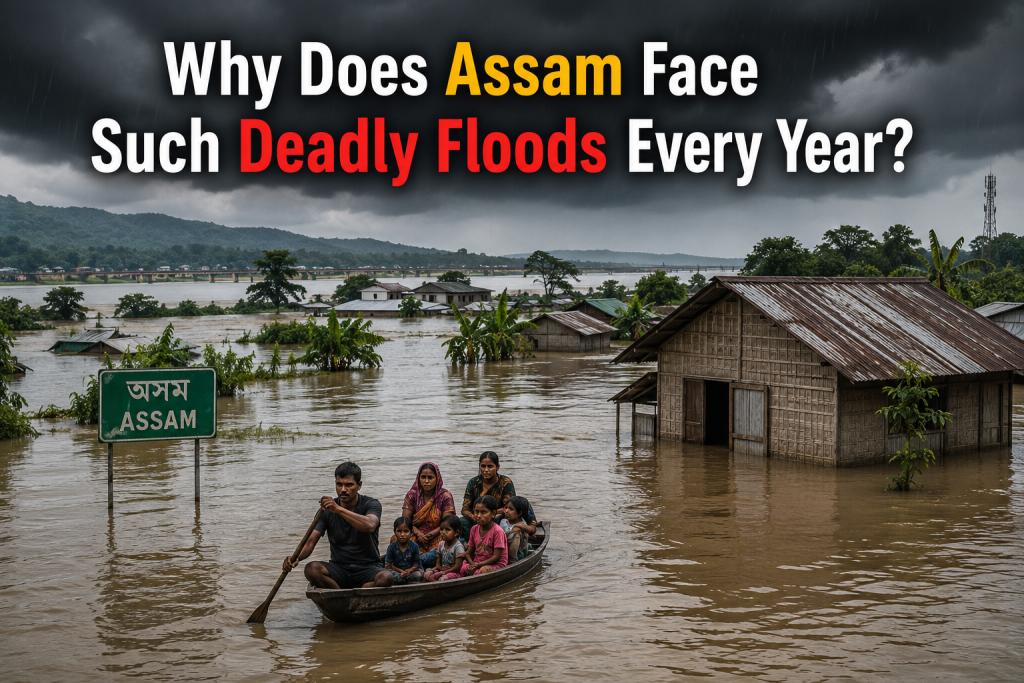
Why Does Assam Face Such Deadly Floods Every Year?
The severity of the Assam flood emergency often begs the question: why does the state drown year after year? The answer lies in a complex mix of geography, meteorology, and infrastructure challenges[1].
- Unique Topography: The Brahmaputra Valley is inherently prone to flooding. The river is vast, braided, and carries a massive amount of sediment from the Himalayas, which raises the riverbed and reduces its water-carrying capacity[1].
- Intense Monsoon Spells: Climate change has altered traditional rainfall patterns. Instead of evenly distributed rain, Assam now frequently experiences sudden, concentrated cloudbursts that overwhelm drainage systems and rivers[1].
- Human Intervention and Infrastructure: Deforestation in neighboring highland states accelerates soil erosion. Furthermore, many of the protective embankments built decades ago are old and succumb to the immense water pressure during peak monsoons[1][4].
Community Solidarity: NGOs and Public Support
Government efforts alone cannot mitigate a disaster of this scale. In a powerful show of solidarity, non-governmental organizations (NGOs) and private citizens have stepped up[9][10]. Organizations like the Assam Foundation of North America (AFNA), along with numerous local groups, are running independent flood relief campaigns[10].
These independent bodies are ensuring that families in the most remote, hard-to-reach villages receive mosquito repellents, disinfectants, and dry rations[10]. This combined community action has been instrumental in averting mass starvation and disease outbreaks in the hardest-hit rural belts[9].
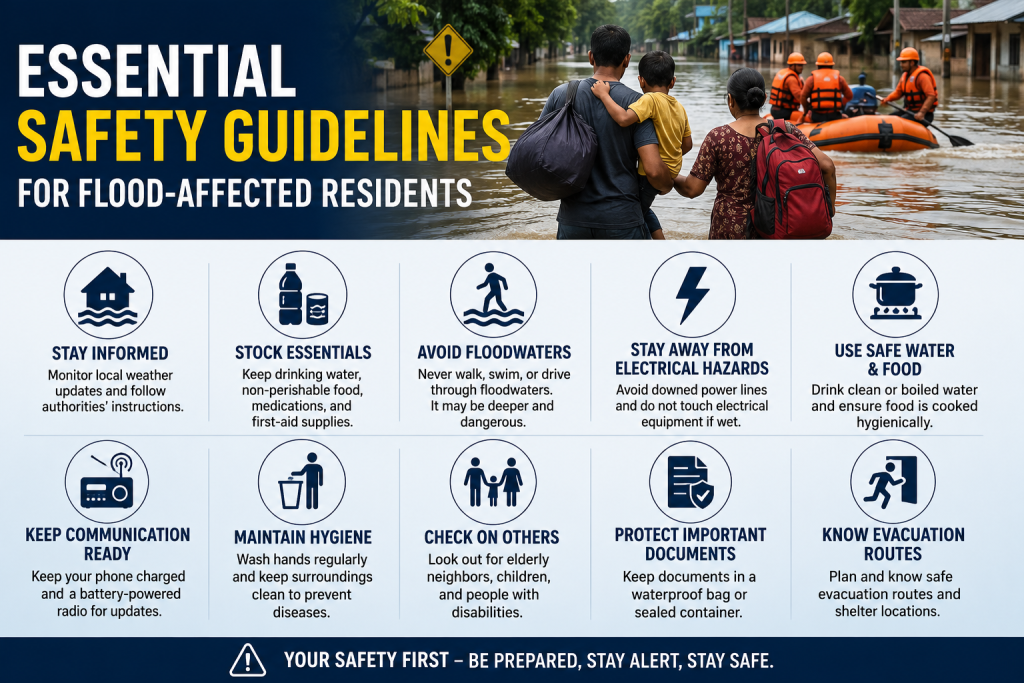
Essential Safety Guidelines for Flood-Affected Residents
As the state transitions from rescue to recovery, residents must remain cautious. Whether you are living near a flood zone or returning to a previously flooded home, strict adherence to safety protocols can save lives:
- Avoid Floodwaters: Never attempt to walk, swim, or drive through floodwaters. Just six inches of fast-moving water can knock an adult off their feet.
- Boil All Drinking Water: Floodwaters easily contaminate municipal and well water sources. Always boil water or use chemical purifiers before consumption to prevent cholera and typhoid.
- Beware of Electrical Hazards: Do not touch wet electrical equipment. Wait for official clearance before switching on the main power supply in a flooded house.
- Watch for Wildlife: Rising waters force snakes and other wildlife to seek higher ground, often inside homes. Be vigilant when clearing debris.
- Follow Official Updates: Rely only on verified information from the ASDMA and the district administration regarding weather alerts and safe routes.
The Long Road to Rehabilitation
The immediate danger of the Assam flood emergency might recede alongside the river levels, but the true hardship for many has just begun.
Rehabilitation requires a monumental effort. Farmers have lost an entire season’s worth of crops, and students have lost their books and uniforms[3][11]. Rebuilding roads, repairing breached embankments, and compensating families for lost livestock and property will take months, if not years[3][4]. However, the resilience of the Assamese people, backed by robust government support and community aid, offers hope that the affected districts will rebuild and recover.