Does the Multiverse Exist? The Science of Parallel Worlds
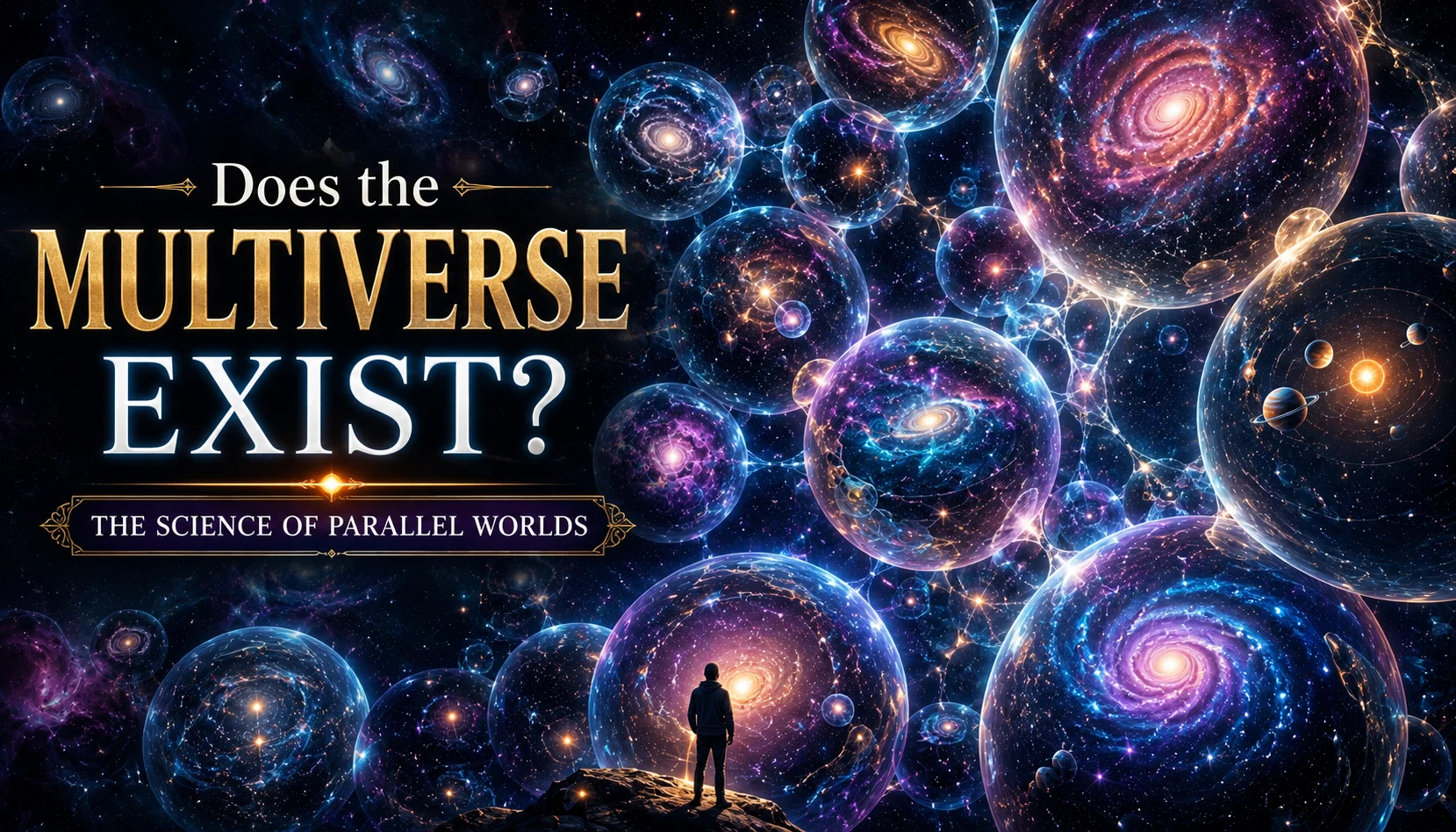
For decades, the idea of parallel universes has fascinated both scientists and science fiction fans alike. Blockbuster movies often show heroes traveling through portals to meet alternate versions of themselves. However, behind the Hollywood magic lies a deep, complex, and highly debated topic in theoretical physics.
When stargazers and physics students look up at the night sky, a common question naturally arises: does the multiverse exist? Is our vast, expanding universe the only one, or is it merely a tiny bubble floating in an endless ocean of other realities?
To answer this question, we have to look past movie scripts and dive into the fascinating world of quantum mechanics, cosmic inflation, and advanced mathematics. Theoretical physicists have proposed several brilliant models suggesting that alternate realities might just be mathematically possible.
In this comprehensive guide, we will break down the complex science of parallel universes into simple, easy-to-understand concepts. We will explore the latest theories, look at potential scientific evidence, and separate hard facts from popular fiction.
What is the Multiverse Theory?
Before diving into complex mathematical models, we must first define what the multiverse actually is. The multiverse theory is a scientific concept suggesting that our universe is not the only one. Instead, it proposes that multiple, perhaps infinite, universes exist parallel to our own.
Our observable universe spans billions of light-years. It contains trillions of galaxies, countless stars, and endless mysteries. However, the multiverse theory suggests that everything we can see is just a tiny fraction of a much grander structure.
These other universes within the multiverse might operate under completely different laws of physics. Alternatively, some might look exactly like ours, but with minor differences in how historical events played out. Therefore, the multiverse is not just a single idea, but a collection of different scientific theories combined under one umbrella term.
Does the Multiverse Exist? The Scientific Perspective
When asking if the multiverse is real, we must examine the theories that leading physicists use to explain reality. Does the multiverse exist according to actual science? The answer depends heavily on which branch of theoretical physics you are studying.
Currently, scientists cannot build a spaceship to travel outside our universe. Therefore, they rely on advanced mathematics, quantum mechanics, and the observation of the cosmos to form their models. Let’s explore the three main scientific frameworks that point toward the existence of parallel universes.
The Many-Worlds Interpretation of Quantum Mechanics
Does the multiverse exist on a microscopic scale? The Many-Worlds Interpretation (MWI) suggests that it absolutely does. Proposed by physicist Hugh Everett in the 1950s, this theory attempts to explain the bizarre behavior of quantum particles.
In quantum mechanics, particles like electrons can exist in multiple states at once, a phenomenon known as superposition. However, when a scientist measures the particle, it forces the particle to “choose” one state. Everett argued that the particle does not actually choose. Instead, the universe splits into multiple branches.
For example, if a particle has a 50% chance of spinning up and a 50% chance of spinning down, both outcomes happen. In one universe, the scientist records the particle spinning up. Meanwhile, in a newly created parallel universe, an alternate version of the scientist records it spinning down. This implies that every single choice made in the universe creates a branching alternate reality.
Cosmic Inflation and Bubble Universes
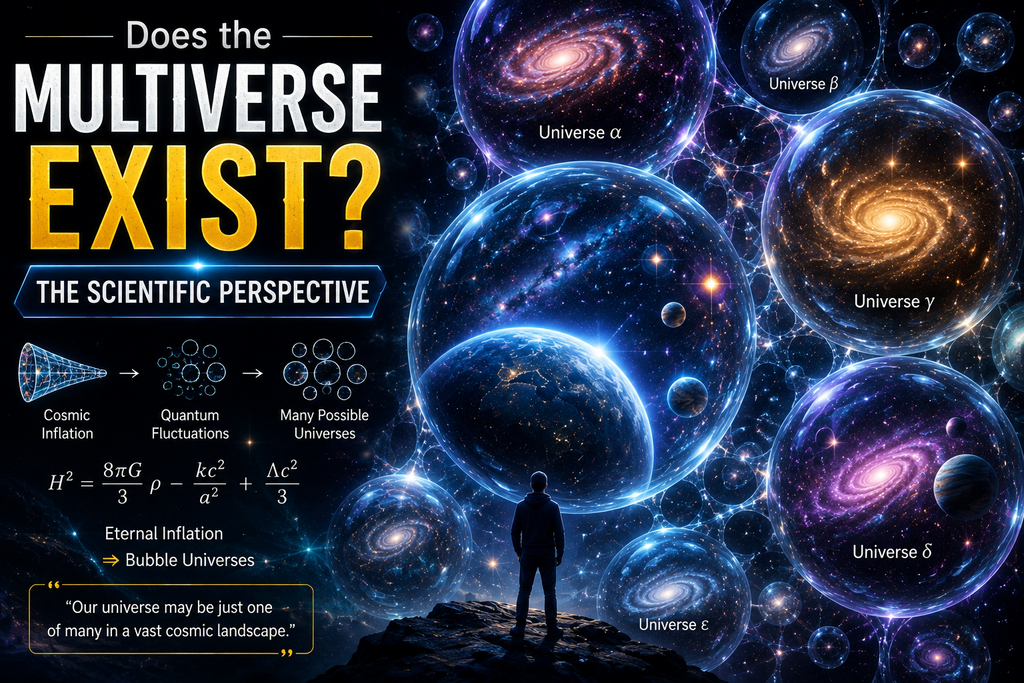
Another compelling argument comes from the study of the Big Bang and cosmic inflation. Cosmologist Alan Guth proposed the inflation theory in the 1980s. This theory states that fractions of a second after the Big Bang, the universe expanded at an unimaginably rapid rate.
However, inflation might not have stopped everywhere at the same time. According to the theory of “eternal inflation,” space is constantly expanding. While inflation stops in some regions, it continues in others. The areas where inflation stops become isolated “bubble universes.”
Our universe is just one of these bubbles. Because the space between these bubbles is expanding faster than the speed of light, we can never reach them or communicate with them. Each bubble universe could have completely different physical laws, varying dimensions, and different fundamental forces.
String Theory and Extra Dimensions
String theory is a theoretical framework attempting to connect gravity with quantum mechanics. In this model, the fundamental ingredients of the universe are not tiny dots, but microscopic, vibrating strings of energy.
For string theory’s mathematics to work, the universe must have extra dimensions beyond the three we experience (up/down, left/right, forward/backward) and the fourth dimension of time. Specifically, string theory requires 10 or 11 dimensions.
These extra dimensions could harbor “branes” (short for membranes). Some physicists suggest that our universe is a three-dimensional brane floating in a higher-dimensional space. Occasionally, these branes might collide with one another. A collision between two massive branes could release enough energy to create a new Big Bang, sparking the birth of an entirely new universe.
Exploring the Four Levels of the Multiverse
To organize these mind-bending concepts, physicist Max Tegmark categorized the multiverse into four distinct levels. This framework helps scientists categorize how alternate realities might function.
| Multiverse Level | Scientific Name | Description | Key Concept |
| Level I | The Extension of Our Universe | Space is infinite. Eventually, matter will repeat itself because there are only so many ways atoms can arrange themselves. | If you travel far enough, you will find an exact copy of yourself. |
| Level II | Bubble Universes | Created by eternal cosmic inflation. Different bubbles have entirely different laws of physics. | Our universe is a bubble in a vast, expanding cosmic ocean. |
| Level III | Quantum Many-Worlds | Every possible quantum outcome becomes a reality in a branching timeline. | Every decision you make creates a new, parallel universe. |
| Level IV | Mathematical Multiverse | Every mathematical structure that can exist, does exist physically somewhere. | Mathematics does not just describe reality; it is reality. |
Is There Any Scientific Evidence for Alternate Realities?
A theory is only as good as the evidence supporting it. Currently, there is no definitive, physical proof of parallel universes. However, scientists have observed some cosmic anomalies that hint at their possible existence.
The Cold Spot in the Cosmic Microwave Background (CMB)
The Cosmic Microwave Background is the leftover radiation from the Big Bang. It is essentially a heat map of the early universe. In 2004, scientists discovered a massive, unexplained “Cold Spot” in this radiation map.
The area is incredibly large and unusually cold compared to its surroundings. Standard cosmological models struggle to explain it. Some researchers propose that this Cold Spot is a “bruise” left behind when our universe bumped into a neighboring parallel universe during its early formation.
The Fine-Tuning Problem
Our universe seems perfectly designed to support life. If the strength of gravity, the mass of an electron, or the power of nuclear forces were slightly different, stars would not form, and life could not exist. This is known as the fine-tuning problem.
Why is our universe so perfect? The multiverse theory provides a logical answer. If there are infinite universes, each with random physical laws, most of them will be dead and empty. However, by pure statistical chance, a few will have the exact right conditions for life. We simply happen to live in one of the lucky ones, because if we didn’t, we wouldn’t be here to observe it.

Science Fact vs. Science Fiction: Pop Culture’s Take
The concept of alternate realities has exploded in popular culture over the last decade. Movies, comic books, and television shows frequently use the concept as a plot device.
In entertainment, a character can easily build a machine or cast a spell to travel to another dimension. They often meet alternate versions of themselves who made different life choices. While these stories are highly entertaining, they are far removed from scientific reality.
In actual physics, traveling between universes is currently considered impossible. Furthermore, in Level II multiverses (bubble universes), an alternate reality would not feature a different version of you. It would feature entirely different laws of physics, lacking carbon, stars, or planets altogether. Therefore, while Hollywood keeps the dream alive, readers should separate creative storytelling from theoretical physics.
The Pros and Cons of the Multiverse Concept
Like all scientific models, this theory has strong supporters and fierce critics.
Pros of the Theory:
- Solves Cosmic Mysteries: It neatly explains the fine-tuning problem of our universe without requiring a supernatural creator.
- Fits the Math: Models like String Theory and Quantum Mechanics naturally predict multiple universes.
- Expands Human Knowledge: It pushes the boundaries of theoretical physics and forces scientists to think outside the observable universe.
Cons of the Theory:
- Lack of Testability: The biggest criticism is that the theory is largely unfalsifiable. We cannot test, see, or travel to these universes.
- Complicates Physics: Some scientists argue it is a “lazy” way out. Instead of figuring out why our universe works the way it does, physicists just say “all possibilities exist.”
- No Direct Evidence: Aside from mathematical equations and anomalies like the Cold Spot, there is zero empirical, physical proof.