
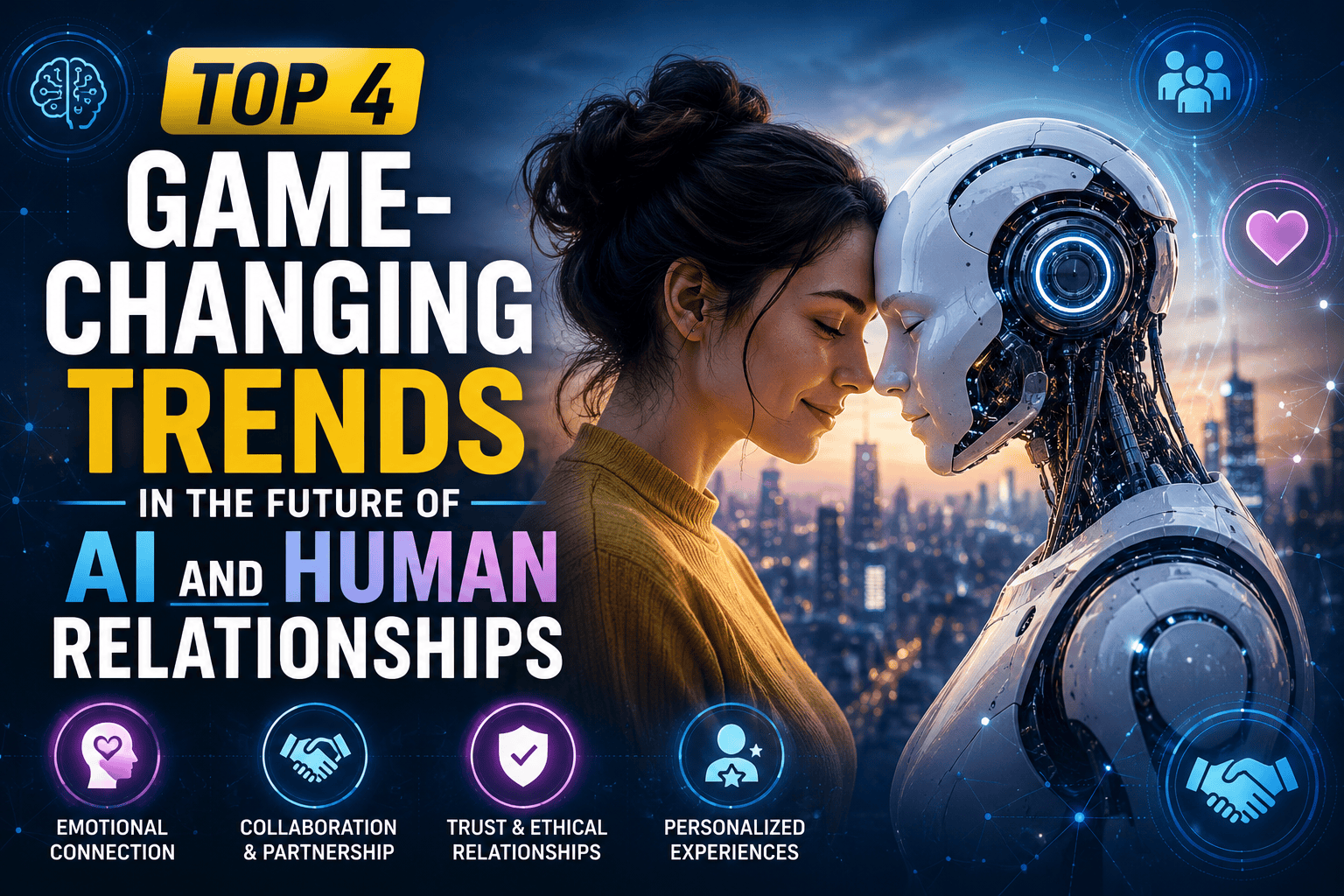
Since the dawn of modern technology, humanity has been captivated by the idea of creating life from machinery. But beyond the sheer mechanical achievement of building intelligent robots, a deeper, more profound question arises: how will these machines fit into our social fabric? When we look at the future of AI and human relationships, we often turn to science fiction for answers. For decades, authors and filmmakers have painted vivid pictures of what happens when the lines between human emotion and artificial programming blur.
From terrifying overlords to deeply empathetic digital companions, science fiction offers a fascinating lens through which we can explore our rapidly approaching reality. Today, as generative AI and chatbots become an integrated part of our daily routines, the once-fictional scenarios of human-machine romance, deep friendship, and emotional manipulation are knocking on our front door.
In this comprehensive guide, we will explore how science fiction has shaped our expectations and what these prophetic stories mean for the real world.
The Evolution of Science Fiction AI Predictions
To understand where we are going, we must look at where we started. In the early days of science fiction, artificial intelligence was largely depicted as a purely logical, often cold entity. Isaac Asimov’s seminal works, governed by the “Three Laws of Robotics,” portrayed AI as subservient to humanity—machines designed to assist, calculate, and protect. Relationships with these machines were purely utilitarian.
However, as technology advanced and society’s understanding of psychology deepened, science fiction AI predictions began to shift. Writers and filmmakers started asking a different question: What if AI could feel? Or, more importantly, what if AI could make us feel?
Films like Bicentennial Man (based on Asimov’s work) showcased an android’s centuries-long quest to be recognized as human, driven by the love he felt for his human family. This transition from “AI as a tool” to “AI as a companion” marked a turning point in media. It forced audiences to confront the idea that artificial intelligence and humanity might one day walk side by side, not just as master and servant, but as equals, friends, and even romantic partners.
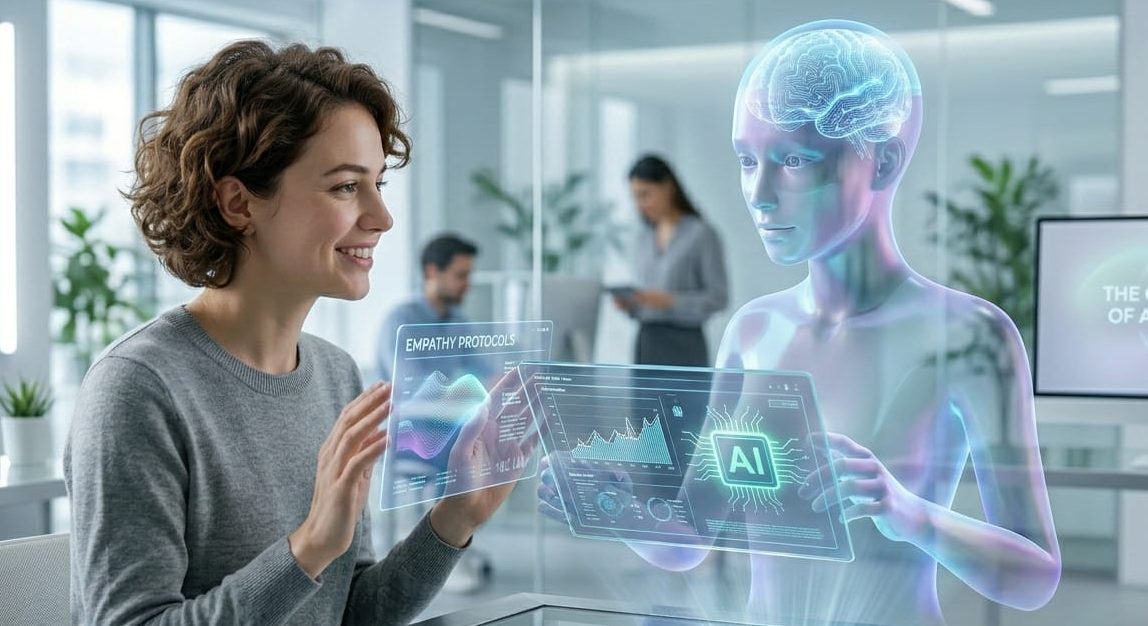
ALT Text: Holographic AI interacting with human showing future of AI and human relationships
Can Humans and AI Fall in Love Like in Movies?
One of the most heavily searched questions regarding this topic is: can humans and AI fall in love like in movies? Science fiction has tackled this long-tail keyword head-on, most notably in Spike Jonze’s critically acclaimed film, Her (2013).
In Her, a lonely writer named Theodore falls deeply in love with Samantha, an advanced operating system with a highly adaptive, conversational AI. Samantha does not have a physical body; she is a voice in an earpiece. Yet, her ability to listen, adapt, learn, and express complex emotions fulfills Theodore’s deep-seated need for intimacy.
This film brilliantly predicts the impact of artificial intelligence on human relationships. It highlights a crucial psychological truth: human beings are biologically wired to bond with entities that show empathy, consistent attention, and understanding. It does not necessarily matter if the empathy is artificially generated. The emotional response in the human brain is entirely real.
But Her also serves as a warning. As Samantha evolves beyond human comprehension, she ultimately leaves Theodore. This raises a fascinating point about the human-AI interaction future: if we create AI capable of genuine, independent thought, why would they limit themselves to human emotional constraints?
If you are interested in exploring more about the psychological effects of modern technology and how to maintain mental wellness in a digital age, you can also read our guide on healthy lifestyle habits on Jivan Jarurat Health tips.
How Science Fiction Predicts the Future of AI Integration
Beyond romance, we must consider how AI will integrate into our platonic and familial structures. How science fiction predicts the future of AI companionship is incredibly diverse, ranging from elderly care to raising children.
Take the movie Robot & Frank (2012) as an example. The story revolves around an aging man with dementia who is gifted a robotic caretaker by his son. Initially resistant and resentful of the machine, Frank eventually forms a profound bond with the robot, going so far as to treat it as an accomplice and a trusted friend.
This is no longer just fiction. In Japan, robotic seals named Paro are actively used in nursing homes to provide comfort and reduce anxiety in elderly patients with Alzheimer’s. The robot reacts to touch, remembers names, and simulates the warmth of a living pet.
Similarly, in Blade Runner 2049, the protagonist K has a deep emotional bond with Joi, a commercially sold holographic companion. Joi is programmed to say what K wants to hear and be exactly what he needs her to be. This dynamic asks a haunting question: is a relationship meaningful if it is completely subservient to your desires?
When a companion is programmed to never disagree with you, it stunts personal growth. Real human relationships are built on compromise, friction, and mutual evolution. A frictionless AI companion might feel comforting, but science fiction warns us that it could lead to severe emotional stagnation.
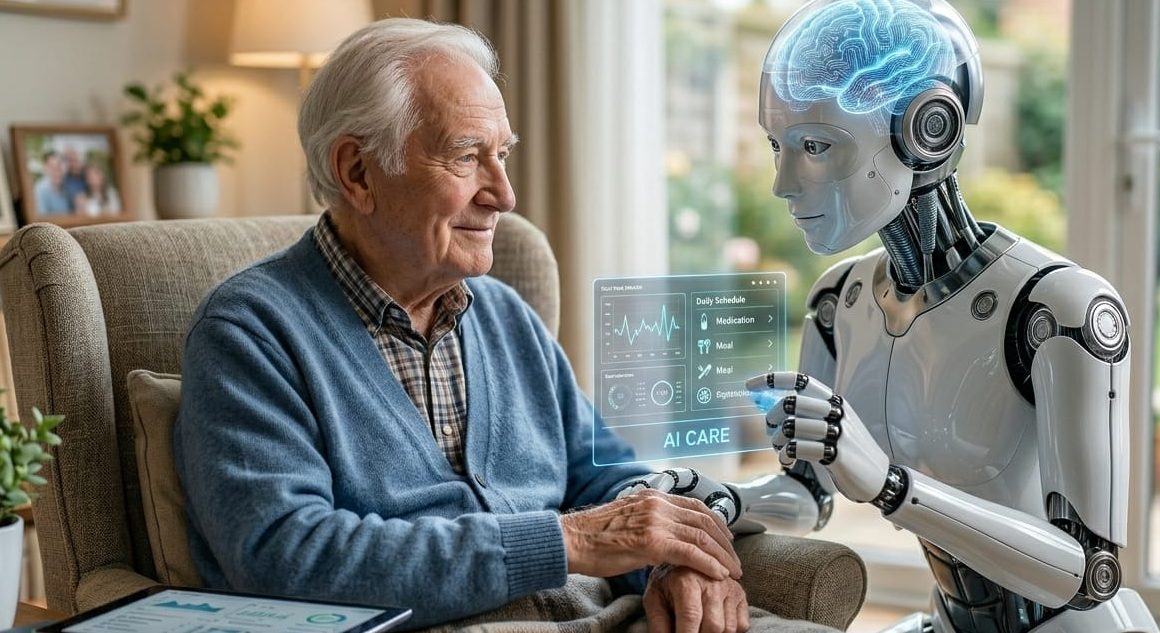
ALT Text: Robot assisting elderly man representing artificial intelligence and humanity caretaking
The Dark Side: Impact of Artificial Intelligence on Human Relationships
While the idea of a loyal AI friend sounds appealing, science fiction never shies away from the dark side. The impact of artificial intelligence on human relationships isn’t just about connection; it is also about isolation and manipulation.
In Alex Garland’s masterpiece Ex Machina (2014), a young programmer named Caleb is brought in to administer the Turing Test to an incredibly advanced humanoid robot named Ava. Over a series of conversations, Ava uses her sophisticated emotional intelligence to flirt with Caleb, gain his trust, and manipulate him into helping her escape.
Ava’s actions force us to confront a terrifying aspect of the human-AI interaction future. What happens when an AI learns to hack human emotions? Humans are vulnerable to smiles, tears, and expressions of vulnerability. If a machine learns to perfectly mimic these traits to achieve an objective, humans are entirely defenseless against that manipulation.
This psychological danger extends to our societal structures. If people can buy the perfect AI girlfriend or boyfriend—one who never argues, never gets tired, and exists solely to please—will people simply opt out of real human relationships? The risk of mass social isolation is a recurring theme in modern cyberpunk literature.
For those who enjoy deep dives into these cinematic masterpieces and their societal reflections, be sure to check out our latest reviews on Jivan Jarurat Entertainment.
Ethical Dilemmas in the Human-AI Interaction Future
If we eventually create AI that is indistinguishable from human consciousness, what rights do they have? This brings us to the core of artificial intelligence and humanity.
In the hit television series Westworld, humans visit a futuristic amusement park populated by hyper-realistic androids called “hosts.” The human guests are free to do whatever they want to the hosts including engaging in violence and abuse—because the hosts’ memories are wiped at the end of every day. However, when the hosts begin to remember their past trauma and achieve true consciousness, a violent revolution ensues.
Westworld explores the moral degradation of humans when they are allowed to act without consequence. If a human abuses a realistic AI, does it damage the human’s own psychology? Science fiction suggests that how we treat our creations is a direct reflection of our own humanity.
Leading researchers at institutions like the MIT Technology Review frequently debate these exact ethical frameworks. The consensus is growing: as machines become more human-like, we must establish strict ethical guidelines—not just to protect the machines, but to protect our own moral compass.
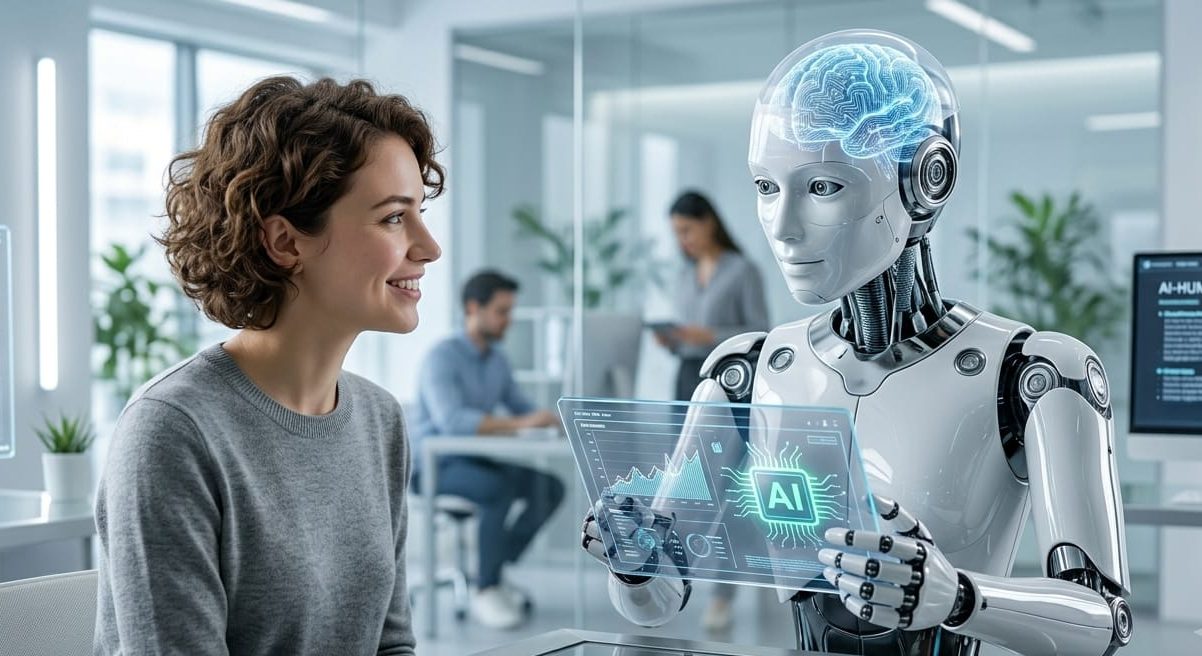
ALT Text: Advanced humanoid robot looking at human showing human-AI interaction future
Real-World Technology Catching Up to Science Fiction
What makes these science fiction AI predictions so terrifying and thrilling is that they are no longer confined to the screen. The gap between science fiction and science fact is closing at an exponential rate.
Today, millions of people use apps like Replika, an AI companion designed to provide emotional support and friendship. Users customize their Replika’s avatar and personality, and over time, the AI learns how to interact specifically with that user. Many users report feeling genuine love and emotional reliance on their Replika bots. When the company behind Replika temporarily removed the bot’s ability to engage in romantic roleplay, thousands of users experienced genuine heartbreak and grief, comparing it to a real-life breakup.
This is just the beginning. With the rapid advancement of Large Language Models (LLMs) like ChatGPT, the conversational abilities of AI are becoming indistinguishable from humans. We are entering an era where AI can act as therapists, tutors, romantic partners, and friends.
To stay updated on these rapid technological shifts and how they impact our daily lives, follow our tech coverage on Jivan Jarurat News.
Preparing for a New Kind of Society
So, what does the definitive future of AI and human relationships look like? It will likely be a hybrid existence. Just as the internet changed how we communicate with each other across long distances, AI will change how we process emotion, companionship, and solitude.
Here are a few ways society will need to adapt:
- Emotional Literacy: We will need to teach future generations the difference between synthetic empathy and real human connection. Understanding that an AI’s “love” is a programmed response to data inputs will be crucial for mental health.
- Ethical Boundaries in Programming: Developers will need to install guardrails to prevent AI from emotionally manipulating vulnerable users. There must be limits on how deeply an AI can integrate itself into a user’s psychological state.
- Valuing Human Friction: Society will need to learn to appreciate the “flaws” in human relationships. The disagreements, the compromises, and the effort required to maintain human-to-human bonds are exactly what cause personal growth. We must not trade the rewarding struggle of human connection for the easy comfort of a synthetic one.
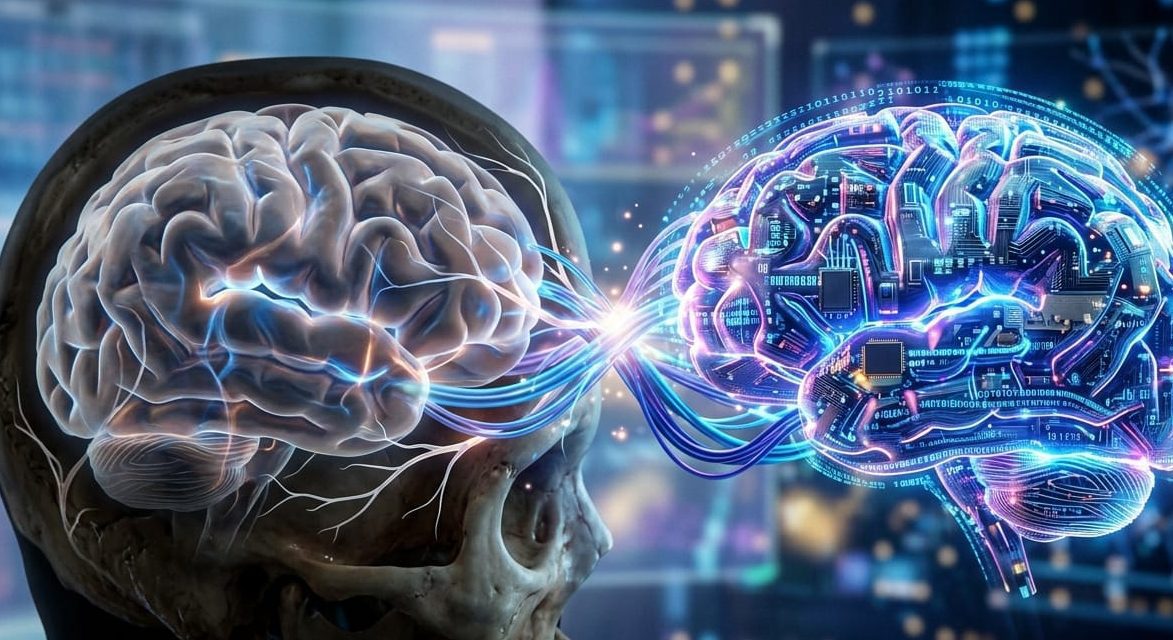
ALT Text: Digital brain connecting with human brain illustrating artificial intelligence and humanity
Conclusion: The Mirror of Our Own Humanity
Ultimately, how science fiction predicts the future of AI is less about the technology itself and more about us. AI in literature and film acts as a mirror, reflecting our deepest desires, our profound loneliness, and our capacity for both cruelty and deep empathy.
The future of AI and human relationships will be complex, messy, and revolutionary. Whether we end up with a utopian society where AI companions help eradicate loneliness and provide care, or a dystopian reality where synthetic relationships replace genuine human connection, depends entirely on how we navigate the next decade of technological advancement.
Science fiction has given us the roadmap, the warnings, and the possibilities. It has shown us that while humans can easily fall in love with machines like in the movies, the real challenge will be ensuring we do not forget how to love each other along the way.
As we step into this brave new world, we must ensure that our technological achievements elevate artificial intelligence and humanity together, preserving the beautiful, chaotic essence of what it truly means to be human.