

Title: The Ultimate Guide to Vincent van Gogh’s Life, Art, and Lasting Legacy
URL: https://jivanjarurat.com/vincent-van-gogh-life-art-legacy
Meta Description: Explore Vincent van Gogh’s life, art, and lasting legacy. Discover the emotional meaning behind his famous paintings and how he changed modern art forever.
Vincent van Gogh’s life
Introduction: The Misunderstood Genius of the Canvas
Few names in the history of human creativity evoke as much emotion, fascination, and universal recognition as Vincent van Gogh. Today, his breathtaking works are printed on coffee mugs, displayed on massive immersive screens, and housed in the most prestigious museums on Earth. Yet, the story behind these vibrant canvases is one of profound sorrow, relentless struggle, and heartbreaking isolation. Exploring Vincent van Gogh’s life, art, and lasting legacy requires us to look past the multi-million-dollar auction prices and peer into the soul of a deeply sensitive man who simply wanted to connect with the world.
During his lifetime, Van Gogh was commercially unsuccessful, selling only a single painting before his tragic death at the age of 37. He was largely considered a madman and a failure by the society he lived in. However, through his obsessive dedication to his craft, his prolific letter-writing to his brother Theo, and his revolutionary use of color, he unknowingly laid the groundwork for modern expressionism.
In this comprehensive guide, we will journey through the history of Vincent van Gogh, analyze his groundbreaking techniques, and uncover how a tortured soul managed to paint the stars with such breathtaking beauty. If you are passionate about exploring how historical figures continue to shape pop culture and modern storytelling, you can also read our engaging updates on Jivan Jarurat Entertainment. For now, let us step into the vibrant, turbulent, and awe-inspiring world of Vincent van Gogh.
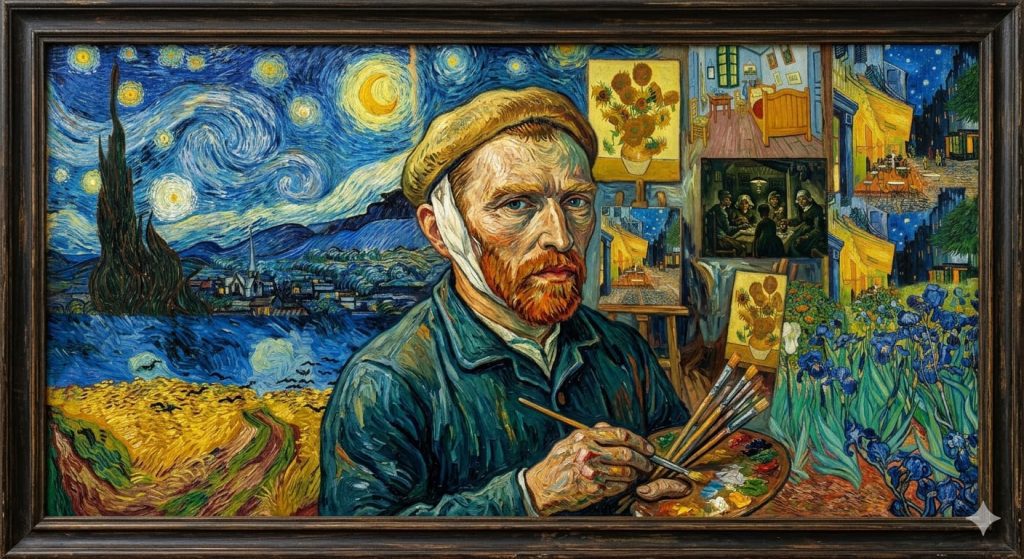
ALT Text: Self portrait showing the complex history of Vincent van Gogh as an artist
The Early Years: A Brief Vincent van Gogh Biography
To truly appreciate the artist, we must first understand the man. A thorough Vincent van Gogh biography begins in the small, quiet village of Zundert in the Netherlands, where he was born on March 30, 1853. The son of a strict, austere Protestant minister, Vincent grew up in a deeply religious household. From a young age, he exhibited a serious, thoughtful, and somewhat melancholic disposition.
Unlike child prodigies such as Mozart or Picasso, Vincent did not show an immediate, overwhelming aptitude for fine art in his early youth. Instead, he spent his early adulthood drifting through various professions, desperately searching for a sense of purpose. At age 16, he began working for his uncle’s art dealership, Goupil & Cie, in The Hague, and later in London and Paris. While this exposed him to centuries of European art, his blunt personality and growing disdain for the commercialization of art led to his dismissal.
Following his termination, Vincent sought spiritual fulfillment. He worked briefly as a teacher in England, a bookseller in the Netherlands, and eventually, a lay preacher in the impoverished coal-mining region of the Borinage in Belgium. He gave away all his worldly possessions to the impoverished miners, living in squalor to empathize with their struggles. The church authorities, however, found his extreme devotion unseemly and dismissed him. It was here, in the depths of failure and rejection at the age of 27, that Vincent finally turned to drawing. He realized that if he could not comfort people with religion, he would attempt to comfort them through art.
Finding His True Calling: The Dutch Period
Vincent’s early artistic endeavors were completely self-taught. Supported financially and emotionally by his younger brother Theo—an art dealer in Paris who would become his lifelong lifeline—Vincent began sketching the peasants and rural landscapes of the Netherlands.
The famous van Gogh paintings from this early “Dutch period” look strikingly different from the vibrant works he is known for today. His palette was heavily restricted to dark, muddy earth tones—deep browns, olive greens, and charcoal blacks. He wanted his art to reflect the harsh, grueling reality of working-class life. His first major masterpiece, The Potato Eaters (1885), exemplifies this era. The painting depicts a family of peasants gathered around a dim table, their faces deeply lined, their hands rough and bony from digging in the soil.
While The Potato Eaters is now considered a masterpiece of raw realism, the contemporary art world in Paris—which was obsessed with the light, airy, and colorful works of the Impressionists—found Vincent’s dark, clumsy figures completely unappealing. Realizing that his technique needed drastic refinement, Vincent packed his bags in 1886 and moved to Paris to live with his brother Theo.
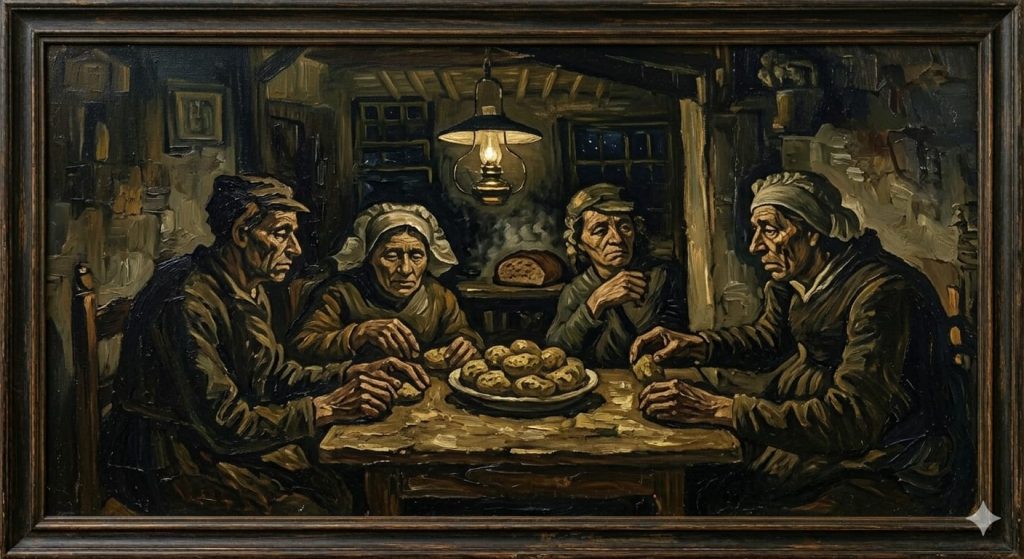
ALT Text: Famous van Gogh paintings reflecting his early dark and earthy Dutch art style
The Shift to Color: Embracing the Post-Impressionism Art Style
The move to Paris was the catalyst that transformed Vincent from a gloomy Dutch realist into a master of color. Paris in the late 1880s was the absolute epicenter of the global art world. Through Theo, Vincent was introduced to the avant-garde artists of the time, including Claude Monet, Camille Pissarro, Paul Signac, and Paul Gauguin.
Exposed to the brilliant, luminous palettes of the Impressionists and the pointillist techniques of the Neo-Impressionists, Vincent experienced a profound artistic awakening. He immediately abandoned his dark, muddy tones. This was the birth of his unique post-impressionism art style. Post-Impressionism was a movement that reacted against the naturalism of Impressionism, focusing instead on exploring emotional and psychological depth through bold colors and expressive, often distorted, forms.
Vincent began experimenting with color theory, utilizing complementary colors (like blue and orange, or red and green) to make his canvases vibrate with energy. He also developed his signature impasto technique—applying oil paint so thickly to the canvas that the brushstrokes stood out in three-dimensional relief. The paint was no longer just a medium to depict a subject; the thick, physical texture of the paint became the subject itself.
The Arles Period: Sunflowers and the Yellow House
Tiring of the frantic, exhausting pace of Paris and longing for the bright, warm sun he admired in Japanese woodblock prints, Vincent moved to the town of Arles in the south of France in February 1888. This period would become the most prolific and creatively explosive time of his entire life. Over the course of just 15 months, he produced over 200 paintings.
In Arles, Vincent rented a property known as the “Yellow House,” dreaming of establishing a utopian artists’ colony where painters could live and work together in harmony. To decorate the room for his anticipated guest, Paul Gauguin, Vincent painted his legendary Sunflowers series. Using newly invented synthetic yellow pigments, these famous van Gogh paintings radiate joy, vitality, and intense warmth.
However, the dream of the artists’ colony quickly turned into a nightmare. Gauguin arrived in Arles, but the two men had wildly clashing personalities and opposing views on art. Their intense, booze-fueled arguments culminated in a catastrophic breakdown in December 1888. In a fit of severe mental distress, Vincent famously severed a portion of his own left ear, wrapped it in paper, and delivered it to a local woman at a brothel. Gauguin fled back to Paris, and Vincent’s dream of an artistic brotherhood was shattered.
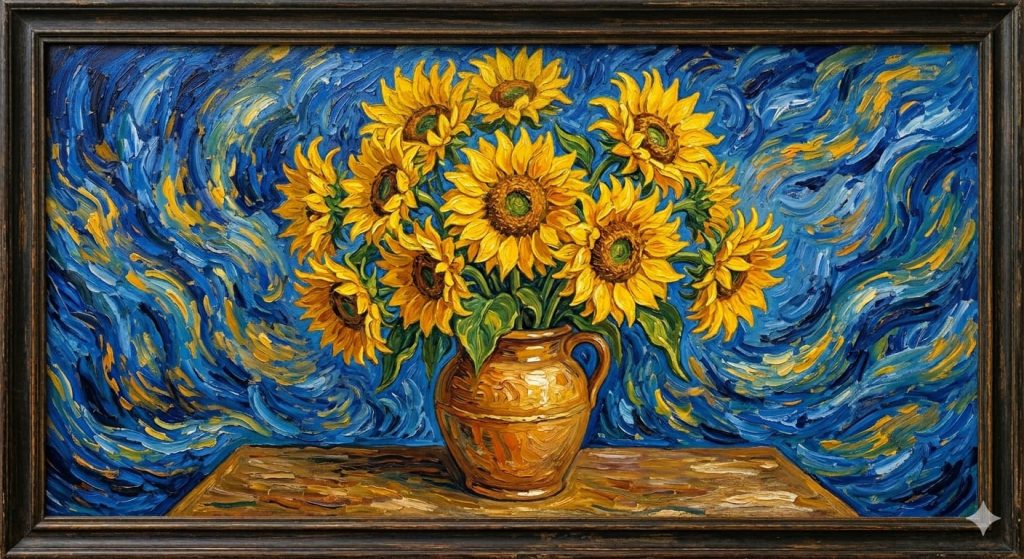
ALT Text: Vibrant yellow sunflowers highlighting the beautiful post impressionism art style of Van Gogh
Navigating Vincent van Gogh Mental Health Struggles
To understand the trajectory of his final years, it is crucial to discuss the tragic reality of Vincent van Gogh mental health struggles. For over a century, medical professionals and historians have debated exact diagnoses for his condition. Theories range from bipolar disorder and temporal lobe epilepsy to schizophrenia, severe depression, and absinthe poisoning.
What is undeniable is the profound suffering he endured. Following the ear incident, the citizens of Arles petitioned the local authorities to have Vincent locked away, referring to him as “the red-headed madman.” Recognizing that he could no longer care for himself and terrified of his own unpredictable manic episodes, Vincent voluntarily committed himself to the Saint-Paul-de-Mausole psychiatric asylum in Saint-Rémy-de-Provence in May 1889.
Despite his immense suffering, Vincent found salvation in his work. During his lucid periods at the asylum, his doctors allowed him to paint. Art became his anchor, his therapy, and his only method of making sense of a chaotic mind. It is a powerful reminder of how deeply interconnected creativity and mental well-being can be. If you are interested in modern approaches to mental wellness and self-care, we encourage you to read our guide on building emotional resilience at Jivan Jarurat Health Tips.
The Meaning Behind Starry Night Painting and Asylum Years
It was behind the barred windows of the Saint-Rémy asylum that Vincent painted his most universally recognized masterpiece: The Starry Night (1889).
The meaning behind Starry Night painting goes far beyond a simple nighttime landscape. Unlike the Impressionists who painted exactly what they saw in nature, Vincent painted this scene largely from memory and imagination. The sky is dominated by aggressive, swirling currents of blue and yellow, reflecting the turbulent, chaotic energy within his own mind. The glowing stars and the crescent moon pulse with a divine, almost spiritual energy.
Below the cosmic drama, a quiet, peaceful village sleeps securely, anchored by a church spire that points up toward the heavens. In the foreground, a dark, flame-like cypress tree—a symbol traditionally associated with death and cemeteries—bridges the gap between the earthly village and the infinite cosmos. The Starry Night is widely interpreted as Vincent’s meditation on death, the afterlife, and his desperate yearning to find comfort in the vast, intimidating universe.
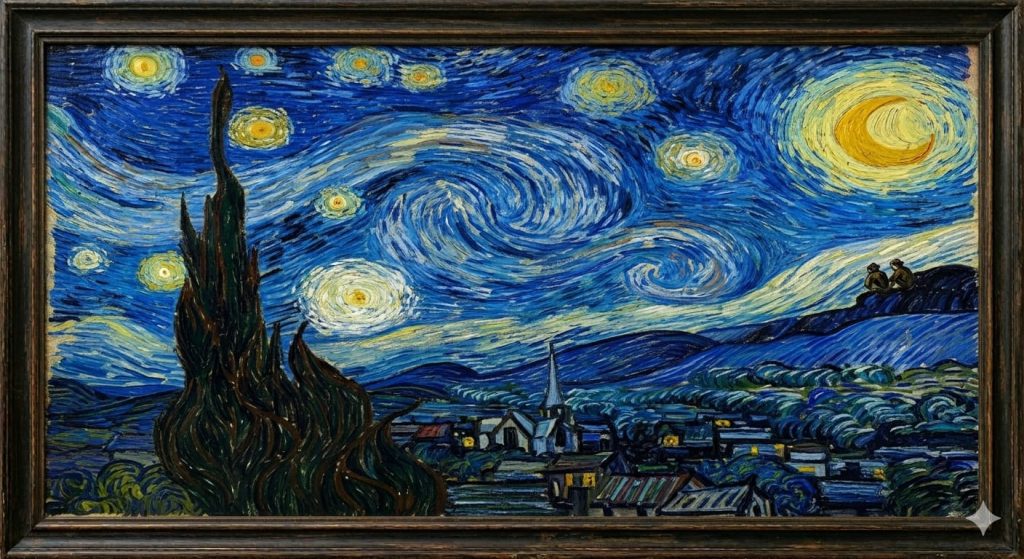
ALT Text: The expressive and emotional meaning behind Starry Night painting by Vincent van Gogh
A Tragic End and Posthumous Fame
In May 1890, feeling that his mental state had stabilized, Vincent left the asylum and moved to the village of Auvers-sur-Oise, near Paris, to be closer to Theo and under the care of a homeopathic doctor named Paul Gachet. For a brief period, he painted with frantic, desperate energy, sometimes completing a canvas a day. His final paintings, such as Wheatfield with Crows, are marked by aggressive, jagged brushstrokes and ominous, stormy skies.
Tragically, the burden of his mental illness, coupled with profound guilt over relying financially on his brother Theo (who was now married with an infant son), became too much to bear. On July 27, 1890, Vincent walked into a wheatfield and shot himself in the chest with a revolver. He managed to stumble back to his inn, where he lingered for two days. Theo rushed to his side, and Vincent’s reported last words to his brother were, “The sadness will last forever.” He died on July 29, 1890, at the age of 37.
Heartbroken, Theo’s own health rapidly declined, and he died just six months later. It seemed the Van Gogh legacy would be buried with them. However, Theo’s young widow, Johanna van Gogh-Bonger, changed the course of art history. She inherited Vincent’s massive collection of hundreds of unsold paintings and letters. Recognizing his sheer genius, Johanna dedicated the rest of her life to promoting his work, organizing exhibitions, translating his letters, and forcing the art world to pay attention.
How Vincent van Gogh Changed Modern Art
Today, it is impossible to overstate how Vincent van Gogh changed modern art. He liberated color from its descriptive function. Before Vincent, if an artist painted an apple, they used red paint because the apple was red in reality. Vincent used color to express emotion. If a scene felt anxious, he painted the sky a sickening, vibrating green. If it felt joyful, he used blinding, synthetic yellows.
This radical approach directly birthed the Expressionist and Fauvist movements of the 20th century. Artists like Edvard Munch, Henri Matisse, and Pablo Picasso drew massive inspiration from Vincent’s willingness to distort reality for the sake of emotional truth. To see the full scope of his preserved masterpieces today, art lovers travel from all corners of the globe to visit the official Van Gogh Museum in Amsterdam, a high-authority institution dedicated entirely to preserving his physical and cultural impact.
Furthermore, Vincent’s deeply personal, confessional letters to his brother completely shifted how society views the “artist.” He cemented the modern archetype of the tormented, passionate, starving artist who sacrifices everything for their vision.
Conclusion: A Legacy Written in the Stars
Reflecting on Vincent van Gogh’s life, art, and lasting legacy, we are left with a story of incredible resilience. He was a man who suffered unimaginable emotional pain, yet he filtered that agony through his paintbrush and offered the world nothing but brilliant, vibrating beauty. He taught us that even in the darkest, most isolated moments of the human experience, there is still light, color, and wonder to be found.
His legacy continues to grow. From immersive digital art experiences that allow visitors to step inside his swirling skies, to movies, documentaries, and literature, Vincent is more alive today than he ever was during his lifetime. To keep up with modern art trends, cultural news, and compelling historical stories, be sure to bookmark our Jivan Jarurat News section.
Vincent van Gogh did not live to see the world embrace his vision. He died believing he was a complete failure. Yet, more than a century later, his paintings do exactly what he always wanted them to do: they comfort the disturbed, they inspire the creative, and they prove that true passion, no matter how deeply misunderstood, will eventually illuminate the world.