
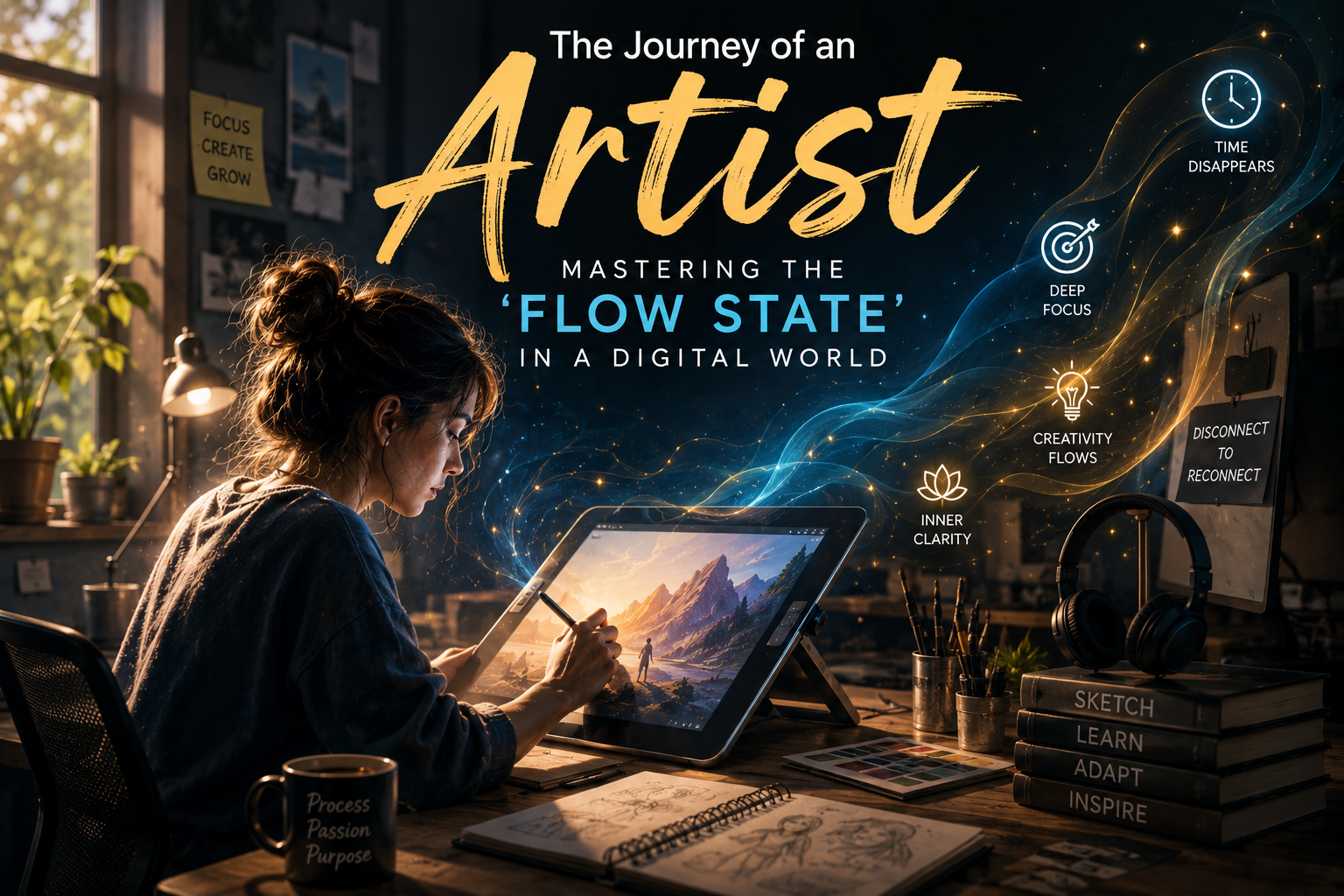
Introduction: More Than Just Paint and Canvas
Every great masterpiece begins not with a stroke of a brush, but with a shift in perspective. The journey toward achieving a flow state for artists is often imagined as a battle against external obstacles, yet the most important challenge usually happens internally. Creative blocks, self-doubt, comparison, and constant digital distractions can quietly interrupt the artistic process. In today’s fast-moving world, where attention is divided across endless notifications and content, the ability to become fully absorbed in creative work has become one of the most valuable skills an artist can develop.
This immersive mental state—commonly called the Flow State—describes those moments when time seems to disappear and creativity feels effortless. Ideas connect naturally, concentration deepens, and the work begins to feel less forced and more instinctive.
In this deep dive, we explore how modern creators are rebuilding focus and protecting their creative energy in a digital environment. This is not simply a guide about technique or learning how to paint. Instead, it explores creative process examples that help artists move from uncertainty to expression and from a blank page to meaningful work.
Whether you are a painter, writer, illustrator, or digital designer, understanding this creative journey can help you discover a stronger artistic voice and develop a more sustainable relationship with your craft.
1. The Genesis: Finding the Artistic Voice
Every artist success story starts with a moment of dissatisfaction. For many, it begins with the realization that they are merely “copying” the world rather than “interpreting” it.
The Psychological Barrier
The biggest hurdle in the journey of an artist is the “Inner Critic.” This is the voice that tells you your work isn’t good enough or that everything has already been done. Unique information from neuroaesthetics suggests that this critic lives in the Prefrontal Cortex—the part of the brain responsible for logical thinking. To create truly unique art, an artist must learn to “deactivate” this area.
How to find your artistic voice:
It requires a period of “creative fasting.” By stepping away from social media and Pinterest trends, an artist allows their subconscious to surface. This is where the most authentic ideas are born.
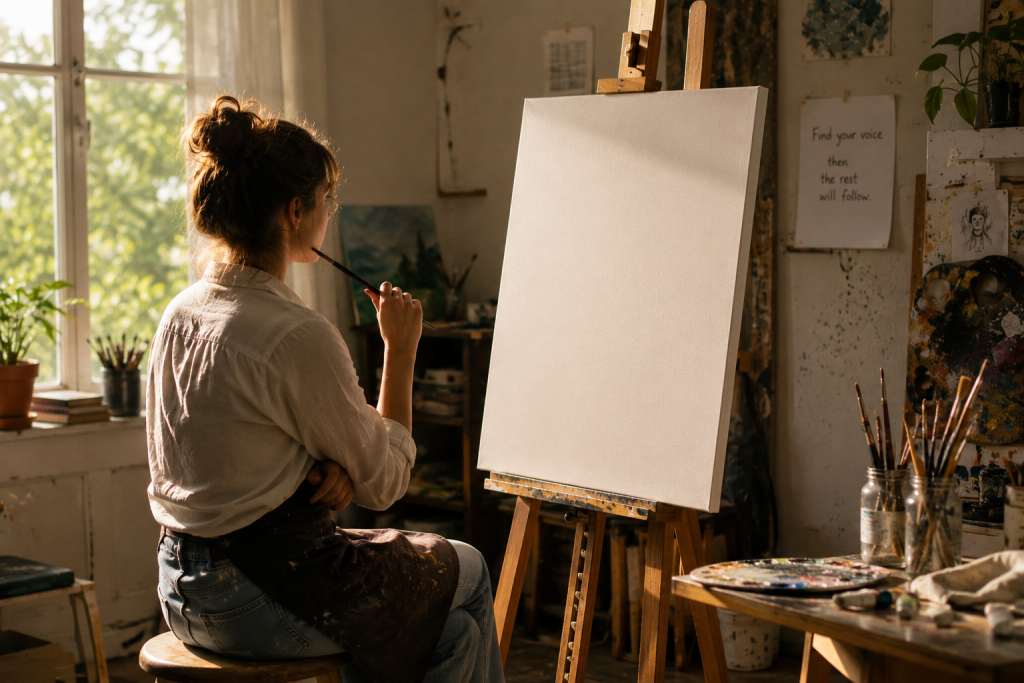
Image ALT Text: An artist sitting in a quiet studio focusing on a blank canvas to find their voice.
2. What is the ‘Flow State’ in Art?
The term “Flow,” coined by psychologist Mihaly Csikszentmihalyi, refers to a state of “optimal experience” where the person is completely immersed in an activity. In the context of a contemporary artist biography, this is often described as the moment where “the brush starts moving itself.”
The Biology of Creativity
During flow, the brain releases a potent cocktail of neurochemicals: dopamine, endorphins, and serotonin. This doesn’t just make the artist feel good; it increases their ability to process information and see patterns that others miss.
Creative process examples in flow:
Time Distortion: An artist may start working at 8:00 PM and “wake up” at 3:00 AM, feeling as though only an hour has passed.
Loss of Self-Consciousness: The fear of failure vanishes.
Instant Feedback: Every move on the canvas feels like the “right” move.
For more tips on maintaining a focused mind, check out our guide on healthy lifestyle habits on Jivan Jarurat.
3. The Modern Challenge: Art in the Age of Algorithms
The journey of an artist today is significantly different from that of Da Vinci or Van Gogh. Today, artists are pressured to be influencers, marketers, and content creators.
The “Scroll” vs. The “Soul”
The unique challenge for modern creators is the “Algorithm of Inspiration.” When an artist looks at trending “Reels” to see what is popular, they are subconsciously training their brain to produce “safe” art that gets likes, rather than “brave” art that moves souls.
Anonymous street art history shows us that the most impactful art often comes from a place of zero public expectation. When the artist doesn’t care about the “Like” count, they are free to experiment with radical new forms.
4. Unique Information: The ‘Glitch’ Technique
One unique method being used by modern digital artists to trigger the flow state is known as “Intentional Glitching.” Instead of aiming for perfection, the artist introduces a random error—a spilled cup of tea on a physical sketch or a corrupted file in a digital one.
Why It Works
This “Glitch” forces the brain out of its logical comfort zone. The artist must now “solve” the problem of the mistake. This problem-solving phase is the fastest gateway into a deep flow state. It turns a standard artist success story into a narrative of resilience and improvisation.
5. Building the Sanctuary: The Environment of a Creator
The journey of an artist is heavily influenced by their surroundings. To achieve peak creativity, the environment must be optimized for “Deep Work.”
The Multi-Sensory Studio
Lighting: Natural light is essential for color accuracy, but dim, warm light is better for conceptual brainstorming.
Sound: “Brown Noise” or “Alpha Wave” music is scientifically proven to help the brain maintain focus during long creative sessions.
Scent: Believe it or not, scents like peppermint or rosemary can improve cognitive performance and memory retention during the creative process.
For the latest updates on how environment impacts your life, visit our news section.
6. Case Study: The Resilience of the “Unknown” Artist
Let’s look at a unique contemporary artist biography—the story of “Vane.” Vane was a corporate graphic designer who felt burnt out. His journey changed when he began “Blind Drawing”—drawing without looking at the paper.
The Transformation
By removing the visual feedback, Vane stopped judging his work as he made it. Within six months, his “blind” sketches had more energy and emotion than his 10 years of polished corporate work. He eventually transitioned into a full-time fine artist. His story proves that the impact of street art on urban culture and gallery culture alike often stems from a willingness to be “ugly” before being “beautiful.”
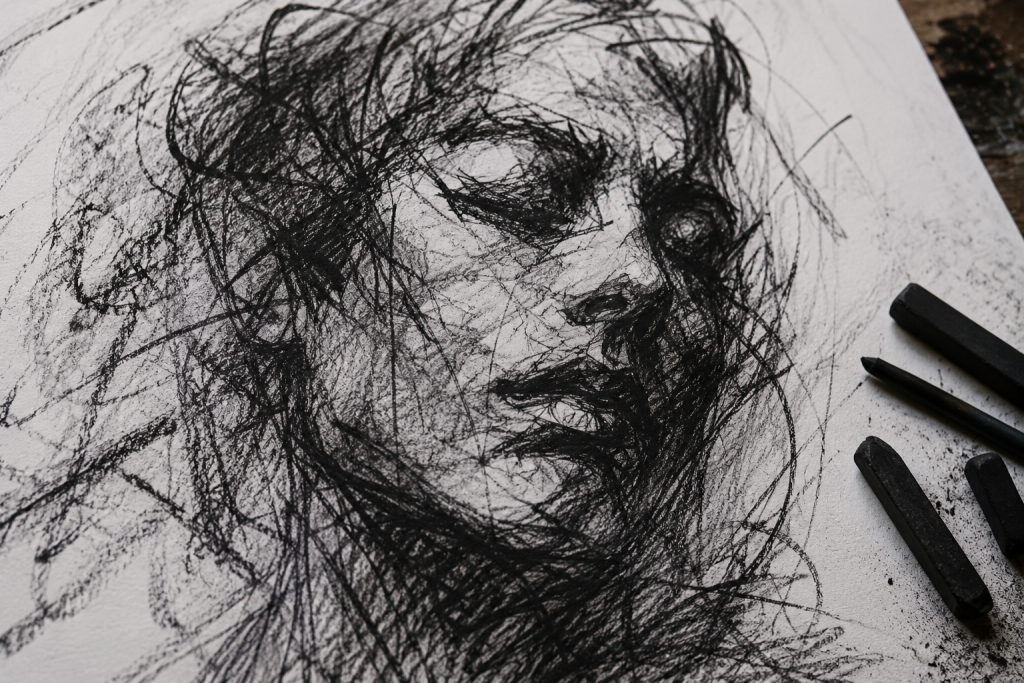
Image ALT Text: Detailed close-up of a charcoal sketch showing the energy and raw emotion of blind drawing.
7. The Science of Creative Incubation
One of the least discussed parts of the creative process is knowing when to pause. Many artists assume progress only happens while actively creating, but creative thinking often continues even when the work stops.
Creative incubation refers to the period where ideas quietly develop beneath conscious attention. Instead of forcing solutions, the mind continues organizing thoughts, impressions, emotions, and observations in the background. For artists, these moments can become surprisingly productive.
Why Ideas Sometimes Arrive Unexpectedly
Many creators have experienced this: after spending hours trying to solve a creative problem, the answer appears later while taking a shower, walking outside, organizing a room, or making tea.
This happens because the mind shifts away from intense focus and gains space to process information differently. Without pressure to immediately produce results, thoughts move more freely and unusual connections can emerge.
Creative breakthroughs rarely appear in a straight line. They often develop in cycles:
- Focus deeply
- Step away
- Return with fresh perspective
This pattern can make ideas feel clearer and more natural.
Creating Space for Better Ideas
Instead of filling every free moment with content, notifications, or background noise, create small periods of intentional stillness.
Try adding quiet creative recovery time into your routine:
- Sit without using your phone for 10–15 minutes
- Go for a short walk without audio
- Observe your surroundings without trying to create
- Sketch loosely without expectations
- Leave unfinished work and revisit it later
These pauses are not wasted time—they give your mind room to absorb and reorganize information.
For the journey of an artist, silence can become part of the process itself. Sometimes progress does not come from doing more. It comes from creating enough space for new ideas to appear naturally.
8. Transitioning from Hobbyist to Professional
Many creators eventually ask: How do I turn my passion into something more meaningful or sustainable? The transition from hobbyist to professional is not always about improving skill—it is often about developing a different mindset.
Hobbyists usually create when inspiration appears. Professionals create consistently, even when motivation changes. The goal is to build a routine that supports creativity over time.
The 80/20 Approach in Art
80% Creation
Spend most of your time creating, experimenting, practicing, and entering periods of focused work where ideas can develop naturally.
20% Curation
Use the remaining time for editing, organizing projects, building a portfolio, networking, marketing, and handling professional responsibilities.
A common mistake is trying to create and manage everything simultaneously. Constantly switching between making art and checking messages or analytics can interrupt focus and reduce creative momentum.
Instead, separate your Creative Time from your Admin Time. Protect uninterrupted periods for creating and schedule business tasks separately.
Becoming a professional artist is less about creating more and more about creating consistently while building systems that support long-term growth.
9. Internal Linking: The Holistic Artist
The journey of an artist is not just about the work; it’s about the person. A healthy body supports a creative mind.
Discover how gut health impacts your focus.
Stay updated on global art trends.
Learn about lifestyle changes for better sleep.
10. Conclusion: Your Story is Still Being Written
The journey of an artist never truly ends. There is no final destination where you “arrive” at perfect creativity. Instead, it is a recurring cycle of searching, finding the flow, and sharing that vision with the world.
If you are struggling to find your voice, remember that the most unique information you have is your own perspective. No one else sees the world exactly as you do. Master your routine, protect your flow state, and the masterpieces will follow.