

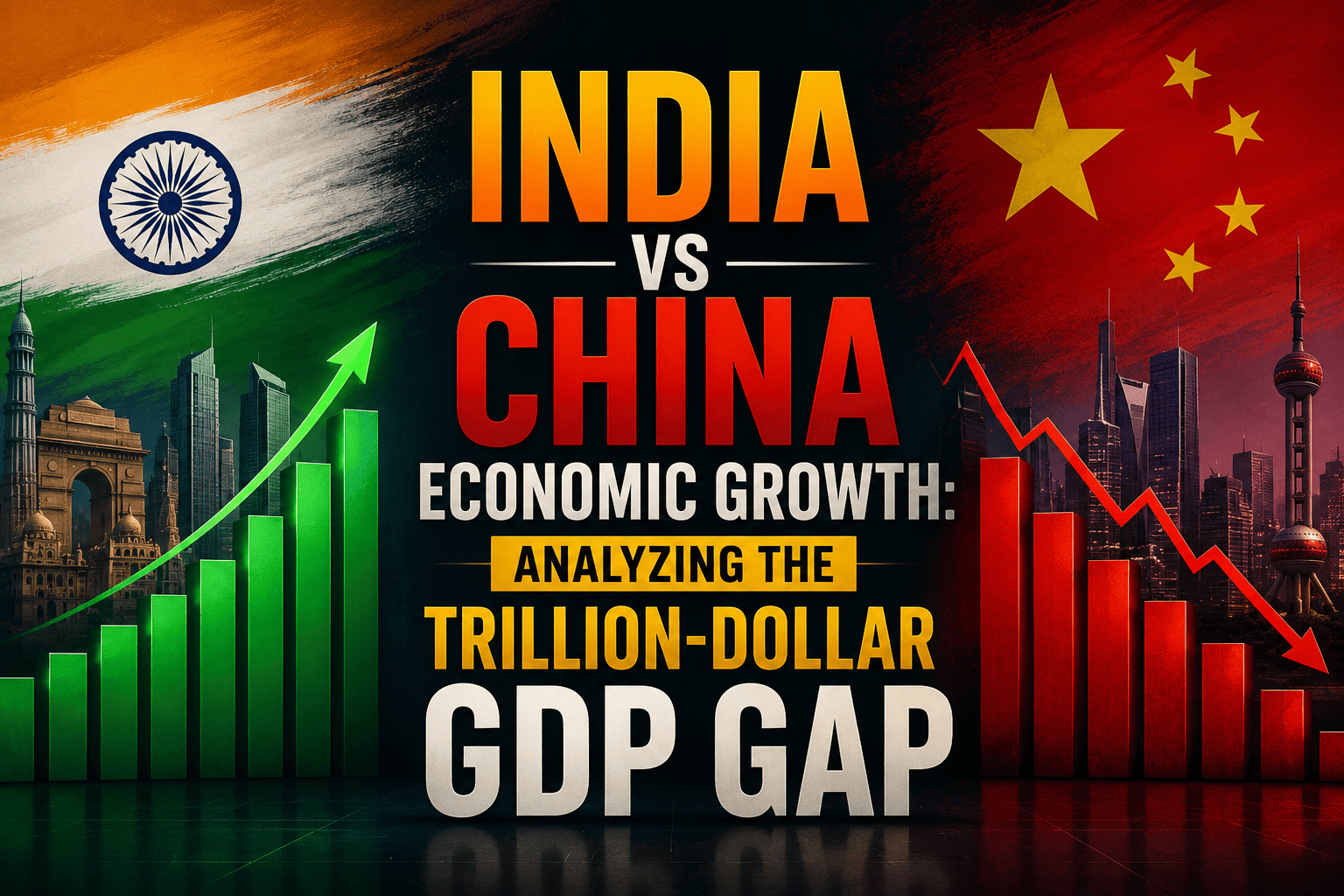
Exploring the Dynamics of India vs China Economic Growth
For decades, economists and policymakers have closely analyzed the trajectory of India vs China economic growth. While both nations possess massive populations and rich histories, their economic paths diverged significantly in the late 20th century. Today, China boasts a GDP vastly larger than India’s, serving as the world’s manufacturing powerhouse. Understanding why the Indian economy historically experienced slower growth compared to its northern neighbor requires a deep dive into policy timing, structural economic choices, and infrastructural investments.
If you want to stay updated on the latest financial trends and market shifts, you can read our comprehensive updates on the Jivan Jarurat News page.
The Timing of Economic Liberalization
The most fundamental reason for the disparity in India vs China economic growth lies in the timing of their respective market reforms. A nation’s decision to open its doors to global trade dictates the pace at which it can accumulate wealth.
China’s 1978 Head Start
Under the leadership of Deng Xiaoping, China initiated its open-door policy and economic reforms in 1978. The country aggressively transitioned from a closed, centrally planned system to a market-oriented economy. By establishing Special Economic Zones (SEZs) along its eastern coast, China incentivized foreign companies with tax breaks, cheap land, and abundant labor.
India’s 1991 Crisis-Driven Reforms
In contrast, India maintained heavily protectionist policies and a tightly controlled mixed economy for decades post-independence. It wasn’t until 1991, facing a severe balance of payments crisis, that India formally liberalized its economy. This 13-year delay gave China a massive head start. By the time India began opening up to foreign direct investment (FDI), China had already established itself as an attractive destination for global capital.
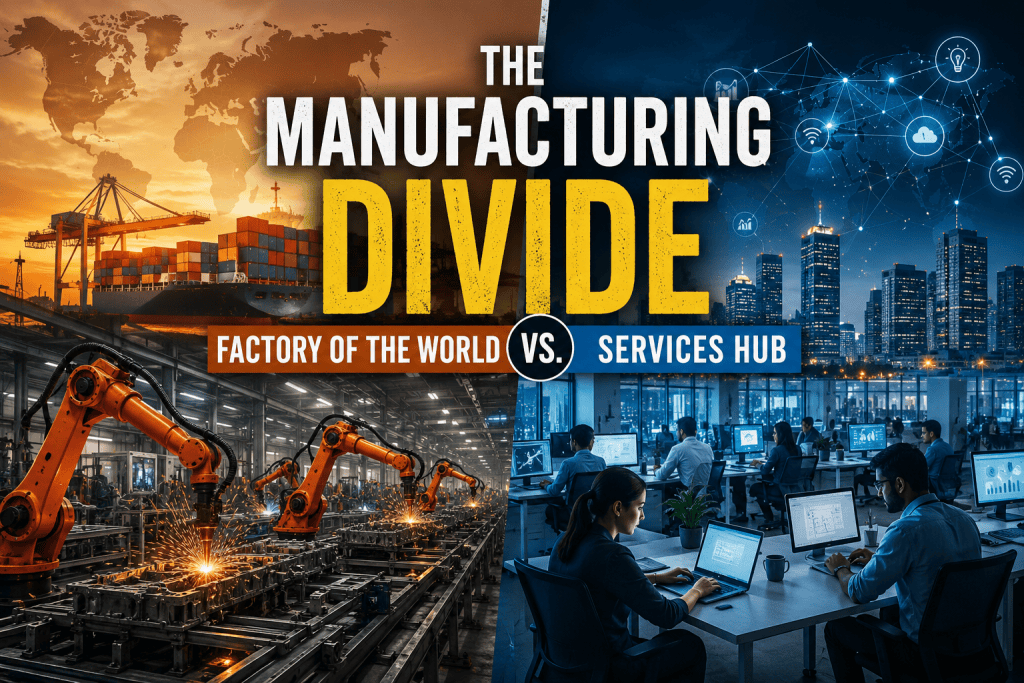
The Manufacturing Divide: Factory of the World vs. Services Hub
The structural composition of growth in both countries presents a stark contrast. The gap in India vs China economic growth is largely a story of manufacturing versus services.
China’s Export-Led Manufacturing
China built its economic miracle on the back of labor-intensive manufacturing. By focusing on producing goods for export, China absorbed hundreds of millions of low-skilled workers from rural agricultural areas into urban factories. This transition rapidly reduced poverty and drove double-digit GDP growth. The government systematically courted multinational corporations to set up assembly lines, earning China the title of “the world’s factory.”
India’s Leap to the Services Sector
India took an unconventional route. Instead of transitioning primarily from agriculture to manufacturing, India leaped straight into the services sector. Aided by an English-speaking workforce, India became a global hub for Information Technology (IT), software development, and Business Process Outsourcing (BPO). While highly lucrative and essential to India’s modern economy, the IT sector does not require the massive blue-collar workforce that manufacturing does. Consequently, a vast portion of India’s rural population remained dependent on low-yield agriculture, limiting overall economic expansion.
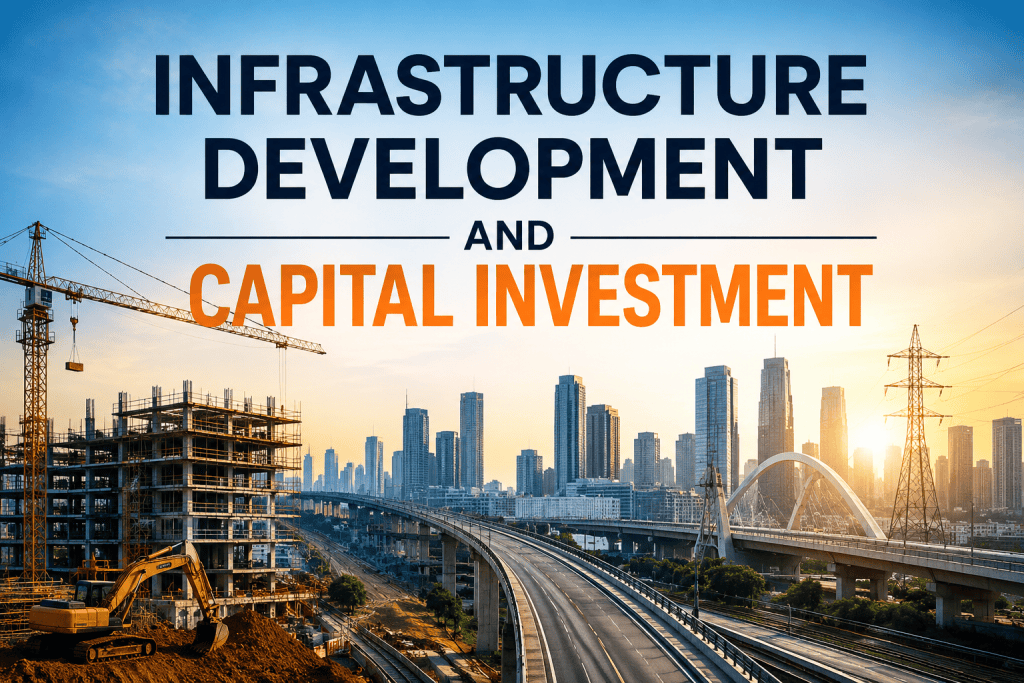
Infrastructure Development and Capital Investment
To sustain high economic growth, a country requires world-class infrastructure. The speed and scale at which China built its physical foundations directly contributed to its rapid expansion.
Swift Implementation in a Centralized System
China’s centralized political system allowed the government to execute massive infrastructure projects with unprecedented speed. From deep-water ports and extensive freight railways to a nationwide network of high-speed bullet trains and massive power grids, China ensured that its factories could transport goods globally without logistical friction.
Challenges in the Indian Democratic Framework
India’s democratic system, while vital for social liberties, often slows down large-scale infrastructure projects. Issues surrounding land acquisition, environmental clearances, and state versus federal jurisdiction historically stalled highway and port expansions. Without adequate roads and reliable electricity, manufacturing plants in India struggled to match the efficiency and output of their Chinese counterparts. Although India has massively accelerated its infrastructure spending in recent years—building thousands of kilometers of highways annually—the historical deficit significantly impacted its growth trajectory.
Bureaucracy, Labor Laws, and Foreign Direct Investment
Attracting foreign capital is critical for developing nations. The ease of doing business plays a major role in a multinational corporation’s decision to invest.
Navigating Red Tape
For a long time, foreign investors viewed India’s bureaucratic framework as overly complex. The remnants of the “License Raj“—a system requiring numerous government approvals to start or expand a business—created significant bottlenecks. Furthermore, strict and archaic labor laws made it difficult for Indian manufacturing firms to scale operations up or down based on market demand.
China’s Streamlined Approach
China, conversely, offered a red-carpet welcome to foreign investors. Local governments competed fiercely to attract international businesses, cutting through red tape and providing ready-to-use factory spaces. This hyper-efficient ecosystem allowed companies like Apple, Tesla, and Foxconn to establish mega-factories that drive billions in export revenue.
Human Capital and Workforce Participation
Economic output is heavily tied to the productivity and participation rate of the population.
Education and Skill Development
China invested heavily in primary education, vocational training, and healthcare long before its economic boom peaked. A highly literate and reasonably skilled workforce was ready to staff the incoming factories. India faces ongoing challenges in standardizing public education quality, leaving a substantial portion of its massive youth demographic under-skilled for modern industrial demands.
Female Labor Force Participation
A critical, often overlooked factor in the India vs China economic growth debate is female labor force participation. In China, women play a massive role in the manufacturing and corporate workforce. In India, female workforce participation has historically remained low due to complex socio-cultural factors. Excluding nearly half the population from formal economic productivity creates a significant drag on national GDP growth.
The Current Scenario: Is India Catching Up?
While analyzing historical context is crucial, it is equally important to acknowledge the current economic landscape.
As of the mid-2020s, India is actually growing faster than China in percentage terms. China’s economy has matured, facing headwinds from an aging population, a real estate crisis, and geopolitical tensions.
The China Plus One Strategy
Global supply chains are actively restructuring. Multinational corporations are adopting a “China Plus One” strategy to diversify their manufacturing bases away from exclusive reliance on China. India is aggressively positioning itself to capture this exodus. Through initiatives like the Production Linked Incentive (PLI) scheme, India is successfully attracting major electronics, semiconductor, and automotive manufacturers.
For more insights on maintaining a balanced life amidst a fast-paced economy, check out our guides on health and lifestyle tips.
Looking Ahead
While India’s current growth rate outpaces China’s, closing the absolute GDP gap will take decades of sustained, high-level growth. By continuing to reform labor laws, expanding infrastructure, and focusing on manufacturing, India aims to replicate the scale of economic transformation previously seen in China.
Frequently Asked Questions
1. Why did China’s economy grow faster than India’s historically?
China opened its economy to global trade and foreign investment in 1978, a full 13 years before India’s major economic reforms in 1991. China also heavily focused on labor-intensive manufacturing and massive infrastructure projects, which accelerated growth.
2. Is the Indian economy currently growing faster than China?
Yes, in terms of annual GDP growth percentage, India has recently been the fastest-growing major economy, outpacing China’s current growth rate. However, China’s overall GDP remains much larger in absolute terms.
3. How does the manufacturing sector affect India vs China economic growth?
Manufacturing absorbs millions of low-skilled workers and boosts exports. China became the “world’s factory,” driving immense wealth creation. India skipped a massive manufacturing phase and focused on services, which employs fewer people overall.
4. What is the China Plus One strategy?
It is a business strategy where multinational companies diversify their manufacturing operations by adding a second supply chain location outside of China, often looking to countries like India or Vietnam to reduce geopolitical and economic risks.
5. How do infrastructure and bureaucracy impact these economies?
China’s centralized system allowed for rapid land acquisition and infrastructure development. India’s democratic structure involves more regulatory steps, which historically delayed projects and made foreign investment more bureaucratic, though this is rapidly improving.
Key Takeaways
- Timing of Reforms: China’s 13-year head start in economic liberalization (1978 vs. 1991) allowed it to capture the first wave of global manufacturing outsourcing.
- Sector Focus: China built its wealth on mass manufacturing and exports, while India relied heavily on the IT and services sectors.
- Infrastructure Lead: China’s ability to rapidly build world-class ports, highways, and energy grids provided a massive advantage for industrial efficiency.
- Future Outlook: Despite historical lags, India is currently implementing aggressive manufacturing initiatives and capturing shifting global supply chains to accelerate its future growth.