


How to Make Money With Claude AI in 2026: 10 Proven Methods That Actually Work
Two years ago, almost nobody outside a small circle of tech insiders had heard of Claude AI. Today, people from college students in Delhi to freelance writers in Manila are quietly using it to pay rent, fund side businesses, and in some cases replace a full-time salary. If you have been scrolling through screenshots of “$100/day with AI” and wondering whether any of it is real, you are asking the right question — because most of it is exaggerated, but a real, repeatable layer of income underneath the hype absolutely exists.
This guide skips the hustle-bro noise. You will get ten methods that are actually being used to earn money with Claude AI right now, a realistic look at what each one pays, a 7-day starter plan you can follow today, and — because a guide nobody finds is useless.
If you are new to the platform, it may help to first read our guide on what Claude AI is and how it compares to ChatGPT before diving into the money-making methods below.
📚 Table of Contents
-
1Why Claude AI Is a Genuine Income Opportunity Right Now➜
-
2What You Actually Need to Get Started (Cost Breakdown)➜
-
310 Proven Ways to Make Money With Claude AI➜
-
4Realistic Income Tiers: What People Are Actually Earning➜
-
5A 7-Day Starter Plan for Your First Paid Client➜
-
6The Tools That Pair Well With Claude AI➜
-
7Common Mistakes That Kill a Claude AI Side Hustle➜
-
8Frequently Asked Questions➜
1. Why Claude AI Is a Genuine Income Opportunity Right Now
Every year brings a new “AI gold rush” headline, so a little skepticism is healthy. What makes the Claude AI opportunity different is that it is not really about the AI at all — it is about speed. Claude has become genuinely good at the exact tasks buyers already pay for: writing that does not read like a robot wrote it, research that comes back organized instead of a wall of text, code that runs the first time more often than not, and editing that catches real structural problems rather than just typos.
That means the same freelance writing, virtual assistant, consulting, and small-agency businesses that have existed for decades can now be run by one person instead of a team. You are not inventing a new market. You are using a faster engine to serve an old one — small businesses that need content, professionals who need their time back, and entrepreneurs who need a working prototype without hiring a developer.
The people who actually make money treat Claude as a very capable junior employee, not a magic button. You are the CEO. Claude drafts, researches, and codes. You are the one who knows what “good” looks like, who talks to the client, and who decides what actually ships. That division of labor is the entire business model behind every method below.
2. What You Actually Need to Get Started (Cost Breakdown)
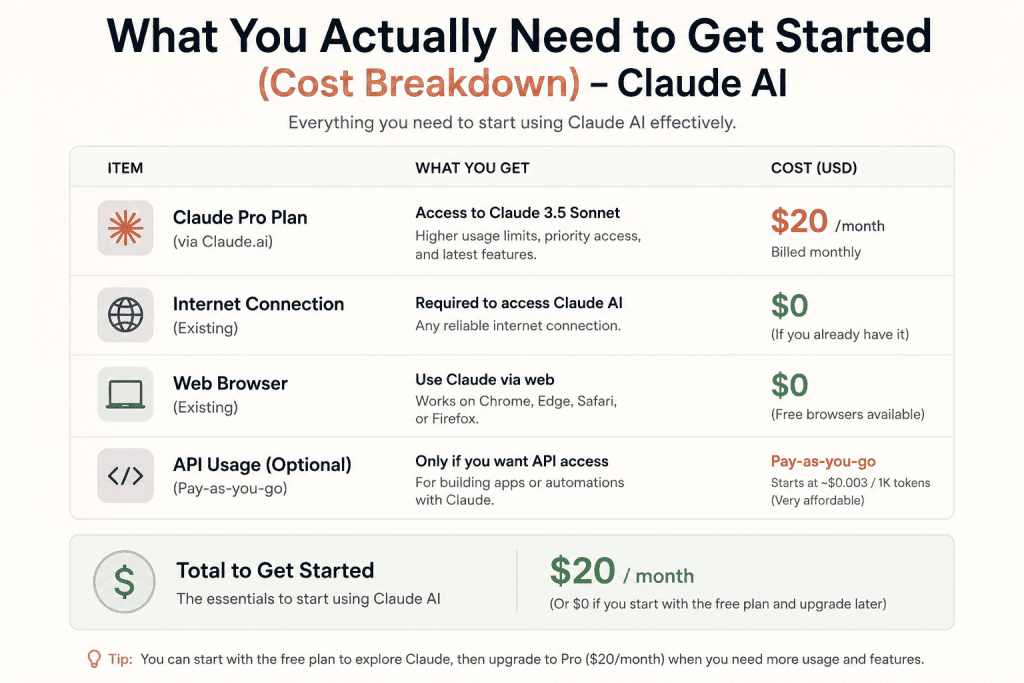
You do not need a computer science degree or a marketing budget to begin. Here is what the entry costs realistically look like as of 2026:
- Claude Free – $0/month. Enough to test ideas, but daily limits make it impractical for client work.
- Claude Pro – around $20/month ($17/month if billed annually). This is the plan most people running a side hustle actually use. It includes higher usage limits, Projects, Research mode, and access to Claude Cowork for multi-step work on your files.
- Claude Max – $100–$200/month, aimed at people running Claude Code heavily or handling a high volume of client work who keep hitting Pro’s limits.
- Claude API – pay-per-token pricing, useful only once you are automating workflows or building a product rather than chatting manually.
Beyond your Claude subscription, budget $0–$30/month for supporting tools (a grammar checker, a design tool like Canva, or freelance platform fees). Total realistic startup cost: under $50. That low barrier to entry is precisely why competition is rising fast — and why the positioning advice in Section 9 matters as much as the money-making method you pick.
3. 10 Proven Ways to Make Money With Claude AI
1. Freelance Writing, Editing, and Content Services
This is still the fastest on-ramp for most beginners. Businesses constantly need blog posts, email sequences, product descriptions, and social captions, and most owners do not have time to write them. Use Claude to produce a strong first draft, then apply your own judgment: fact-check claims, tighten the structure, and rewrite anything that sounds generic. Clients are not paying for words on a page — they are paying for a finished, trustworthy piece of content, and that gap between “AI draft” and “client-ready copy” is where your income lives.
Where to find buyers: Upwork, Fiverr, LinkedIn outreach, and cold emails to small local businesses that clearly have outdated websites or blogs.
2. Content Repurposing
Instead of writing from scratch, take a piece of content a client already owns — a podcast transcript, a webinar recording, a long YouTube video — and turn it into a week’s worth of social posts, a newsletter, and a blog summary. This works exceptionally well because the client already trusts the source material; you are just multiplying its reach. It is also one of the quickest services to productize: package it as “1 video in, 10 posts out” and price per batch rather than per hour.
3. Selling Claude Skills and Prompt Packs as Digital Products
Agent Skills let you save a specific workflow — say, an SEO blog writer, a proposal generator, or a client-onboarding checklist — as a reusable instruction set Claude runs on command. If you have real expertise in a niche (bookkeeping, real estate listings, recruiting, whatever), you can package that expertise into a skill or prompt pack and sell it as a one-time digital product. This is genuinely one of the highest-leverage methods on this list, because you build it once and sell it repeatedly, and buyers do not need any technical background to use what you sell them — most Skills are just markdown files.
4. Proposal and Application Writing for Other Freelancers
A slightly under-the-radar niche: freelancers on Upwork and Fiverr lose hours writing proposals, and a large share of those proposals never land a client. Offer to write high-converting, personalized proposals using Claude, charging per proposal or a small retainer. Because you are one layer removed from the client-facing work, this can be started with almost no portfolio of your own.
5. Research, Summarization, and Data-Cleanup Gigs
Small businesses regularly sit on spreadsheets and customer data they never look at. Offer a service where you connect Claude to their exported data, clean it up, and let them ask plain-English questions about their own numbers. This resonates strongest with small businesses that are comfortable sharing their data with an AI tool but do not have the in-house skill to analyze it themselves.
6. AI-Assisted Virtual Assistant Work
Inbox triage, meeting notes, first-pass calendar scheduling, and drafting routine replies are all things Claude accelerates dramatically. Position yourself as a “high-leverage VA” who uses AI to handle more clients at a higher quality bar than a traditional VA, and price accordingly rather than undercutting yourself to compete with $5/hour outsourcing.
7. Building Small Automations and Simple Agents for Local Businesses
Not long ago, helping a business launch required hiring a designer, a copywriter, and a developer separately. Today, one person using Claude and Claude Code can build a landing page, a basic chatbot, and a simple email funnel for a small business — and Claude Code’s ability to write and test working code makes this one of the more technical, but also more scalable, methods on this list. You do not need to be a professional developer; you need to be able to tell good output from bad and iterate with the client until it works.
8. Claude Code Freelance Development
If you already have some coding background — even beginner level — Claude Code turns you into a far more productive developer. Small businesses and solo founders are actively hiring freelancers to build internal tools, simple websites, Chrome extensions, and MVPs quickly and cheaply. This niche pays noticeably more per hour than pure content work, because clients are paying for a working product, not just words.
9. Coaching, Corporate Training, and Paid Courses
Once you have real experience using Claude productively, that experience itself becomes sellable. Busy professionals — particularly people in mid-level corporate roles who want to look “AI-native” for a promotion — will pay for 1:1 coaching or a short course that saves them hours per week. This is the highest-effort-per-dollar method to start, since you are the product, but it is also one of the fastest ways to land a first paying client if you already have some credibility in your niche or a modest social following.
10. Micro-SaaS and Vibe-Coded Products
For the more ambitious: use Claude and Claude Code to “vibe code” a small, focused SaaS tool that solves one specific problem — think a simple scheduling tool, a niche calculator, or an AI-powered version of an existing manual process. This is the slowest path to first income and the hardest to get right, but it is also the only method on this list with real passive-income potential, since a working product can earn while you sleep instead of trading your hours directly for dollars.
4. Realistic Income Tiers: What People Are Actually Earning
Treat any specific dollar figure you see online with healthy suspicion, including the ones in this article — but the general shape of the income curve is consistent across most honest reports:
- First 30 days: Most beginners earn between $0 and a few hundred dollars while they find their first client and refine their offer. This stage is about proof, not profit.
- 1–3 months in, consistent effort: A realistic range for someone spending 1–2 focused hours a day is roughly $500–$2,000/month, usually from freelance services (writing, repurposing, proposals, VA work).
- 3–12 months, with a productized offer: People who package a specific service or digital product (like a Skills pack or a niche automation) and market it consistently report moving into the $2,000–$10,000/month range.
- Agency or SaaS scale: A smaller number of people running a small team, an agency model, or a genuine software product report $10,000–$30,000+/month, but this tier usually takes over a year of compounding work, not a few weeks of prompting.
The common thread across every case study worth trusting: nobody got there by prompting alone. They got there by combining Claude with a specific, narrow, paid offer and consistent outreach.
5. A 7-Day Starter Plan for Your First Paid Client
Day 1 — Pick one method, not five. Choose a single method from Section 3 based on your existing skills. If you can write reasonably well, start with freelance writing or content repurposing. If you have any coding background, start with Claude Code freelance work.
Day 2 — Build one proof piece. Use Claude to create one high-quality sample — a blog post, a repurposed content bundle, or a small working tool — in your chosen niche. This becomes your portfolio piece even before you have a client.
Day 3 — Write a narrow offer. Avoid “I do AI content.” Instead: “I turn your podcast episode into 5 LinkedIn posts and a newsletter draft within 48 hours.” Specific offers convert far better than vague ones.
Day 4 — Set up your storefront. Create a Fiverr gig, an Upwork profile, or a one-page site, and post your proof piece.
Day 5 — Outreach, not just posting. Send 10–15 direct, personalized messages to potential buyers — small businesses, other freelancers, or people in relevant communities. A gig sitting passively rarely gets discovered in week one.
Day 6 — Handle objections and refine pricing. Expect price pushback. Have a clear, honest answer ready for “is this AI-generated?” — disclosure plus a quality guarantee usually resolves it.
Day 7 — Deliver, over-deliver slightly, and ask for a review. Your first client matters far more for the testimonial than the payment. A strong review compounds into your next five clients.
6. The Tools That Pair Well With Claude AI
Claude rarely operates alone in a real income workflow. The most common stack looks like this:
- Grammarly or a similar editor for a final human-quality pass on written work.
- Canva for quick visual packaging of content or digital products.
- Fiverr and Upwork as the two most beginner-friendly places to find your first paying buyers.
- A simple landing page builder once you are ready to sell a productized service or a digital download directly instead of through a marketplace.
- Claude Code, specifically, if any part of your offer involves building or automating something rather than just writing it.
7. Common Mistakes That Kill a Claude AI Side Hustle
Treating Claude like a vending machine. Typing one vague prompt and expecting a finished, sellable product is the single most common reason people give up after a week. Good output requires specific instructions, examples, and iteration — the same way a human employee needs direction.
Skipping the editing step. Unedited AI output is easy for buyers to spot and increasingly easy for platforms to flag. The editing and quality-control layer is where your actual value — and your actual fee — comes from.
Picking a vague offer. “I do AI stuff” does not sell. A narrow, specific promise with a clear deliverable and turnaround time sells.
Ignoring disclosure requirements. Most platforms, including Fiverr and Upwork, permit AI-assisted work as long as it is disclosed where required and the final quality holds up. Hiding AI use and getting caught damages trust far more than disclosing it upfront ever would.
Chasing five ideas at once. Splitting your first month across five different methods from Section 3 means none of them get enough attempts to work. Pick one, give it thirty real days, then expand.
8. Frequently Asked Questions
Is it actually possible to make money with Claude AI in 2026? Yes. The realistic path is selling a service or product where Claude speeds up your delivery, not expecting the AI to generate income by itself. Freelance writing, content repurposing, digital products like Skills packs, and small development or automation work are the methods with the most consistent track record.
How much does it cost to start? As little as $20/month for a Claude Pro subscription, plus optional low-cost tools like Canva or a freelance platform fee. Most people can realistically start for under $50 total.
Do I need to know how to code? No. Several of the highest-earning methods — freelance writing, content repurposing, proposal writing, coaching — require zero coding ability. Coding helps most with Claude Code freelance work and micro-SaaS products, but it is not a requirement to start earning.
Is this considered a real job or just a side hustle? It can be either. Most people start it as a side hustle worked in 1–2 hours a day, and a smaller number scale it into a full-time agency, coaching practice, or product business over 6–12 months.
Will clients know the content is AI-assisted, and does that matter? Often they will not be able to tell if it has been properly edited, and on most freelance platforms disclosure — where required — plus consistent quality matters far more than whether AI was involved in the drafting stage.