
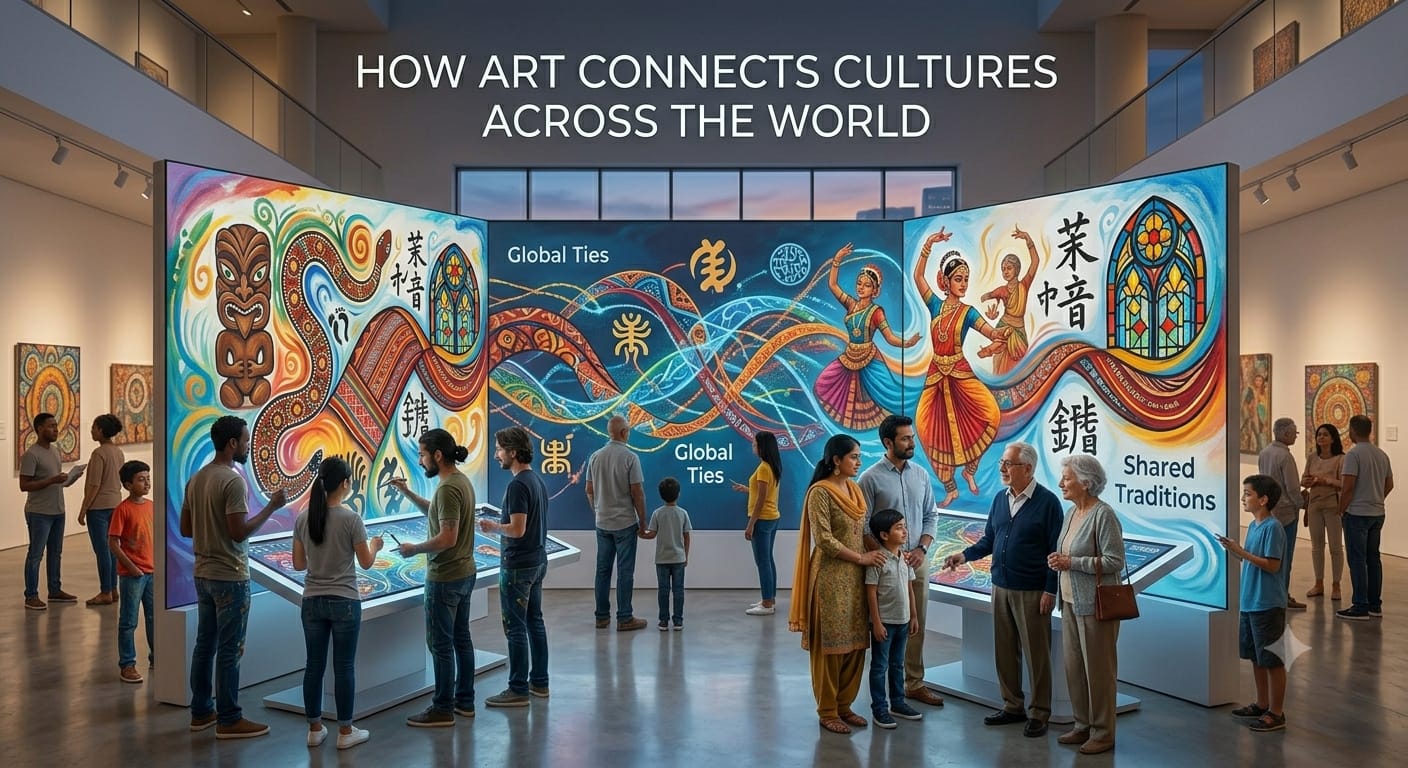
Since the dawn of humanity, human beings have felt an innate need to express themselves. From the ancient cave paintings in Lascaux to the towering digital billboards of modern metropolises, creativity has always been at the core of human existence. But beyond mere expression, there is a profound phenomenon at play: how art connects cultures across the world.
In a world deeply divided by geographic borders, political ideologies, and thousands of different spoken languages, art remains the one true universal medium. It is a bridge that spans across oceans and centuries, allowing someone in modern-day Tokyo to feel the exact emotional weight of a painting created in 15th-century Florence.
Whether it is through painting, sculpture, music, dance, or architecture, global art culture serves as a mirror reflecting our shared human experience. In this comprehensive guide, we will explore the deep historical roots of creative expression, how it breaks down societal barriers, and why understanding this connection is vital for our global future.
Art as a Universal Language: Breaking Down Barriers
When we travel to a foreign country, language is often the first and most intimidating barrier we face. If you do not speak the local tongue, communicating even the simplest of ideas can be a struggle. Yet, if you walk into a local art gallery or stand before a public sculpture, you instantly understand the message. This is the power of art as a universal language.
Visual arts rely on elements that are intrinsically understood by the human brain: color, light, shadow, form, and composition.
- Red often signifies passion, danger, or love globally.
- Blue brings a sense of calm, melancholy, or spirituality.
- Sharp, jagged lines evoke chaos or anxiety, while smooth, flowing curves bring peace.
Because these psychological triggers are hardwired into human biology, a viewer does not need a dictionary to understand the grief depicted in Käthe Kollwitz’s sketches or the overwhelming joy in a vibrant Henri Matisse painting. The role of art in connecting different cultures is rooted in this shared emotional vocabulary. When we look at a piece of art from a culture completely foreign to our own, we suddenly realize that the artist felt the same joys, fears, and hopes that we do. It instantly humanizes the “other.”
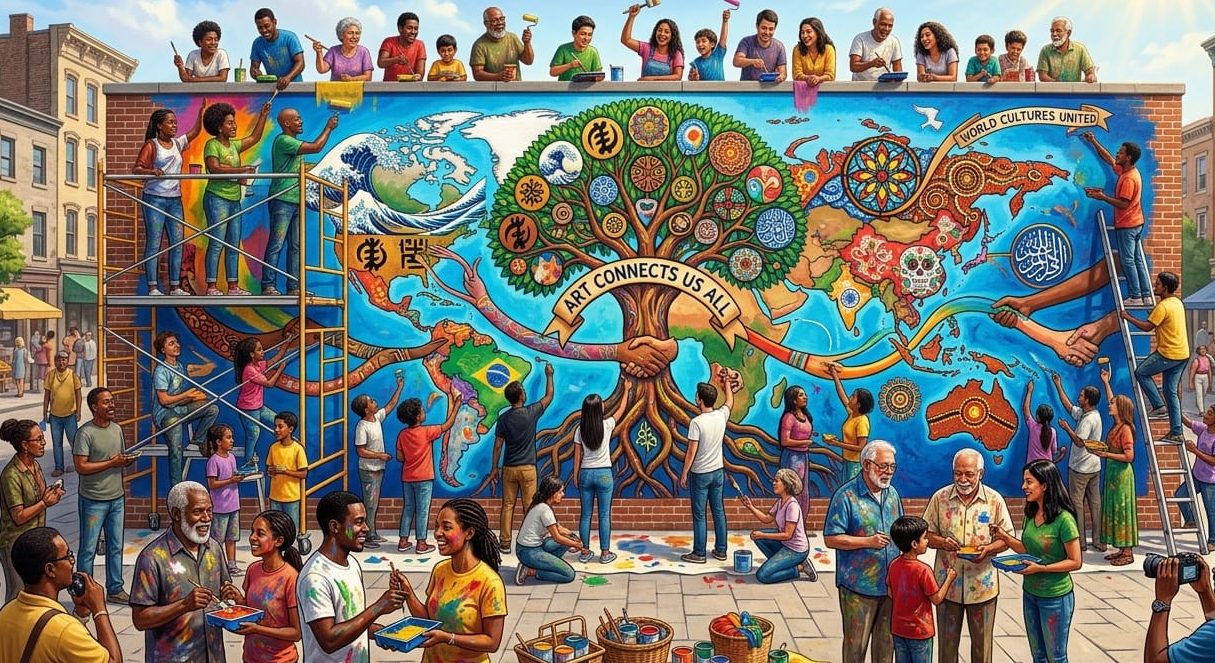
ALT Text: Diverse community painting a mural showing how art connects cultures across the world
The Deep Historical Roots of Cultural Exchange Through Art
To truly understand how art connects cultures across the world, we must look back at history. The idea of an interconnected global art culture is not a modern invention born from the internet; it has been happening for millennia.
The Silk Road: A Canvas of Trade
The Silk Road is famous for the trade of spices, silk, and precious metals, but it was also a massive conduit for cultural exchange through art. As merchants traveled from China through Central Asia, India, and the Middle East to Europe, they brought with them artistic techniques, pigments, and philosophies.
For instance, the beautiful blue pigment known as ultramarine, made from lapis lazuli mined in Afghanistan, made its way to Renaissance Europe. Without this cross-cultural trade route, masterpieces like Johannes Vermeer’s Girl with a Pearl Earring or the brilliant blue skies painted by Michelangelo in the Sistine Chapel would not exist in the way we know them.
Greco-Buddhist Art
Another fascinating historical example is Greco-Buddhist art. Following the conquests of Alexander the Great, Greek culture merged with local traditions in the Indian subcontinent. This resulted in statues of the Buddha that featured flowing, toga-like Greek drapery and classical Mediterranean facial features. It is a stunning visual representation of East meeting West.
Japonisme and the Impressionists
In the 19th century, when Japan opened its borders to international trade, Japanese woodblock prints (Ukiyo-e) flooded the European market. French artists, including Claude Monet and Vincent van Gogh, were deeply inspired by the flat perspectives, bold colors, and everyday subjects of these prints. This cultural exchange directly birthed the Impressionist and Post-Impressionist movements, forever changing the trajectory of Western art.
How Traditional Art Preserves Cultural Heritage Globally
As globalization accelerates, there is a very real fear that unique cultural identities might be swallowed up by a homogenized, commercialized worldview. This is where we see exactly how traditional art preserves cultural heritage.
Traditional arts and crafts—whether it is Native American beadwork, Indian intricate Mandala paintings, Japanese pottery, or African tribal mask carving—serve as historical records. For many indigenous communities, history was not written in books; it was woven into textiles, painted onto pottery, and carved into wood.
Passing Down Generational Knowledge
Traditional art is a vehicle for storytelling. The intricate dot paintings of the Indigenous Australians are not just visually striking; they are maps, laws, and religious texts. They tell the stories of the “Dreamtime,” explaining how the land and its creatures were formed. By continuing to create and share this art, indigenous artists are protecting their heritage from erasure.
When these traditional pieces are exhibited globally, they invite the rest of the world into their sacred histories. It fosters respect and awe. It teaches global audiences that civilization did not just happen in Europe, but that sophisticated, spiritually rich cultures have thrived on every continent.
If you are fascinated by how traditional lifestyles and mental well-being are interconnected, take a moment to explore our comprehensive resources on Jivan Jarurat Health tips. You will find that many ancient cultural practices beautifully align with modern holistic health.
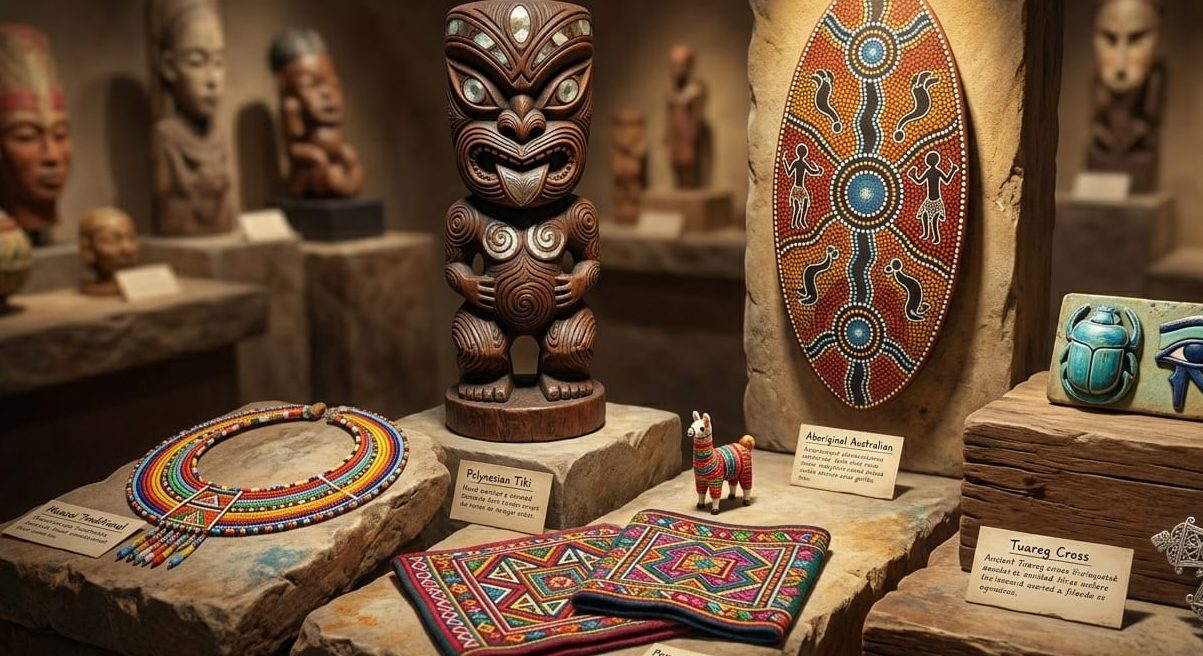
ALT Text: Traditional indigenous artifacts displaying the rich global art culture and ancient human heritage
Modern Masterpieces: The Role of Art in Connecting Different Cultures
In the contemporary world, the role of art in connecting different cultures has taken on a more deliberate and activist tone. Modern artists frequently use their platforms to bridge cultural gaps, challenge prejudices, and force uncomfortable but necessary conversations.
International Biennales and Exhibitions
Events like the Venice Biennale, Art Basel, and Documenta are massive international art fairs that bring together creators from hundreds of nations. In these spaces, a contemporary artist from Nigeria can showcase their work right next to an artist from South Korea or Brazil. These exhibitions are melting pots of global art culture, where diverse perspectives tackle universal modern issues like climate change, poverty, and human rights.
Public Murals and Street Art
Street art has become a powerful tool for cultural connection. Unlike museums, which can sometimes feel elitist or inaccessible, street art is for the people. Artists like Banksy have traveled the globe, leaving politically charged, culturally relevant art on walls from London to the West Bank. In cities like Berlin, the remains of the Berlin Wall have been transformed into the East Side Gallery—a massive international memorial for freedom featuring murals painted by artists from all over the world.
Music and Dance as Cross-Cultural Art
We cannot talk about art connecting cultures without mentioning music and dance. The explosion of K-Pop across the Western world, the global love for Latin American salsa and reggaeton, and the international appreciation for African Afrobeats prove that rhythm and melody need no translation. Music bridges the gap between the youth of different nations, fostering a shared global pop culture.
To keep up with how modern art forms, including cinema and music, are shaping global trends, you can always read our latest updates on Jivan Jarurat Entertainment.
Famous Examples of Art Bridging Cultural Gaps
Let’s look at some specific examples of art bridging cultural gaps in recent history to see these concepts in action.
1. The West-Eastern Divan Orchestra
Founded in 1999 by Palestinian literary scholar Edward Said and Israeli conductor Daniel Barenboim, this orchestra brings together young classical musicians from Israel, Palestine, and other Arab countries. By sitting side-by-side and creating beautiful music, these young artists bypass the fierce political conflicts of their home nations. It is a living, breathing testament to how art can foster peace and mutual respect.
2. The “Inside Out” Project by JR
French street artist JR launched a global participatory art project called “Inside Out.” He prints massive black-and-white portraits of everyday people and pastes them in public spaces. The project has traveled to over 140 countries. By showing the faces of ordinary citizens—from marginalized communities in Brazilian favelas to indigenous tribes in the Arctic—he forces the world to see the humanity in strangers.
3. The Louvre Abu Dhabi
When the Louvre opened a branch in Abu Dhabi, it wasn’t just a franchised museum; it was a deliberate act of cultural exchange through art. The museum’s curation does not separate art by geography. Instead, it groups artifacts by timeline and theme. You will see an ancient Egyptian relic placed next to an ancient Chinese artifact from the exact same era. This brilliant curatorial choice highlights that despite the distance, human civilizations were developing similar ideas, tools, and spiritual beliefs simultaneously.
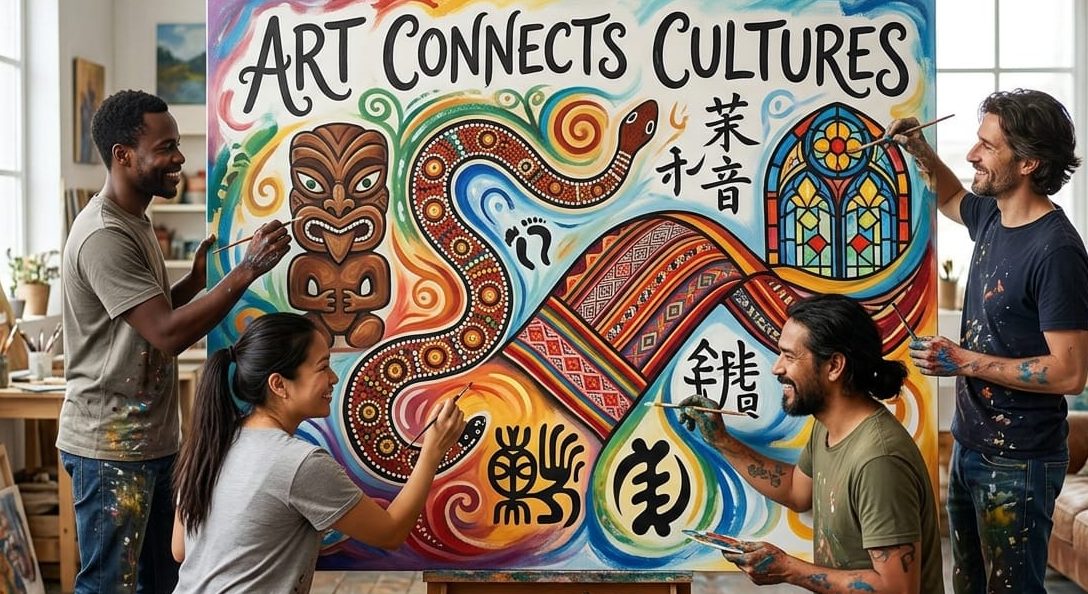
ALT Text: Artists collaborating on canvas highlighting the role of art in connecting different cultures
Global Art Culture in the Digital Age
The advent of the internet and social media has revolutionized how art connects cultures across the world. Historically, to see a masterpiece, you had to be wealthy enough to travel to Paris, Rome, or New York. Today, the world’s art is at our fingertips.
Platforms like Google Arts & Culture have partnered with over 2,000 museums across the globe to digitize millions of artworks in ultra-high resolution. A student in rural India can zoom in on the brushstrokes of a Van Gogh painting, and an art lover in Canada can virtually walk through the ancient temples of Kyoto.
Furthermore, social media platforms like Instagram and TikTok have democratized the art world. An independent artist in Kenya can build a global following, sell their art internationally, and share their cultural stories without needing the approval of elite Western galleries. This direct artist-to-audience connection fosters a truly decentralized global art culture. It allows for instant feedback, collaboration, and a blending of styles that is entirely unprecedented in human history.
For the latest updates on how technology and digital media are reshaping our world, make sure to visit our breaking news section at Jivan Jarurat News.
The Impact of Art on Empathy and Human Connection
Why does all of this matter? Why should we care about how art connects cultures across the world? The answer lies in human empathy.
Prejudice and xenophobia thrive in environments of ignorance. When we do not understand a culture, it is easy to stereotype or fear it. Art acts as a powerful antidote to this fear. When you read a beautifully translated Japanese novel, watch an emotionally gripping Iranian film, or stand before a powerful Mexican mural, your perspective shifts.
Art demands empathy. It places you in the shoes of the creator. It whispers, “Look at the world through my eyes for just a moment.” When we engage in cultural exchange through art, we build cognitive bridges. We realize that the desire for love, the pain of loss, the struggle for freedom, and the search for meaning are not Western traits or Eastern traits—they are human traits.
Furthermore, participating in art—whether creating it or consuming it—has profound psychological benefits. It lowers cortisol levels, reduces anxiety, and helps process complex trauma. When a society embraces art, it embraces a healthier, more emotionally intelligent population.
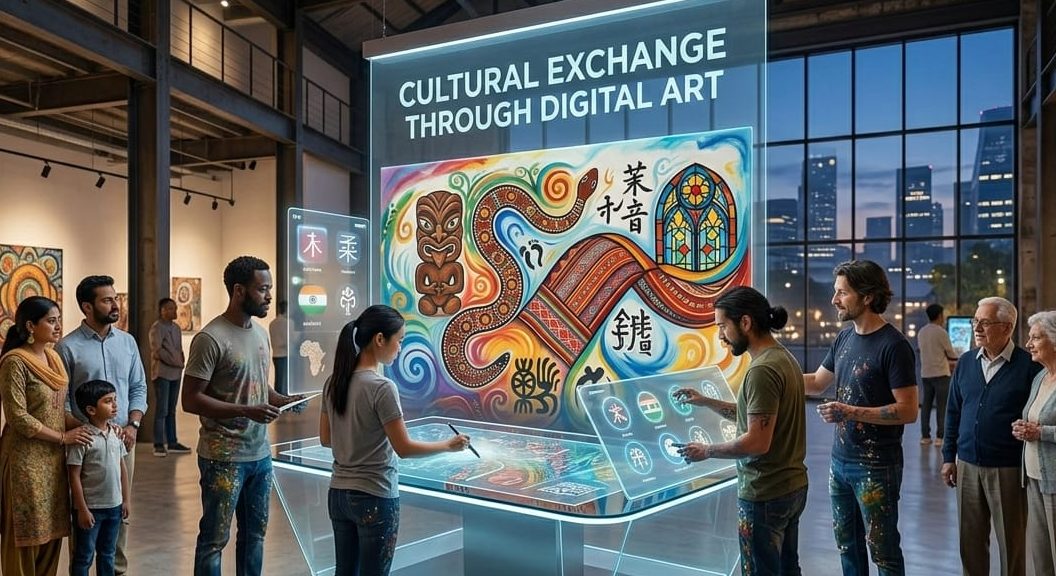
ALT Text: Modern digital art exhibition demonstrating beautiful cultural exchange through art in modern times
A Call for Continued Support of the Arts
If we want to continue fostering global unity, we must actively support the arts. This means funding public art programs, protecting indigenous crafts, and ensuring that art education remains a staple in our schools.
When governments cut arts funding, they are not just removing painting or music classes; they are removing the very tools children need to understand a complex, diverse world. By supporting international art festivals, visiting local galleries, and purchasing art from diverse creators, we vote for a world that values connection over division.
Ways You Can Engage with Global Art:
- Visit local museums and cultural centers that highlight diverse artists.
- Support indigenous and international creators by buying their work or sharing it on social media.
- Travel with curiosity, making time to explore local crafts and traditional performances rather than just tourist traps.
- Consume international media, including foreign films, literature, and music.
Conclusion
The story of humanity cannot be told without the story of our art. From the trading paths of the ancient Silk Road to the high-speed fiber-optic cables of the modern internet, the human race has always found a way to share its creativity.
Understanding how art connects cultures across the world is the key to understanding each other. Art is not a luxury; it is a necessity. It is the thread that weaves the diverse tapestry of humanity together, ensuring that no matter how far apart we are geographically, we are always connected emotionally.
As we look toward an increasingly globalized future, let us lean into the beauty of our shared global art culture. Let us celebrate how traditional art preserves cultural heritage while simultaneously embracing the role of art in connecting different cultures in innovative, modern ways. Because as long as we continue to create, we will continue to connect.