
Unprecedented Standoff at the Prime Minister’s Residence
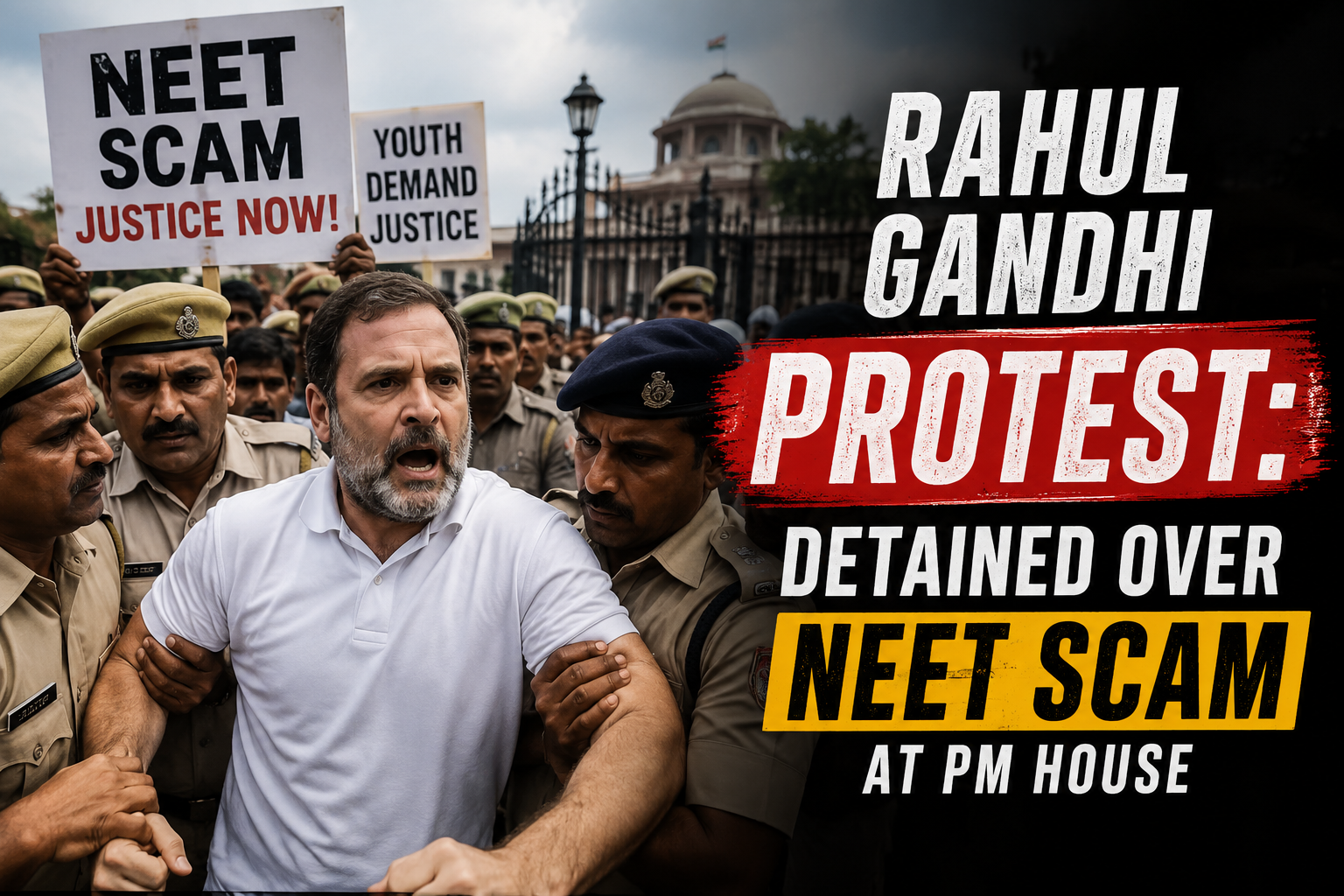
Rahul Gandhi Protest:- In a dramatic escalation of political tensions in New Delhi, Leader of the Opposition in the Lok Sabha, Rahul Gandhi, was briefly detained by Delhi Police on Tuesday. The detention occurred following a surprise sit-in protest orchestrated outside the official residence of Prime Minister Narendra Modi at 7, Lok Kalyan Marg.
The demonstration was launched in solidarity with students across the nation demanding justice over the recent NEET exam paper leaks. The sudden convergence of top Congress leaders at the high-security zone took both law enforcement and the ruling administration entirely by surprise.
Alongside Rahul Gandhi, several prominent political figures were forcibly removed from the site. This included Congress General Secretary Priyanka Gandhi Vadra and Samajwadi Party chief Akhilesh Yadav. The images of opposition leaders being physically carried into police buses quickly dominated national headlines, igniting a fierce debate on the democratic right to dissent.
A Covert Assembly Under the Guise of a Celebration
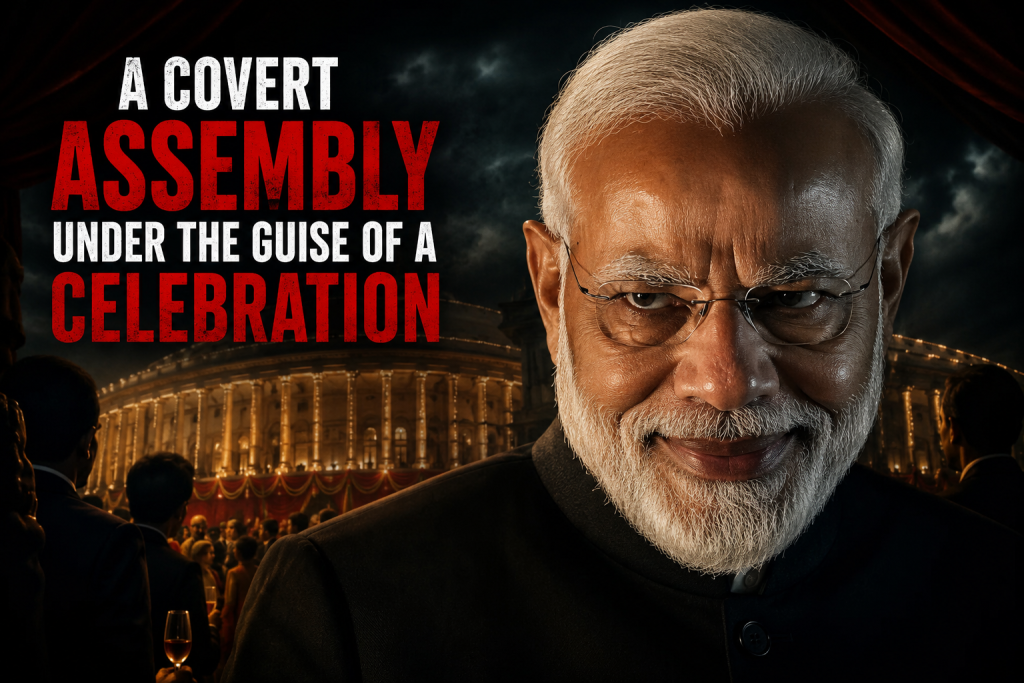
Executing a protest in one of the most heavily guarded zones in the country required meticulous planning and strict secrecy. Sources revealed that the Congress party leadership kept the operation under wraps to prevent any preemptive police intervention.
Nearly 25 Congress Members of Parliament were instructed to gather at the residence of Congress President Mallikarjun Kharge. The stated reason for this gathering was a simple birthday celebration. The MPs were kept in the dark about the actual agenda until the last possible moment.
Once the brief celebration concluded, the leaders were instructed to follow Rahul Gandhi’s convoy without asking questions. This strategic diversion allowed the political contingent to bypass typical security barricades and successfully launch the sit-in at the Prime Minister’s doorstep.
The Core Issue: NEET Leaks and the Student Uprising
The immediate catalyst for the Rahul Gandhi protest was the brutal police crackdown on students just a day prior. Thousands of young aspirants had gathered in central Delhi to demand the resignation of the Union Education Minister following catastrophic irregularities in the NEET examinations.
The nationwide medical entrance test has been plagued by allegations of mass paper leaks, systemic corruption, and irregular grading. This has left millions of students in a state of despair regarding their academic futures. When students took to the streets to demand transparency, they were reportedly met with baton charges and teargas by the authorities.
You can also stay updated on similar ongoing national developments by visiting our dedicated section on Jivan Jarurat.
Solidarity With the Cockroach Janta Party
Adding a unique layer to this unrest is the emergence of the “Cockroach Janta Party” (CJP)—a youth-led, grassroots movement symbolizing the resilience of students who refuse to be crushed by a flawed system.
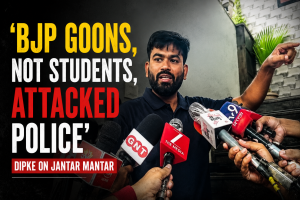
The CJP has been conducting a prolonged agitation at Jantar Mantar, featuring indefinite hunger strikes by notable activists, including Sonam Wangchuk. Rahul Gandhi stated that his sit-in was a direct act of solidarity with these young protesters. He argued that the government has consistently ignored their genuine grievances and refused to allow a comprehensive debate in Parliament.
Detention and Chaos on the Streets of Delhi
As the Congress contingent occupied the area outside the Prime Minister’s residence, Delhi Police swiftly mobilized to disperse the crowd. Footage from the scene showcased chaotic moments as law enforcement officers descended upon the politicians.
Officers were seen holding Rahul Gandhi by his arms and legs, forcibly removing him from the tarmac, and pushing him through a dense crowd of supporters into a waiting police bus. Similar scenes unfolded with Priyanka Gandhi and Akhilesh Yadav, who were also escorted away from the high-security zone.
Despite being detained, Gandhi remained defiant. He reiterated that the administration is terrified of accountability and is using police force to silence the voices of India’s youth. The leaders were transported away from the site by early evening, though sources initially suggested Gandhi had planned to continue the sit-in overnight.
Intense Political Backlash: BJP and AAP Hit Back
The surprise protest did not just anger the ruling Bharatiya Janata Party (BJP); it also drew severe condemnation from the Aam Aadmi Party (AAP), highlighting the complex dynamics within the national opposition.
The Ruling Party Condemns the ‘Spectacle’
The Union government launched a scathing counterattack against the Congress party. Education Minister Dharmendra Pradhan accused Rahul Gandhi of “shamelessly exploiting” the students as political tools.
Pradhan took to social media to state that the Congress was prioritizing political spectacle over democratic debate. He claimed that the government had already expressed readiness for a comprehensive parliamentary discussion regarding the exam irregularities. Furthermore, BJP’s national leadership branded the protest at the Prime Minister’s residence as a “symbol of anarchy,” accusing Gandhi of manufacturing confrontation rather than seeking solutions.
AAP Alleges Congress is Hijacking the Movement
In a surprising twist, the Aam Aadmi Party heavily criticized the Rahul Gandhi protest. Senior AAP leader and former Delhi Chief Minister Atishi labeled the Congress dharna as a “jugalbandi” (collusion) with the BJP.
AAP leaders questioned how Rahul Gandhi was permitted to reach and protest outside the highly secure PM residence, while the actual students and activists like Sonam Wangchuk have been ignored at Jantar Mantar for over a month.
AAP Rajya Sabha MP Sanjay Singh accused the Congress of actively trying to undermine and hijack the organic student movement. According to AAP, the Congress ecosystem is attempting to dilute the CJP’s grassroots efforts by turning the crisis into a mere political photo opportunity.
Rahul Gandhi’s Unyielding Demands
Following his release from detention, Rahul Gandhi addressed the media, cementing his stance against the central administration. He demanded an unconditional apology from Prime Minister Narendra Modi to the student community for the police brutality inflicted upon them.
Furthermore, the Leader of the Opposition called for the immediate resignation of both the Prime Minister and Home Minister Amit Shah. Gandhi emphasized that the systemic failure to conduct fair examinations is a direct betrayal of the nation’s youth, effectively “destroying the future of India.”
The Broader Implications for India’s Education System
The events unfolding in the national capital represent more than just a partisan clash; they highlight a deep-seated crisis in India’s educational infrastructure. The recurrent leaks of crucial examination papers like NEET undermine the meritocracy of the country.
As millions of students invest years of preparation and significant financial resources into these exams, the lack of secure evaluation systems breeds deep resentment. The rise of youth movements like the CJP indicates a generational shift where young citizens are bypassing traditional political routes to demand immediate systemic reforms.
While political parties debate the optics of the Rahul Gandhi protest, the core issue remains unresolved. The youth of India continue to wait for concrete answers, robust educational reforms, and a transparent system that rewards hard work rather than corruption.
- 5 Frequently Asked Questions with Answers
Q1: Why was Rahul Gandhi protesting outside the PM’s residence?
A: Rahul Gandhi was protesting in solidarity with students who have been demanding justice over the NEET exam paper leaks. He was also condemning the recent police brutality against youth activists demanding educational reforms.
Q2: What is the Cockroach Janta Party (CJP)?
A: The CJP is a newly formed, youth-led grassroots movement protesting against systemic flaws in India’s education system, exam paper leaks, and rising educational fees.
Q3: How did Congress leaders manage a surprise protest in a high-security zone?
A: Congress MPs were secretly gathered at party president Mallikarjun Kharge’s residence under the pretext of a birthday celebration. From there, they discreetly followed Rahul Gandhi’s convoy to the PM’s residence, bypassing advance police intelligence.
Q4: Why did the Aam Aadmi Party (AAP) criticize Rahul Gandhi’s protest?
A: AAP leaders accused Congress of hijacking the organic student movement. They questioned how Rahul Gandhi was allowed to reach the highly secure PM residence, suggesting it was a political stunt that undermines the month-long hunger strikes by activists at Jantar Mantar.
Q5: What were Rahul Gandhi’s main demands during the sit-in?
A: Rahul Gandhi demanded that Prime Minister Narendra Modi apologize to the students for the police crackdown. He also called for the resignations of both Education Minister and Home Minister Amit Shah over the administration’s handling of the education crisis.
- Key Takeaways
- Surprise Sit-in: Rahul Gandhi and top opposition leaders bypassed security protocols to launch a surprise protest outside PM Modi’s residence.
- Student Solidarity: The demonstration was a direct response to the NEET exam paper leaks and recent police violence against protesting youth.
- Brief Detentions: Delhi police forcefully removed and briefly detained Rahul Gandhi, Priyanka Gandhi Vadra, and Akhilesh Yadav from the protest site.
- Divided Opposition: The Aam Aadmi Party severely criticized the Congress, accusing them of executing a political stunt that undermines the genuine grassroots movement led by students.
- Call for Accountability: Congress continues to demand the resignation of top government officials, pushing for immediate and transparent educational reforms in India.