
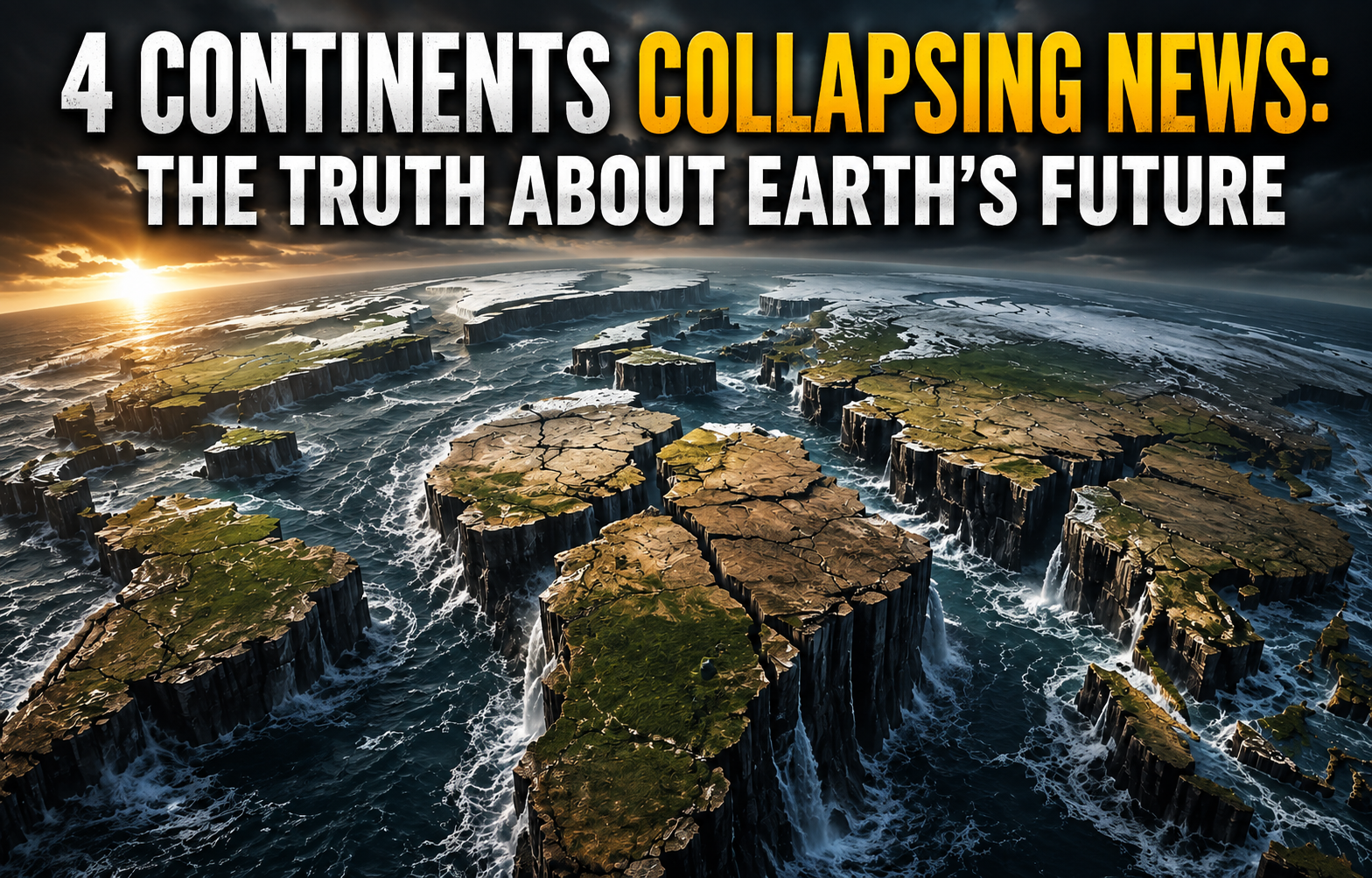
If you have been browsing social media or reading trending science articles lately, you might have stumbled across some rather alarming headlines. Phrases like the 4 continents collapsing news have been circulating rapidly, leaving many readers wondering if a catastrophic geological event is right around the corner. Are our continents actually about to smash into one another?
The short answer is yes, continents are constantly moving and will eventually merge. However, the timeline is vastly different from what sensationalized news might lead you to believe. This is not an event that will happen in our lifetimes, nor in the next thousand years. Instead, it is a slow, methodical geological process driven by plate tectonics that will take hundreds of millions of years to complete.
In this comprehensive guide, we will explore the real science behind the 4 continents collapsing news. We will look at recent studies regarding the future supercontinent known as “Amasia,” explain how the Earth’s surface is constantly reshaping itself, and help you understand what this monumental planetary shift means for the future of Earth.
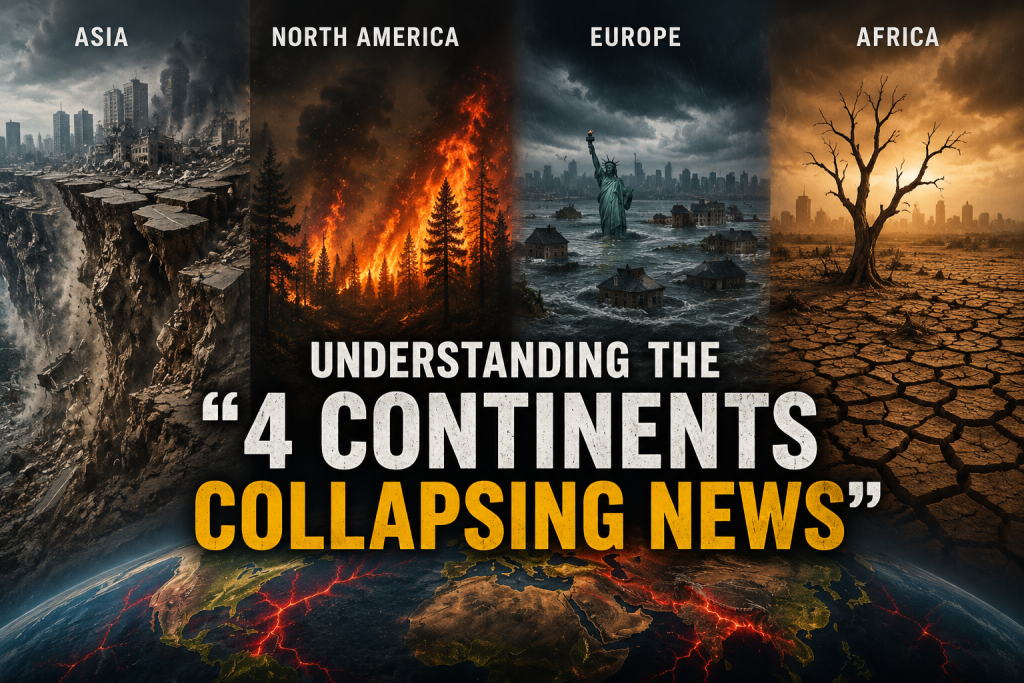
Understanding the “4 Continents Collapsing News”
Whenever scientific modeling predicts massive changes to the Earth, the internet tends to amplify the dramatic aspects of the story. The recent surge in interest regarding continents collapsing together stems from advanced geological modeling, particularly a highly publicized 2022 study by researchers at Curtin University in Australia.
What the Latest Scientific Studies Actually Say
Using advanced supercomputers, geologists simulated the future movements of Earth’s tectonic plates. The study concluded that because the Earth has been cooling over billions of years, the thickness and strength of tectonic plates under the oceans decrease over time.
The most likely scenario for the next supercontinent involves the closing of the Pacific Ocean. Instead of new oceans forming, the existing Pacific will slowly shrink, bringing North America, South America, Asia, and Australia together. This scientific projection is the actual basis of the 4 continents collapsing news.
Debunking the Doomsday Timeline
It is crucial to clarify what scientists mean by “the coming years.” In geology, time is measured in millions, not months or decades. When researchers state that continents are on a collision course, they are referring to a timeline of 200 to 300 million years from today.
Therefore, there is no immediate danger. You do not need to worry about the Americas suddenly crashing into Asia tomorrow. The movement happens at roughly the same speed that your fingernails grow—about a few centimeters per year.
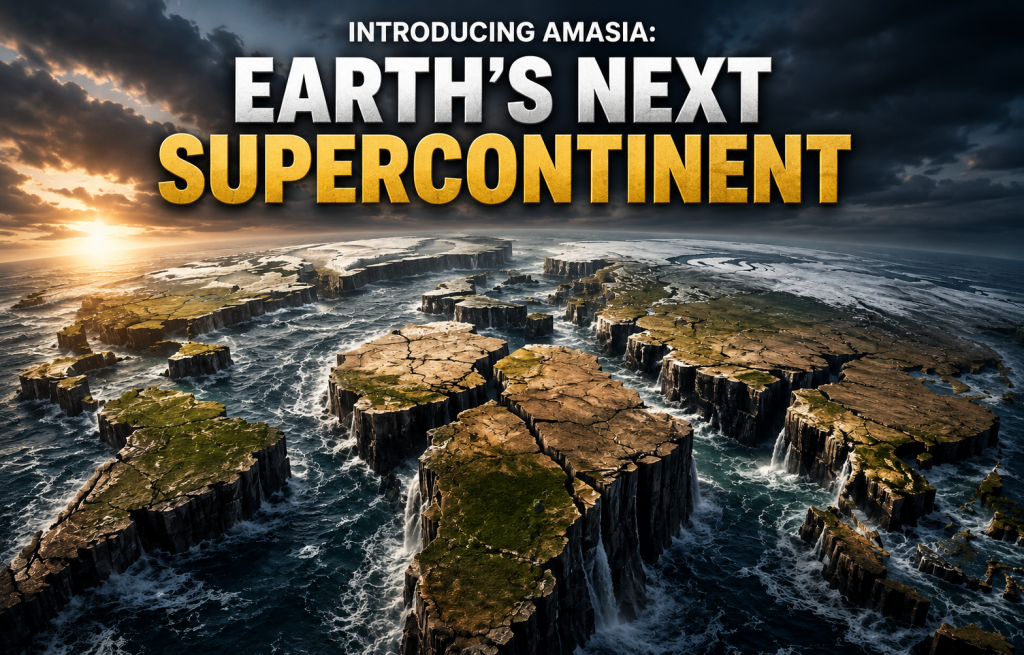
Introducing Amasia: Earth’s Next Supercontinent
Scientists have given a name to this future colossal landmass: Amasia. The name is a portmanteau of “America” and “Asia,” reflecting the primary tectonic plates that will anchor this new supercontinent.
How Will Amasia Form?
Currently, the Pacific Ocean is the oldest ocean on Earth. It is a remnant of the Panthalassa superocean that surrounded the last supercontinent, Pangea. However, the Pacific is actively shrinking. Huge subduction zones—areas where one tectonic plate is forced under another—surround the Pacific in a ring known as the “Ring of Fire.”
As the Pacific sea floor gets pushed deep into the Earth’s mantle and melts, the ocean slowly closes. Simultaneously, the Atlantic Ocean is slowly expanding. This dynamic means that the continents bordering the Pacific are gradually being pushed toward each other.
Which Four Continents Are Merging?
The 4 continents collapsing news generally refers to the massive landmasses that will make up the core of Amasia. According to the geological models, the primary players are:
- North America: Moving westward.
- South America: Moving westward alongside North America.
- Asia: Acting as the eastern wall that the Americas will eventually hit.
- Australia: Currently moving northwards at a rapid pace (geologically speaking) and expected to collide with Asia long before the Americas arrive.
Eventually, Antarctica may also migrate northward, joining the massive supercontinent, leaving the planet with one giant landmass and one massive global ocean.
The Science Behind Continents Colliding
To truly understand why the map of the Earth is destined to change, we have to look beneath the surface. The Earth is not a solid sphere of rock; it is highly dynamic.
Why Do Tectonic Plates Move?
The Earth’s outer shell, the lithosphere, is broken up into several large and small tectonic plates. These plates float on the asthenosphere, a semi-fluid layer of the Earth’s mantle.
Deep inside the Earth, intense heat from the radioactive decay of elements and residual heat from the planet’s formation creates convection currents. Hot rock rises, cools near the surface, and then sinks back down. These massive, slow-moving currents act like a conveyor belt, dragging the tectonic plates along with them.
The Shrinking of the Pacific Ocean
The Pacific plate is currently moving northwest at a rate of about 7 to 11 centimeters per year. As it moves, it dives beneath the Eurasian Plate and the North American Plate. Because the Pacific Ocean is shrinking by a few centimeters every year, the distance between the Americas and Asia is slowly but surely decreasing. This is the exact mechanism driving the future formation of Amasia.
The Geological Timeline: When Will This Happen?
When discussing planetary changes, understanding the vastness of geological time is essential to fully grasp the subject.
The Wilson Cycle Explained
Earth has a recurring pattern of supercontinent formation and destruction known as the Wilson Cycle. Named after Canadian geophysicist J. Tuzo Wilson, this cycle dictates that continents come together to form a supercontinent, break apart, and then drift back together over a period of roughly 400 to 600 million years.
The last supercontinent, Pangea, broke apart about 180 million years ago. If we follow the math of the Wilson Cycle, we are currently in the middle phase. The continents are currently dispersed, but they are already beginning the long journey back toward unification.
The 200 to 300 Million Year Projection
Based on the speed of current tectonic movements and supercomputer modeling, scientists estimate that Amasia will fully form in about 200 to 300 million years. To put that into perspective, dinosaurs went extinct 66 million years ago. The amount of time it will take for these four continents to collapse into each other is roughly three to four times the entire duration that has passed since the age of the dinosaurs ended.
What Happens When Continents Collide?
While we do not have to worry about this tomorrow, the eventual collision of these continents will drastically alter the face of the Earth. The physical, climatic, and biological changes will be immense.
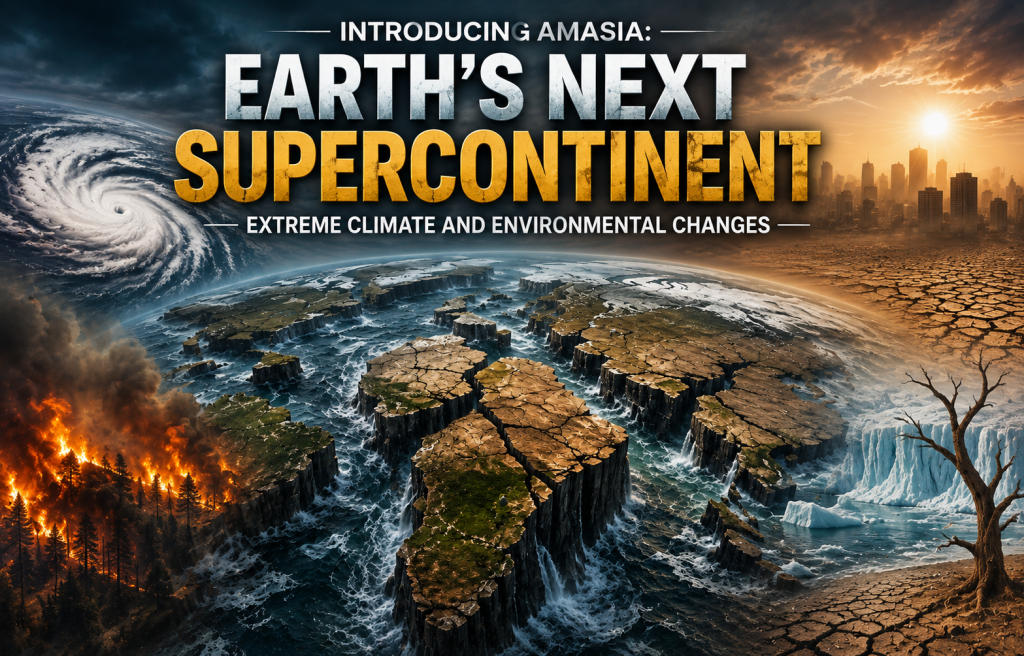
Extreme Climate and Environmental Changes
When a supercontinent forms, the climate changes dramatically. Currently, the Earth’s climate is heavily regulated by ocean currents that circulate warm and cold water around the globe. A single, massive landmass disrupts these currents.
Here is what scientists predict the climate of Amasia will look like:
- Hyper-Arid Interior: Because the center of the supercontinent will be thousands of miles away from any ocean, rain-bearing clouds will not be able to reach the interior. This will create massive, barren deserts comparable to, or even larger than, the Sahara.
- Extreme Temperatures: Without the regulating effect of the ocean, the interior of Amasia will experience extreme temperature swings—scorching hot during the day and freezing cold at night.
- Lower Sea Levels: Geological models suggest that the formation of Amasia will lead to a cooling of the Earth’s mantle, which could lower global sea levels significantly.
The Fate of the World’s Oceans
When the continents merge, the Pacific Ocean will cease to exist. In its place, the expanded Atlantic and Indian Oceans will merge into a single, massive global superocean. This will fundamentally change marine ecosystems, ocean currents, and global weather patterns.
Comparing Past and Future Supercontinents
Earth’s history is written in its rocks, and by looking at the past, we can accurately predict the future.
Lessons from Pangea and Rodinia
Earth has hosted several supercontinents in its deep past. Here is a quick comparison of the major historical landmasses compared to the projected future:
| Supercontinent Name | Time Period | Key Characteristics |
| Rodinia | 1 Billion Years Ago | Formed mostly bare rock; life existed primarily as single-celled organisms in the oceans. |
| Pangea | 335 to 175 Million Years Ago | The most famous supercontinent; allowed dinosaurs to roam freely across connected landmasses. Surrounded by the Panthalassa ocean. |
| Amasia (Future) | 200 to 300 Million Years in the Future | Will likely form around the North Pole. Expected to have an extremely dry interior with harsh temperature extremes. |
Studying the rock formations left behind by Pangea helps scientists accurately model how the continents will deform and crumple when they meet again to form Amasia.
How Will This Affect India?
For our readers at JivanJarurat.com, you might be wondering about the fate of the Indian subcontinent. India has a fascinating geological history. Millions of years ago, the Indian plate broke off from Madagascar and sprinted northward at a rapid geological pace, eventually slamming into the Eurasian plate. This massive collision pushed the earth upward, creating the majestic Himalayan mountain range.
The Future of the Indian Tectonic Plate
In the Amasia projection, the Indian plate is already firmly attached to the Eurasian plate. As Australia moves northward and the Americas move westward, the entire Eurasian block (including India) will become the central anchor of the new supercontinent. The Himalayas will likely continue to rise for millions of years before eventually eroding, while new massive mountain ranges will form wherever the new continents collide with Asia.
Will Humanity Survive the Formation of Amasia?
This is a profound question. Will human beings be around to witness the final stages of the 4 continents collapsing news?
Impact on Evolution and Biology
Given that modern humans (Homo sapiens) have only existed for about 300,000 years, surviving another 200 million years is highly unlikely without radical evolutionary changes or space colonization.
If mammals do survive, the formation of a supercontinent will force a massive evolutionary bottleneck. When landmasses connect, animal species that were previously isolated will suddenly be thrown into competition with one another. Predators will have access to new prey, and invasive species will spread across the single landmass. Historically, the formation of supercontinents has been associated with mass extinction events, followed by periods of intense evolutionary innovation.