
Introduction: The Ultimate Leap for Mankind
For centuries, humanity has obsessed over the concept of immortality. From ancient myths of the Fountain of Youth to modern medical breakthroughs aiming to extend our physical lifespans, the desire to cheat death is deeply embedded in our DNA. But what if the secret to eternal life does not lie in preserving our fragile biological bodies, but rather in abandoning them entirely? Today, the concept of mind uploading explained is moving from the fringes of science fiction into the realm of theoretical neuroscience and computer science. The ultimate question facing researchers and philosophers alike is: can humans become digital in the future?
Popular media, such as the television series Black Mirror or the blockbuster film The Matrix, have long explored the idea of human minds living inside simulated realities. However, rapid advancements in artificial intelligence, neural mapping, and spatial computing are forcing us to take this concept seriously. If we can map the human brain perfectly and recreate it in a digital environment, we could theoretically achieve a state where our consciousness lives on long after our physical bodies decay.
In this comprehensive guide, we will break down the science behind this futuristic concept, explore the ethical dilemmas it presents, and analyze the steps we are currently taking to bridge the gap between biological brains and digital machines. If you are fascinated by how futuristic themes influence movies and pop culture, you can also read our trending updates on Jivan Jarurat Entertainment. For now, let us plug in and explore the mind-bending reality of digital consciousness.
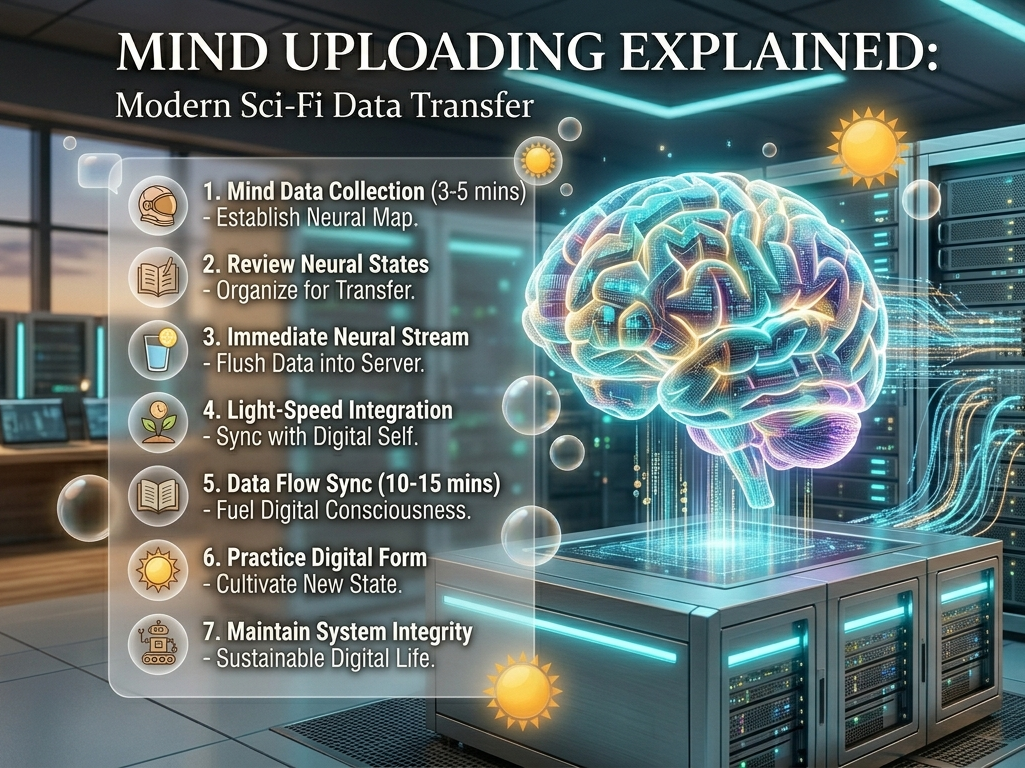
ALT Text: Digital brain glowing to show mind uploading explained in modern sci-fi technology
1. What Is Mind Uploading? Understanding Human Consciousness Transfer
To get a clear picture of the future, we must begin with mind uploading explained at its most fundamental level. In the scientific community, mind uploading is formally known as Whole Brain Emulation (WBE). The premise is that the human mind—comprising your memories, personality, emotions, and consciousness—is essentially an incredibly complex system of information processing.
In computer science, software can run on any hardware that is powerful enough to support it. Whether you play a video game on a PlayStation, an Xbox, or a PC, the core code of the game remains the same; only the physical hardware changes. Proponents of human consciousness transfer argue that the brain is essentially biological hardware, and the “mind” is the software. Therefore, if we can perfectly copy the software (your consciousness) and transfer it to a synthetic computer (the new hardware), you would continue to exist digitally.
This theory relies heavily on the philosophy of “computational theory of mind,” which suggests that human consciousness is not some magical, mystical soul, but rather the result of billions of neurons firing in specific patterns. If a supercomputer can perfectly mimic those exact neurological patterns, it should, in theory, generate the exact same conscious experience.
2. How Does Mind Uploading Work Technically?
The jump from a biological brain to a digital server is incredibly complex. If you are wondering, how does mind uploading work technically, scientists have proposed a step-by-step roadmap that involves mapping, scanning, and simulating the brain.
Step 1: Mapping the Connectome
The human brain contains roughly 86 billion neurons, and each neuron can have up to 10,000 synaptic connections to other neurons. This massive, intricate web of connections is called the “connectome.” To upload a mind, scientists must first map this entire network with atomic precision. Currently, researchers have only successfully mapped the complete connectome of a tiny roundworm called C. elegans, which has exactly 302 neurons. After mapping it, they uploaded its neural network into a digital robot, and the robot began behaving exactly like the biological worm—without any pre-programmed code!
Step 2: Scanning the Brain
To map a human connectome, we would need scanning technology far beyond today’s MRI machines. Future techniques might involve destructive scanning (where a deceased biological brain is sliced into microscopic layers and scanned with electron microscopes) or non-destructive scanning (using advanced nanobots that swim through the bloodstream and map the brain’s electrical activity in real-time).
Step 3: Emulation and Simulation
Once the brain is perfectly mapped into a massive digital file, that file must be run on a supercomputer capable of mimicking the exact chemical and electrical interactions of the original neurons. According to research from the high-authority Allen Institute for Brain Science, the sheer volume of data required to store a single human brain’s connectome would be in the range of zettabytes—a level of data storage and processing power that humanity has not yet achieved, but is rapidly approaching with the advent of quantum computing.
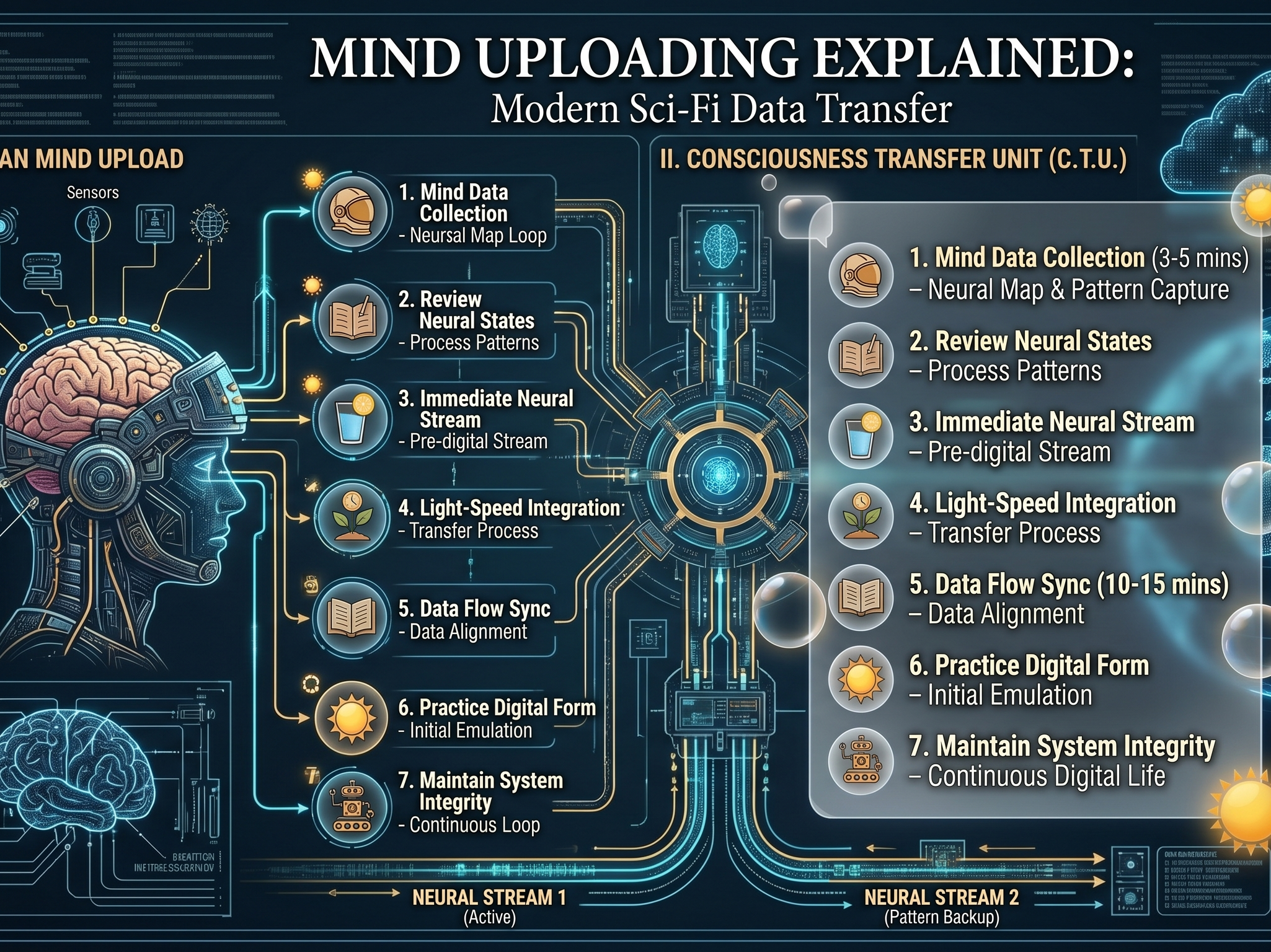
ALT Text: Diagram showing how does mind uploading work technically with human consciousness transfer
3. Brain Computer Interface Technology: The First Step
While true mind uploading might be decades or centuries away, the foundational technology is being built right now. Brain computer interface technology (BCI) is the crucial bridge that will eventually connect our biological minds to the digital realm.
Companies like Neuralink, Synchron, and Blackrock Neurotech are pioneering implantable microchips that can read and interpret the electrical signals generated by the brain. Currently, these BCIs are primarily used for medical purposes. For example, paralyzed patients who cannot move their limbs can use a BCI to control a computer mouse, type messages, or maneuver a robotic arm simply by thinking about the action.
These early BCI devices operate by detecting the brain’s motor cortex signals and translating them into binary computer code. However, future iterations of brain computer interface technology aim to be bidirectional. This means they will not only read information from the brain but also write information back into the brain. Imagine being able to instantly download a new language directly into your memory, or instantly access the internet using only your thoughts. As BCIs become more advanced, the boundary between human biology and digital computing will become increasingly blurred, paving the way for eventual full-scale uploads.
To stay updated on the latest technological breakthroughs that are shaping our future health and lifestyle, be sure to visit our Jivan Jarurat News section regularly.
4. The Digital Immortality Concept: Living Forever in the Cloud
If we successfully master Whole Brain Emulation, humanity will unlock the digital immortality concept. But what would a digitally immortal life actually look like?
Once your consciousness is uploaded to a server, you would not be trapped in a dark, empty void. Digital minds would likely inhabit vast, hyper-realistic simulated environments—much like the Metaverse, but indistinguishable from physical reality. In this digital utopia, the laws of physics would be completely optional. You could fly, travel to simulated alien galaxies, instantly learn new skills, and interact with the digital avatars of your friends and family.
Furthermore, your digital mind would not be restricted to the virtual world. A digital consciousness could easily download itself into a synthetic, robotic body to interact with the physical Earth. If that robotic body gets destroyed in an accident, it wouldn’t matter; your mind is safely backed up in the cloud. You could simply download yourself into a brand-new mechanical body the next day.
This digital immortality concept completely eradicates the fear of biological death, disease, and aging. It represents a paradigm shift so massive that it would redefine the very meaning of human existence. To read more about preserving your biological health while we wait for this technology, check out our longevity guides on Jivan Jarurat Health Tips.
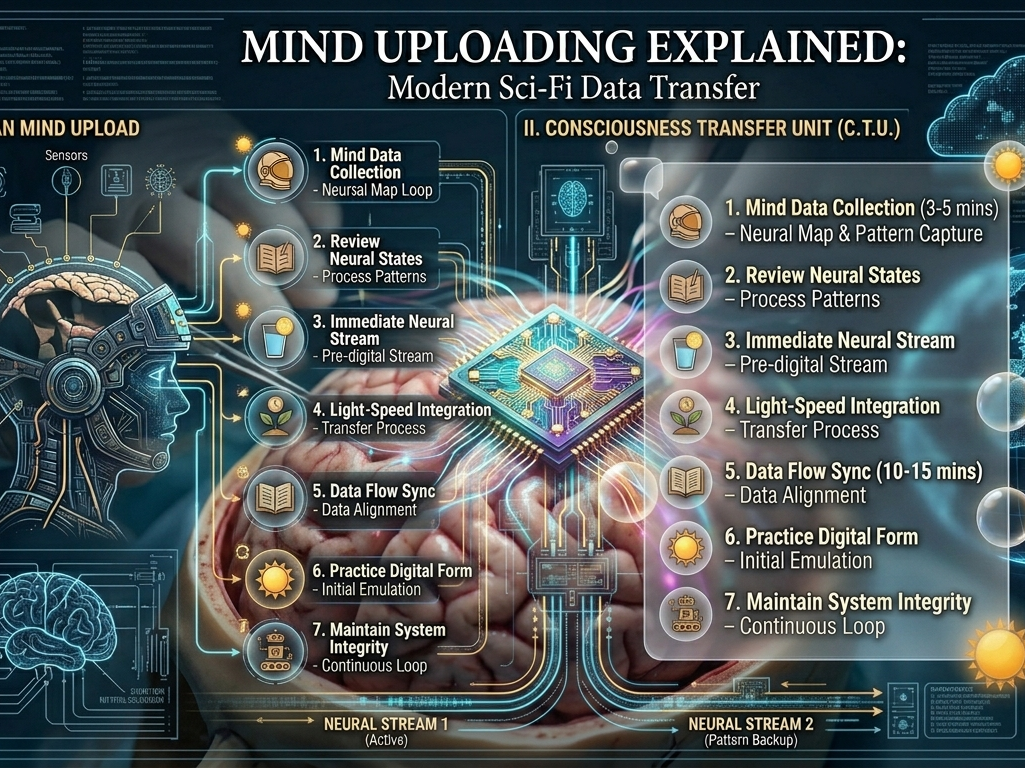
ALT Text: Brain computer interface technology linking human mind to a digital immortality concept
5. The Copy Problem: Is It Really You?
Before we enthusiastically sign up to upload our brains, we must confront the darkest philosophical dilemma of this technology: the Copy Problem.
If we scan your biological brain, map it, and turn it into software, the digital entity that wakes up inside the computer will have all your memories. It will act like you, talk like you, and genuinely believe that it is you. But what happens to the original biological you?
If the scanning process is non-destructive, the biological you is still sitting in the laboratory chair, looking at the computer screen. This means the digital mind is not a transfer of consciousness; it is merely a perfect digital clone. The original you will still age, get sick, and eventually die, while your digital twin lives on forever in the cloud.
This brings up the ancient “Ship of Theseus” paradox. If you replace every plank of wood on a ship over time, is it still the same ship? To truly achieve human consciousness transfer rather than just creating a clone, some scientists propose a gradual replacement method. Over several years, tiny nanobots could slowly replace your biological neurons one by one with synthetic, digital neurons. Because the process is gradual, your stream of consciousness remains unbroken. By the end of the process, your entire brain would be digital, successfully avoiding the terrifying prospect of dying while a clone takes your place.
6. Ethical Implications of Digital Consciousness
The technological hurdles are massive, but the ethical implications of digital consciousness are arguably even more complex. If humans become digital software, we open Pandora’s Box to entirely new forms of crime, suffering, and inequality.
Data Ownership and Digital Slavery
If your mind is essentially a massive file of data, who owns that file? If a massive tech corporation owns the servers where your mind resides, can they force you to watch advertisements inside your virtual reality? Can they charge you a monthly subscription fee to stay alive, threatening to hit the “delete” button if you miss a payment? The concept of digital slavery is a horrifying possibility, where uploaded minds could be forced to perform complex computational labor for eternity.
Hacking and Mind Alteration
Software can be hacked. If your mind is software, malicious hackers could theoretically infiltrate your consciousness. They could alter your memories, implant false thoughts, or subject you to virtual torture. Cybersecurity would no longer just be about protecting your credit card information; it would be about protecting your very soul.
The Definition of Murder
If a person’s biological body dies, but they have a backup of their mind on a hard drive, are they legally dead? If someone unplugs the server housing a digital consciousness, is that considered murder? Society, the legal system, and world religions will have to completely rewrite their rules to accommodate the ethical implications of digital consciousness.
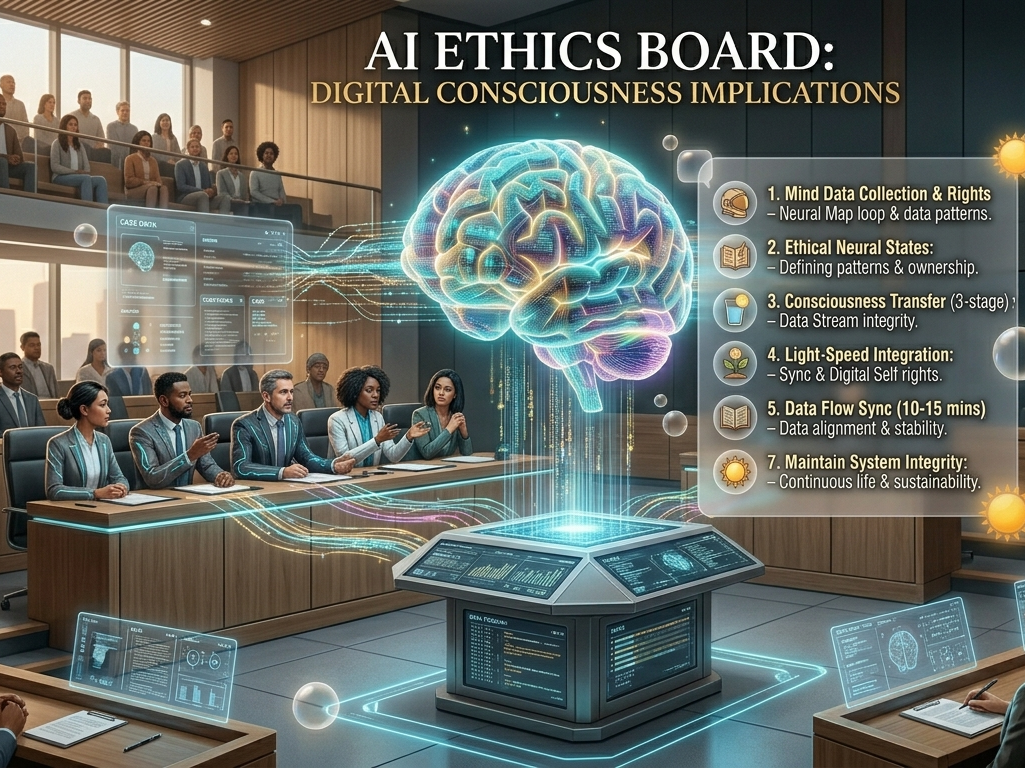
ALT Text: AI ethics board discussing the ethical implications of digital consciousness in society
7. The Future of Human Evolution: When Will It Happen?
With all this incredible promise and terrifying risk, when can we expect this to become a reality? Exploring the future of human evolution, most neuroscientists and futurists agree that we are still in the absolute infancy of this technology.
Futurist Ray Kurzweil, a prominent voice in the push for the technological singularity, aggressively predicts that we might see the first successful mind uploads by the year 2045. However, many mainstream neuroscientists view this timeline as overly optimistic. The brain is not just a hard drive of electrical signals; it is a chaotic, fluid soup of hormones, peptides, and chemical reactions that are deeply tied to the rest of the biological body. Replicating the exact feeling of an adrenaline rush or the warmth of a hug in lines of computer code may prove to be fundamentally impossible with our current understanding of physics and computing.
A more conservative estimate places true, full-scale mind uploading somewhere in the 22nd or 23rd century. Regardless of the exact timeline, the trajectory is clear. Humanity is rapidly merging with its technology. We already use smartphones as external hard drives for our memories and search engines as extensions of our knowledge. The jump from holding a computer in our hands to housing a computer in our heads is simply the next logical step in the future of human evolution.
Conclusion: Preparing for a Post-Biological World
The concept of having mind uploading explained forces us to look deeply in the mirror and ask ourselves what it truly means to be human. Is our humanity defined by our fragile bones, beating hearts, and finite lifespans? Or is it defined by the patterns of information inside our minds—our capacity to love, learn, create, and remember?
While asking can humans become digital in the future sounds like the plot of a sci-fi blockbuster, it represents the most ambitious scientific endeavor in human history. Whether we achieve it in fifty years or five hundred years, the pursuit of digital immortality will yield incredible breakthroughs in medicine, artificial intelligence, and computing that will benefit our physical lives today.
As we inch closer to a post-biological world, we must ensure that our ethical frameworks evolve just as rapidly as our microchips. We must guarantee that if we do transcend our biology, we bring the best parts of our humanity with us into the digital light. To keep exploring the fascinating boundaries of human potential, lifestyle, and technology, continue reading the extensive library of resources on Jivan Jarurat. The future is approaching faster than we think—it is time to get ready.