
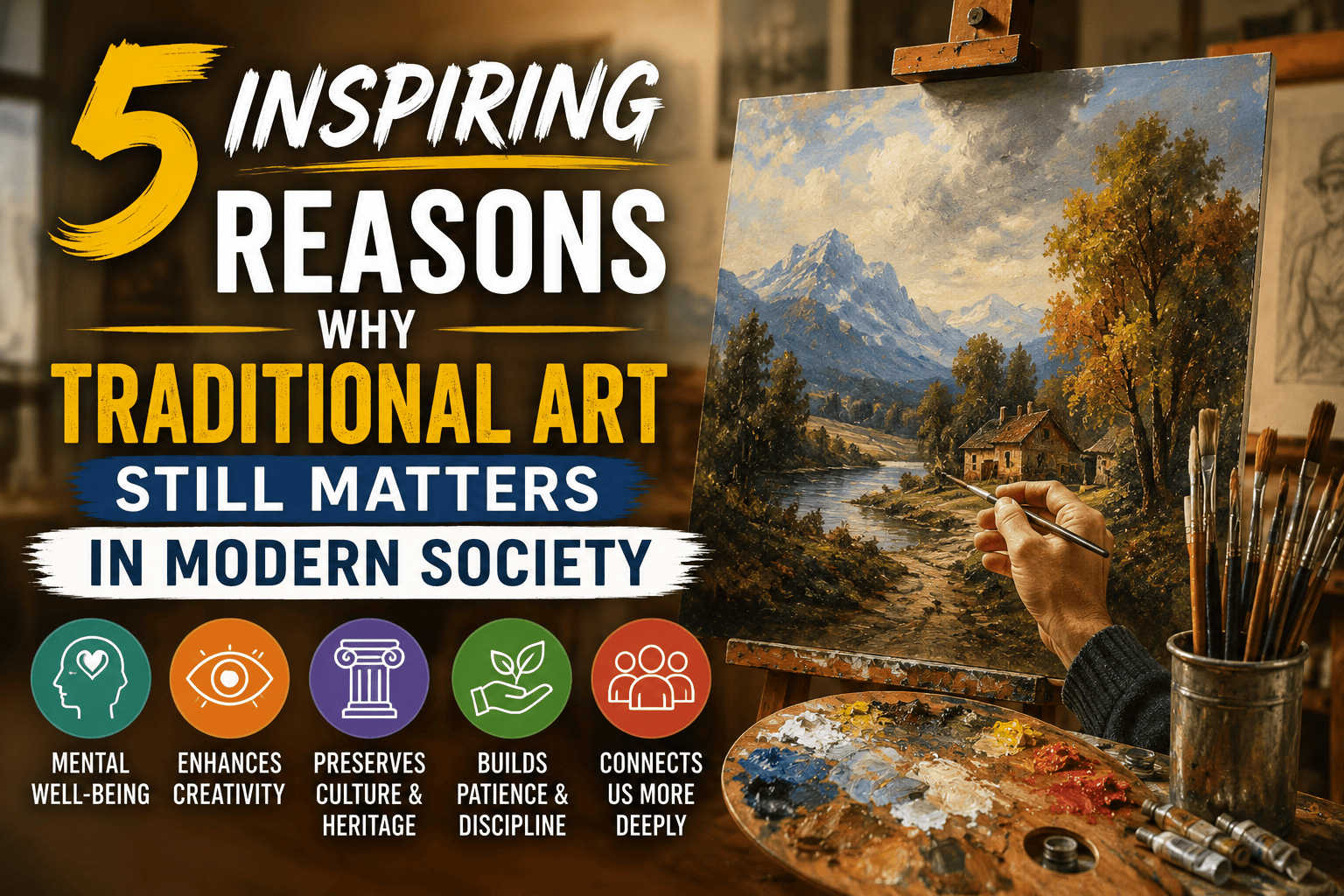
Importance of Traditional Art
We are currently living in an era dominated by screens, pixels, and artificial intelligence. With the rapid rise of digital painting software and AI image generators that can produce masterpieces in mere seconds, many people have begun to ask a very valid question: does physical, tangible art still have a place in our world? The short answer is a resounding yes. Understanding why traditional art still matters in modern society requires us to look beyond mere aesthetics and delve deeply into human psychology, history, and the profound need for authentic, physical connection.
Traditional art—whether it involves sweeping oil paint across a woven canvas, sculpting raw clay with bare hands, or meticulously sketching with charcoal—offers something that a computer screen simply cannot replicate. It represents a raw, unfiltered translation of human emotion into a physical medium. In a fast-paced, hyper-digital social media landscape, the slower, deliberate pace of physical creation grounds us.
In this comprehensive guide, we are going to explore the undeniable importance of traditional art, why it is critical for our mental well-being, and how it continues to shape the contemporary world. If you are passionate about exploring how culture and history intersect with modern entertainment, you can also read our engaging updates on Jivan Jarurat Entertainment. For now, let’s grab our paintbrushes, step away from the glowing screens, and explore the enduring magic of the physical art world.
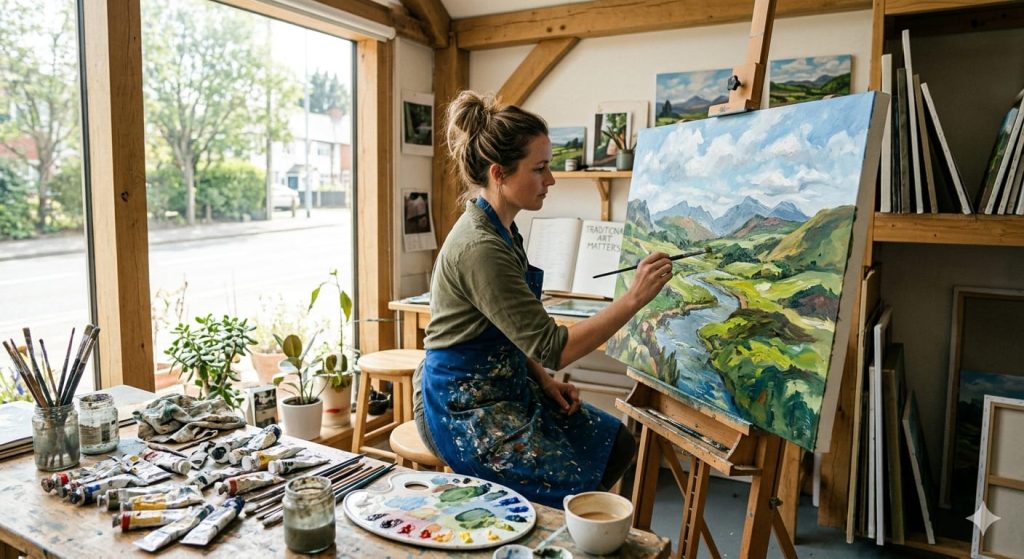
ALT Text: Artist painting on canvas showing why traditional art still matters in modern society
Physical Art Vs Digital Art Debate
1. The Tangible Connection: The Physical Art vs Digital Art Debate
To truly grasp why traditional art holds such immense value today, we have to examine the ongoing physical art vs digital art debate. Digital art is incredibly efficient; it allows for infinite “undo” buttons, layers, and instant sharing across the globe. However, this convenience often comes at the cost of tangibility.
When you stand in front of a traditional painting, you are experiencing a unique, physical object occupying the same three-dimensional space as you are. You can see the varied textures of the brushstrokes, the slight cracking of the dried pigment, and the layered depth of the varnished surface. Traditional art engages our senses in a multi-dimensional way. The distinct, earthy smell of linseed oil, the rough texture of cold-pressed watercolor paper, and the messy, chaotic reality of mixing real pigments on a wooden palette create an irreplaceable sensory experience.
There is an inherent vulnerability in traditional art. Because there is no “Ctrl+Z” (undo) function, every stroke of the brush carries weight, commitment, and consequence. Mistakes are not easily erased; they must be incorporated, painted over, or accepted as part of the artwork’s unique journey. This permanence is precisely what gives the value of physical art forms their weight and emotional resonance in an increasingly disposable digital world.
2. Preserving Human History and Cultural Heritage
Since the dawn of humanity, art has been our primary method of record-keeping. Long before the invention of written language, our ancestors were leaving their handprints and hunting stories on the walls of caves in Lascaux and Altamira. Throughout the centuries, traditional art has served as a visual timeline of human evolution, societal shifts, and cultural revolutions.
Today, high-authority cultural institutions like The Metropolitan Museum of Art (The Met) dedicate immense resources to preserving these physical artifacts. When we look at a Renaissance oil painting or an ancient Greek marble sculpture, we are looking at a direct, physical link to the past. The artist’s actual hand touched that canvas; their sweat and energy went into chiseling that stone.
This brings us to a crucial point about how traditional art impacts modern culture: it provides us with an anchor. In a society that is constantly looking toward the future, traditional art reminds us of where we came from. It preserves the cultural identities, struggles, and triumphs of marginalized communities, historical epochs, and bygone eras. Without the continued practice and appreciation of traditional arts, we risk severing the vital umbilical cord that connects us to our shared human ancestry.
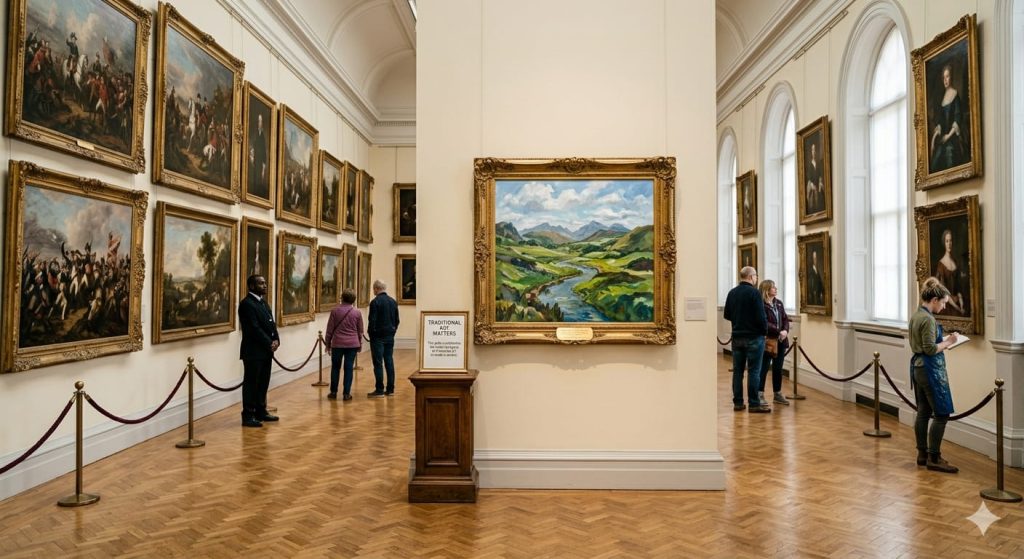
ALT Text: Historic oil paintings in a museum highlighting the importance of traditional art
3. The Flawed Beauty of the Human Touch
In recent years, the explosion of Artificial Intelligence (AI) art generators has sparked massive debates regarding the future of human creativity. Algorithms can now generate photorealistic images, mimic the exact style of Vincent van Gogh, and design complex fantasy landscapes in the blink of an eye. With computers doing the heavy lifting, why traditional art still matters in modern society has become a deeply philosophical question.
The answer lies in imperfection. AI generates images based on mathematical perfection and aggregated data. It lacks a soul, lived experiences, and human emotion. Traditional art, on the other hand, is inherently flawed, and those flaws are precisely where the beauty resides.
Consider a hand-thrown ceramic bowl. It might not be perfectly symmetrical; there may be a slight wobble in the rim or an uneven pooling of the glaze. Those “imperfections” are the fingerprints of the creator. They tell the story of the artist’s mood on that specific day, the fatigue in their hands, or a sudden burst of spontaneous inspiration. The human touch breathes life into an inanimate object. We are drawn to traditional art because we subconsciously recognize and connect with the human struggle and passion embedded within it.
4. Mental Health Benefits of Practicing Traditional Art Today
Aside from its historical and cultural significance, one of the most compelling benefits of practicing traditional art today is its profound impact on mental health. We are currently facing a global epidemic of anxiety, depression, and digital burnout. Staring at screens for 10 to 12 hours a day exhausts our nervous systems and fragments our attention spans.
Engaging in traditional art serves as a powerful form of mindfulness and active meditation. When you are focused on blending the perfect shade of green or carefully shading the contours of a charcoal portrait, your mind cannot simultaneously dwell on stressful emails or social media drama. You are forced to be entirely present in the moment.
Art therapy is a widely recognized psychological treatment. The physical act of creation lowers cortisol (the stress hormone) levels and triggers the release of dopamine. Working with your hands creates a state of “flow,” where time seems to stand still. For more actionable advice on maintaining a healthy mind and body in our hectic modern world, you can explore our comprehensive guides on Jivan Jarurat Health Tips.
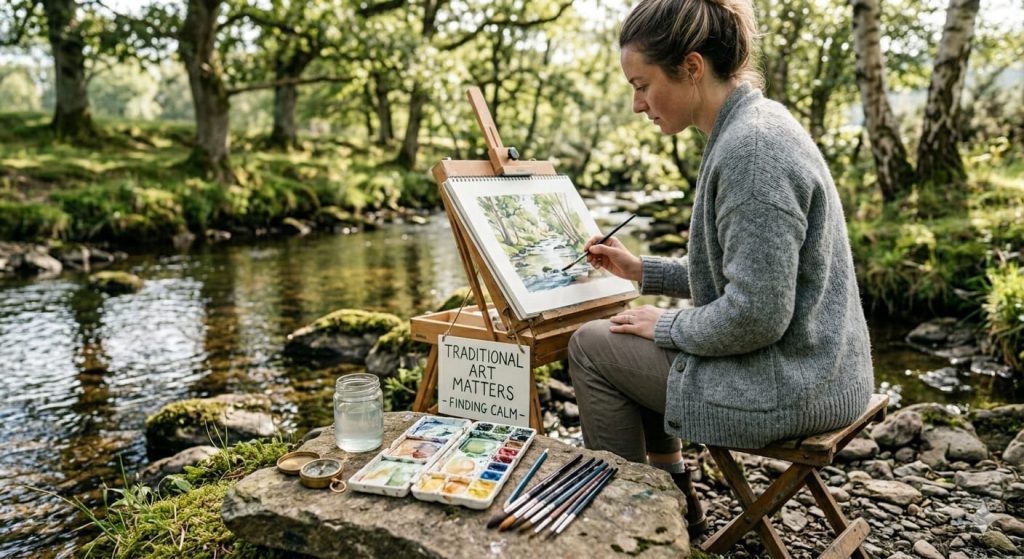
ALT Text: Person using traditional art techniques to improve focus and reduce daily stress
5. Traditional Art Techniques: The Foundation of Digital Design
There is a common misconception that traditional art and digital art are mortal enemies. In reality, they are two sides of the same coin, and the latter relies heavily on the former. If you want to be a successful digital illustrator, graphic designer, or 3D animator, you must first understand traditional art techniques.
The software is merely a tool, much like a brush or a pencil. However, software cannot teach you the fundamental principles of art. To create a compelling digital painting, an artist must possess a deep understanding of color theory, spatial perspective, human anatomy, lighting, and composition. These foundational skills have been developed, refined, and taught through traditional art mediums for centuries.
Even top-tier animation studios like Disney and Studio Ghibli begin their cutting-edge digital films with traditional, hand-drawn sketches and clay maquettes. Learning to draw on physical paper forces an artist to develop strong hand-eye coordination and spatial awareness without relying on digital shortcuts. Therefore, traditional art acts as the essential bedrock upon which all modern visual media is built.
6. The Economic and Collectible Value of Physical Art Forms
From an economic and investment standpoint, the physical nature of traditional art grants it a unique status. While digital art has seen the rise (and subsequent volatility) of NFTs (Non-Fungible Tokens) in an attempt to create digital scarcity, the traditional art market has remained robust, tangible, and prestigious for centuries.
Original, physical artworks are one-of-a-kind. When a collector purchases an original oil painting or a bronze sculpture, they are acquiring an exclusive piece of history that no one else in the world possesses in that exact physical form. Prints and digital copies can be made, but there is only one original canvas bearing the artist’s actual brushstrokes.
This undeniable value of physical art forms fuels a massive global economy of art galleries, auction houses, framing businesses, and art supply manufacturers. The joy of curating a physical art collection, displaying it in your home, and passing it down as a family heirloom is an deeply enriching experience that digital files stored on a hard drive simply cannot match. It connects the collector, the artist, and the viewer in a shared physical space.
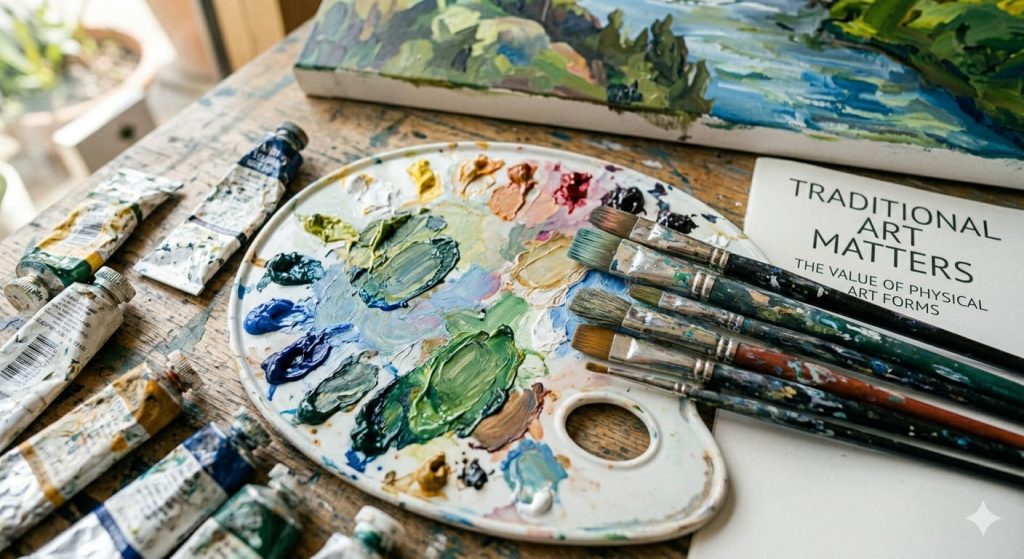
ALT Text: Close up of messy paint palette emphasizing the value of physical art forms
7. Slowing Down in a Fast-Paced World
Modern society is obsessed with speed, efficiency, and instant gratification. We want our food delivered in twenty minutes, our movies streamed instantly, and our packages shipped overnight. Art, however, demands patience. This contrast is another core reason why traditional art still matters in modern society.
Traditional art is an act of rebellion against the culture of instant gratification. An oil painting cannot be rushed. You must wait for layers of paint to dry—sometimes for weeks—before you can apply glazes. A marble sculpture requires hundreds of hours of painstakingly slow, repetitive chipping. A complex watercolor requires careful planning, as the water takes on a life of its own, demanding that the artist slow down and observe.
By practicing or even simply observing traditional art, we are forced to decelerate. We learn the value of delayed gratification, perseverance, and dedication to a long-term goal. In a world that constantly demands us to hurry up, traditional art gently reminds us to slow down, breathe, and appreciate the journey of creation rather than just the final product.
8. How to Integrate Traditional Art into Your Modern Life
You do not need to be the next Leonardo da Vinci to reap the incredible benefits of practicing traditional art today. Integrating traditional art into your modern life can be surprisingly simple and profoundly rewarding. Here are a few ways to get started:
- Start a Sketchbook Habit: Carry a small, physical sketchbook and a pencil with you. Instead of scrolling through your phone while riding the train or waiting at a café, take ten minutes to sketch your surroundings. It doesn’t have to be perfect; the goal is simply to observe and create.
- Visit Local Galleries and Museums: Make it a habit to view art in person. Standing in front of a massive canvas changes your perspective. Support local artists by attending gallery openings and purchasing physical art for your home.
- Take a Hands-On Class: Enroll in a local pottery, watercolor, or life-drawing class. The tactile experience of getting your hands dirty with clay or charcoal is incredibly therapeutic.
- Create a Creative Space: Dedicate a small corner of your home specifically for traditional art. Keep it free from screens and digital distractions. Let it be a sanctuary where you can explore your creativity using tangible tools.
To stay updated on the latest lifestyle tips, creative ideas, and cultural news, be sure to bookmark our dedicated Jivan Jarurat News section.
Conclusion: A Canvas for the Future
As we navigate an increasingly virtual world, we need to ask ourselves if we can preserve our traditional art? The need for physical grounding becomes ever more critical. We have explored the depths of why traditional art still matters in modern society, discovering that its importance goes far beyond pretty pictures. Traditional art is a vital historical record, a pillar of mental wellness, the foundational language of modern design, and a celebration of human imperfection.
While technology will continue to advance, introducing new and exciting mediums for expression, it will never render the physical canvas obsolete. The smell of oil paint, the texture of clay, and the scratching sound of charcoal on paper speak to a primal part of our humanity. They remind us that we are tactile beings, driven by a deep-seated need to leave a physical mark on the world around us.
The importance of traditional art is firmly rooted in its ability to connect us to our past, anchor us in the present, and inspire our future. So, the next time you feel overwhelmed by the glowing screens and the digital noise of modern life, pick up a pencil. Draw a line on a blank piece of paper. In that simple, physical act of creation, you will find the enduring, irreplaceable heartbeat of human art.