

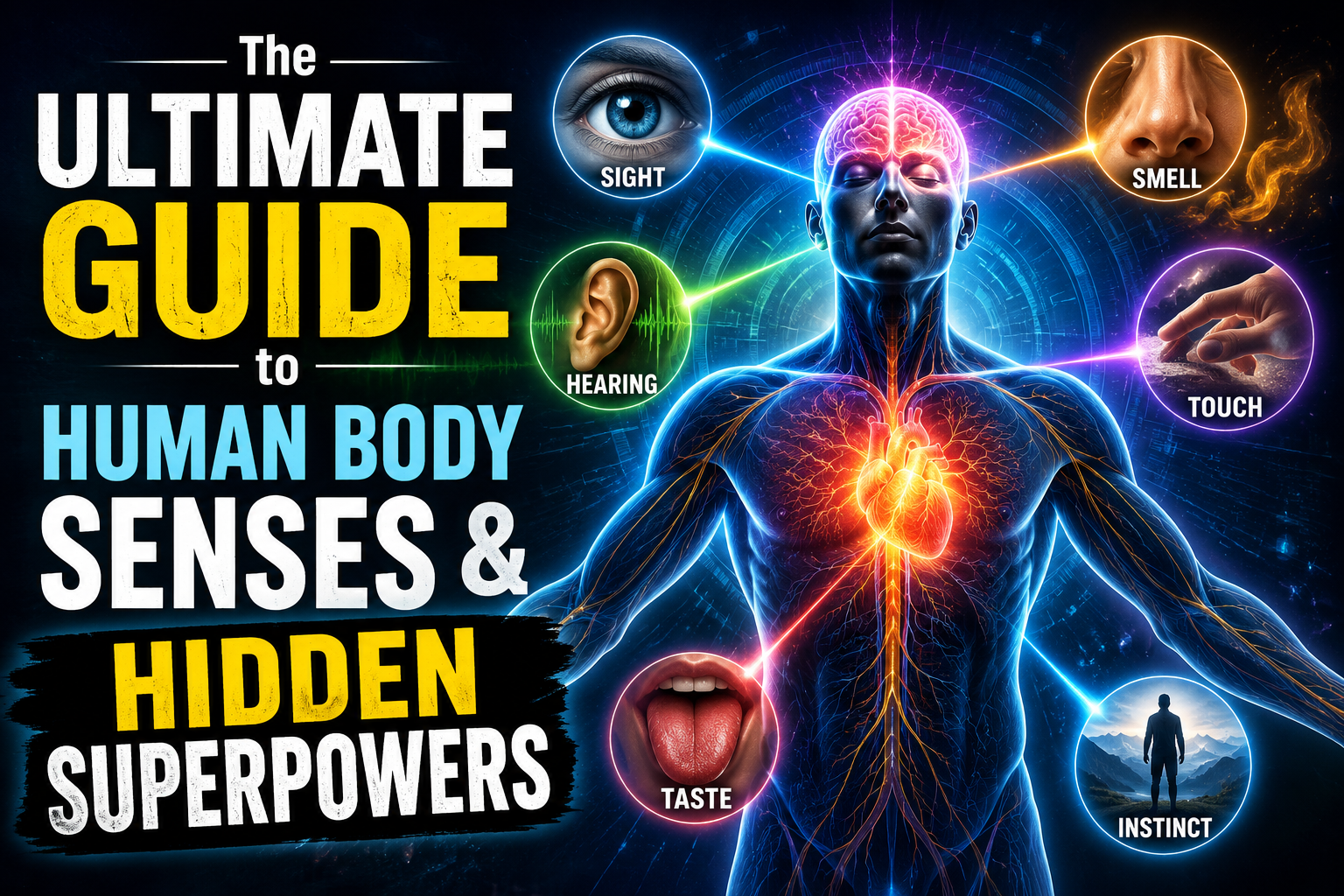
When we think about our daily experience in this world, we almost immediately credit the famous five senses taught to us in grade school: sight, hearing, smell, taste, and touch. However, modern medical science and neuroscience have revealed that this traditional model is vastly oversimplified. In reality, your human body senses are a highly sophisticated, interconnected network of biological receptors, firing neurons, and intricate pathways that give you superpowers you likely take for granted.
Neurologists now argue that the actual number of human body senses ranges anywhere from 21 to 33 distinct sensory systems! Your body is constantly absorbing, filtering, and translating millions of data points every single second.
In this comprehensive, deep-dive guide, we will explore the extraordinary and hidden human body senses, look at unique facts about human anatomy, and provide actionable tips on how to preserve and enhance your sensory health. By the end of this article, you will view your body not just as a physical vessel, but as a masterpiece of biological engineering.
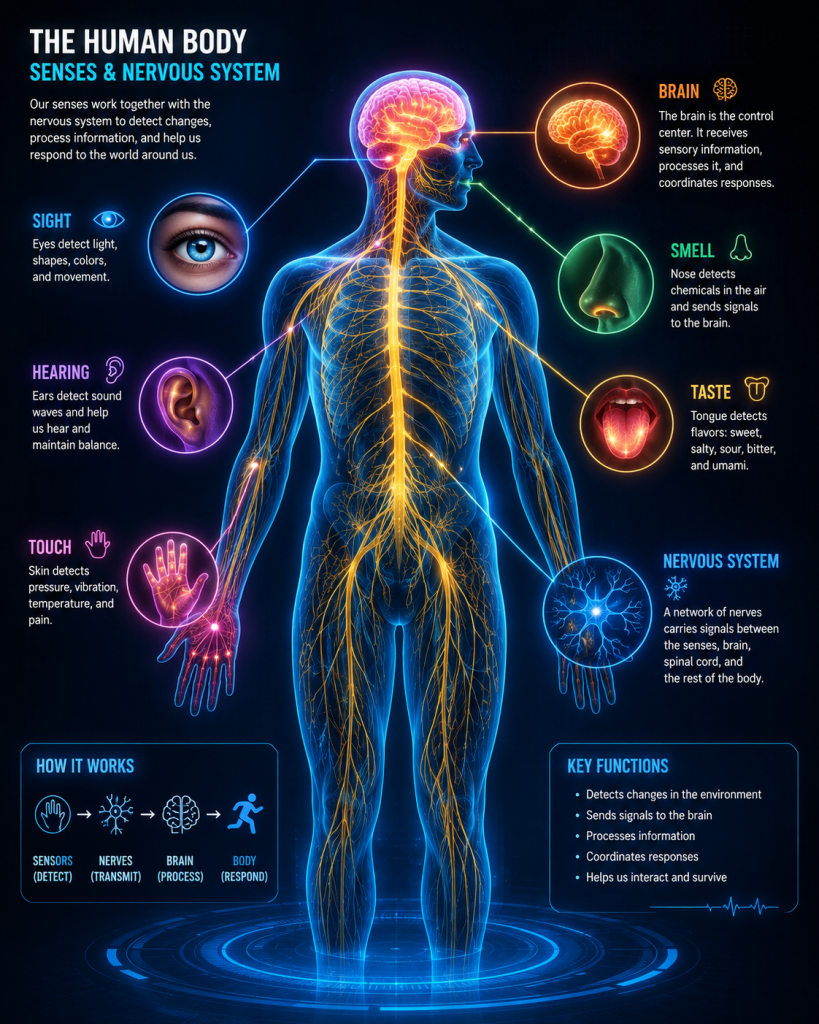
Image ALT Text: Diagram of amazing human body senses showing brain and sensory organs
1. The Myth of the Five Senses: Discovering Your Hidden Human Body Senses
Aristotle first classified the five basic senses over 2,000 years ago, and the idea stuck in our cultural consciousness. But to truly understand your human body senses, we must look beyond the eyes, ears, nose, tongue, and skin. Let’s explore some of the fascinating hidden human body senses that keep you alive, balanced, and functioning every single day.
Proprioception: Your Body’s Internal GPS
Close your eyes and touch your nose with your index finger. How did you accomplish that without seeing your hand moving through the air? The answer is proprioception. This is one of the most critical human body senses, giving your brain an internal map of your body’s position, motion, and equilibrium in space. Receptors located in your muscles, tendons, and joints constantly send electrical signals to your brain. This sense allows you to walk up the stairs without looking at your feet, type on a keyboard without staring at the keys, and perform complex athletic movements seamlessly.
Vestibular Sense: The Balance Master
Located deep inside your inner ear is a complex maze of fluid-filled canals known as the vestibular system. This is the center of your balance and one of the most vital human body senses. As you move your head, the fluid inside these microscopic canals sloshes around, bending tiny hairs that send electrical signals to your brain about your head’s rotation, acceleration, and gravitational orientation. Without the vestibular sense, you wouldn’t be able to stand upright, and you would constantly suffer from severe vertigo.
Interoception: The Inner Voice of Your Organs
Interoception is your brain’s perception of the internal state of your body. It is the sensory network that tells you when you are hungry, thirsty, or need to use the restroom. Furthermore, it plays a massive role in your mental health. When you feel “butterflies in your stomach” before a big presentation, or a tightness in your chest when anxious, that is your interoceptive system communicating emotional states through physical sensations.
Thermoception: The Temperature Detectors
While often lumped in with “touch,” sensing temperature (thermoception) is an entirely distinct sensory system. Thermoception relies on specific receptors in the skin that only fire when they detect a sudden drop or rise in temperature. Interestingly, we have more cold receptors than heat receptors, which is an evolutionary trait designed to prevent us from freezing to death in harsh environments.
Nociception: The Pain Alarm System
Nociception is your body’s dedicated alarm system for pain and physical damage. It detects cellular damage caused by extreme heat, toxic chemicals, or mechanical crushing. Interestingly, pain is entirely constructed by the brain. If you stub your toe, the toe itself doesn’t “hurt.” Instead, the nerves in the toe send a rapid danger signal to the brain, and the brain creates the sensation of pain to force you to protect the injured area.
Chronoception: The Sense of Time
Did you know that you have a biological sense of time passing? Chronoception refers to how the passage of time is perceived and experienced. While we don’t have a specific “time organ” like we have eyes for vision, our brain uses a combination of the cerebral cortex, cerebellum, and basal ganglia to track time. This is one of the most mysterious human body senses, explaining why “time flies when you’re having fun” and drags on when you are bored.
(Want to learn more about keeping your body functioning at its peak? You can also read our guide on healthy lifestyle habits on Jivan Jarurat by visiting our Health Tips section.)
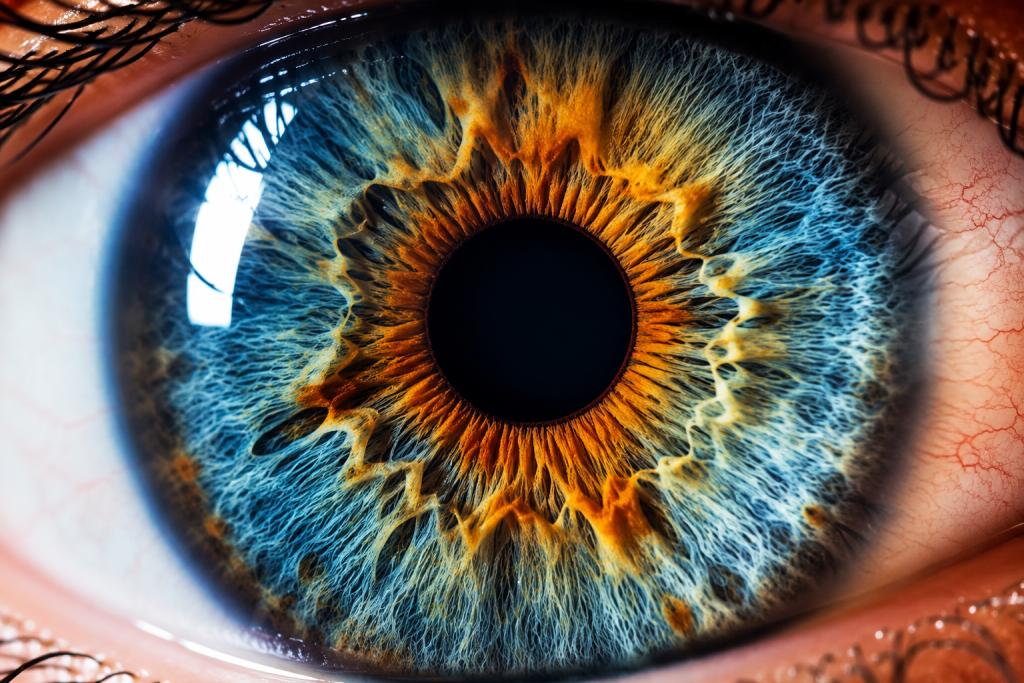
Image ALT Text: Close up of human eye highlighting healthy human body senses and vision facts
2. Vision: The Quantum Catchers of the Human Body
Our eyes are perhaps the most celebrated of all the human body senses, but their true biological capabilities are nothing short of mind-blowing. Your eyes don’t just passively “see” the world; they actively construct a visual reality for you to interact with.
Seeing Single Photons in the Dark
The human eye is so incredibly sensitive that, under perfect conditions in total darkness, it can detect a single photon of light. A photon is the smallest measurable quantum unit of light in the universe. To put the power of these human body senses into perspective: if the Earth were completely flat and totally dark, a human being could clearly see a candle flickering up to 30 miles (48 kilometers) away!
The Illusion of Reality and the Blind Spot
Because of the curved shape of the cornea and lens, light bends as it enters the eye, projecting an inverted (upside-down) image onto the back of the retina. Your brain seamlessly flips the image right-side up so incredibly fast that you never notice it.
Furthermore, everyone has a natural blind spot in each eye where the optic nerve connects to the retina, as there are no light receptors there. You don’t see two black holes in your vision because your brain actively “photoshops” the missing details using surrounding visual information from the other eye.
Tetrachromacy: Real-Life Super Vision
Most humans have three types of color-receptive cones in their eyes (red, green, and blue), allowing us to see about 1 million different shades of color. However, a rare genetic mutation found mostly in women gives them a fourth type of cone. These individuals, known as tetrachromats, possess upgraded human body senses and can see up to 100 million different colors! To them, a simple green leaf might contain thousands of distinct, vibrant hues that the rest of us are completely blind to.
3. The Symphony of Hearing: The Biological Equalizer
Hearing is a mechanical marvel of physics and biology. Sound travels through the air as invisible pressure waves. When these waves hit your eardrum, they activate one of the most delicate human body senses.
The Smallest Bones in Your Body
Sound waves vibrate the tympanic membrane (eardrum), which in turn moves three of the smallest bones in your body: the malleus, incus, and stapes (also known as the hammer, anvil, and stirrup). These bones are small enough to fit on the face of a coin. They amplify the sound vibrations and send them into the cochlea, a snail-shaped organ filled with fluid and lined with tens of thousands of microscopic hairs called stereocilia.
Human Echolocation: Seeing with Sound
Did you know that humans can learn to navigate the world like bats and dolphins? Human echolocation is a real, scientifically documented phenomenon that proves how adaptable our human body senses truly are. Some visually impaired individuals have learned to make sharp clicking sounds with their tongues and listen to the echoes bouncing off surrounding objects.
Through neuroplasticity, their brains repurpose the visual cortex to process these returning sound waves. This allows them to “see” the shape, size, distance, and even the density of objects around them using only their sense of hearing.
The Cocktail Party Effect
Have you ever been at a loud, chaotic party but managed to have a crystal-clear conversation with the person standing right in front of you? This is known as the “Cocktail Party Effect.” Your brain has the extraordinary ability to tune out background noise and selectively focus its auditory attention on a specific frequency and voice. Highly advanced artificial intelligence and directional microphones still struggle to replicate this natural filtering ability perfectly.
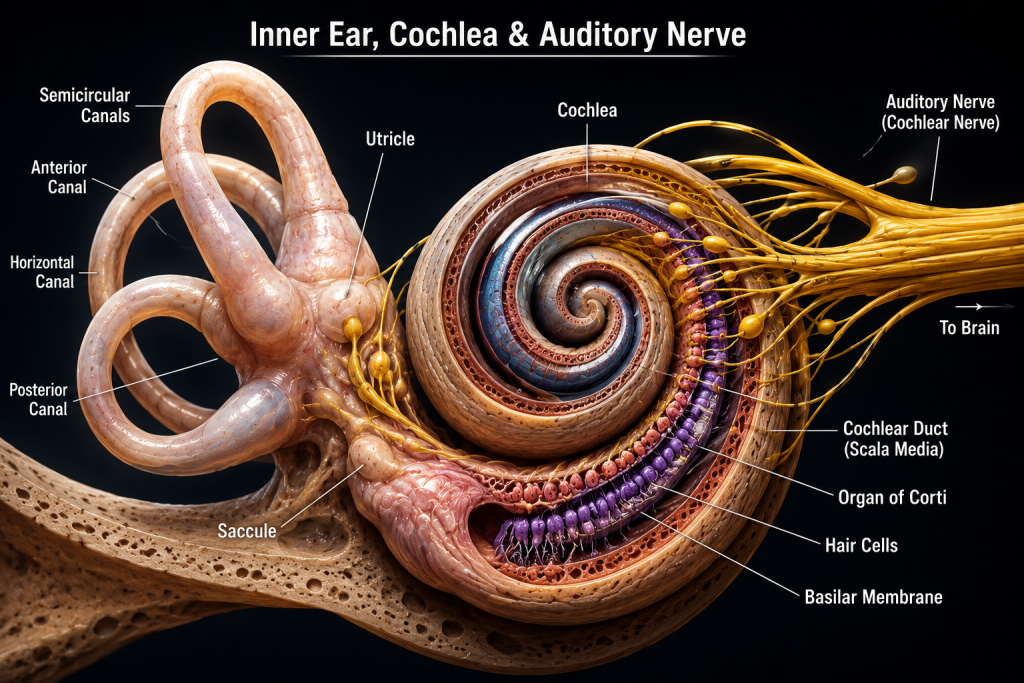
Image ALT Text: Anatomy of the ear explaining how human body senses process sound waves
4. Smell and Taste: The Chemical Detectors
Smell (olfaction) and taste (gustation) are our chemical human body senses. Rather than detecting light or sound waves, these senses literally sample the microscopic molecules of the physical world around us.
The Time Machine in Your Nose
Why does the smell of a specific perfume, fresh rain on hot pavement, or a particular home-cooked meal instantly transport you back to a vivid memory from your childhood? The olfactory bulb, the structure in the front of the brain that processes smells, is directly wired into the limbic system. Specifically, it connects directly to the amygdala and the hippocampus—the brain regions responsible for intense emotion and memory formation.
Unlike your other human body senses, which route their signals through the brain’s main “switchboard” (the thalamus) first, your sense of smell bypasses the switchboard and goes directly to the emotional and memory centers. This makes smell the most nostalgic and emotionally powerful of all human body senses.
The Truth About the Tongue Taste Map
For decades, science textbooks taught that different zones of the tongue tasted different things—sweet at the tip, salty on the sides, and bitter at the back. We now know this is a complete myth! Every single taste bud on your tongue has the capability to detect all five basic tastes:
- Sweet: Identifies energy-rich carbohydrates.
- Salty: Ensures we consume enough sodium for nerve function.
- Sour: Warns us of spoiled or unripe foods.
- Bitter: An evolutionary warning system against poisonous plants.
- Umami: A savory taste that identifies protein-rich foods.
The Intimate Link Between Smell and Taste
Did you know that your sense of taste is actually about 80% smell? While your tongue can only detect the five basic tastes mentioned above, all the complex flavors—like the difference between a strawberry and a cherry—come from your olfactory receptors. As you chew, air is forced up the back of your throat into your nasal cavity. If you plug your nose while eating a gourmet meal, your human body senses will fail to process the flavor, making the food taste like bland mush.
(Stay updated with the latest fascinating discoveries by checking out our News section on Jivan Jarurat!)
5. Touch: Your Body’s Largest Sensory Organ
Your skin is not just a wrapper for your organs; it is your largest organ, weighing roughly 16% of your total body weight. It is packed with a complex variety of specialized receptors, making touch one of the most diverse human body senses.
The Receptors of Touch
Your skin features different types of mechanoreceptors to interpret the physical world:
- Merkel cells: Located near the surface, these detect light touch and textures. They are what allow you to feel the softness of a feather or the grain of a piece of wood.
- Meissner’s corpuscles: These are responsible for sensing low-frequency vibrations and slips, helping you adjust your grip on a glass of water before it drops.
- Ruffini endings: Deep in the skin, these detect skin stretch and deformation, aiding in proprioception and finger movement.
- Pacinian corpuscles: These act as high-frequency vibration detectors. They are so sensitive they can detect vibrations transmitted through tools, making a pen feel like an extension of your own hand.
The Social Power of Touch
Touch is not just physical; it is deeply emotional. When we hug someone, hold hands, or receive a massage, our skin receptors send signals to the brain to release oxytocin, often called the “love hormone” or “cuddle chemical.” Oxytocin drastically lowers stress, reduces blood pressure, and promotes feelings of trust and bonding. This proves that our human body senses are crucial not only for physical survival but for our psychological well-being.
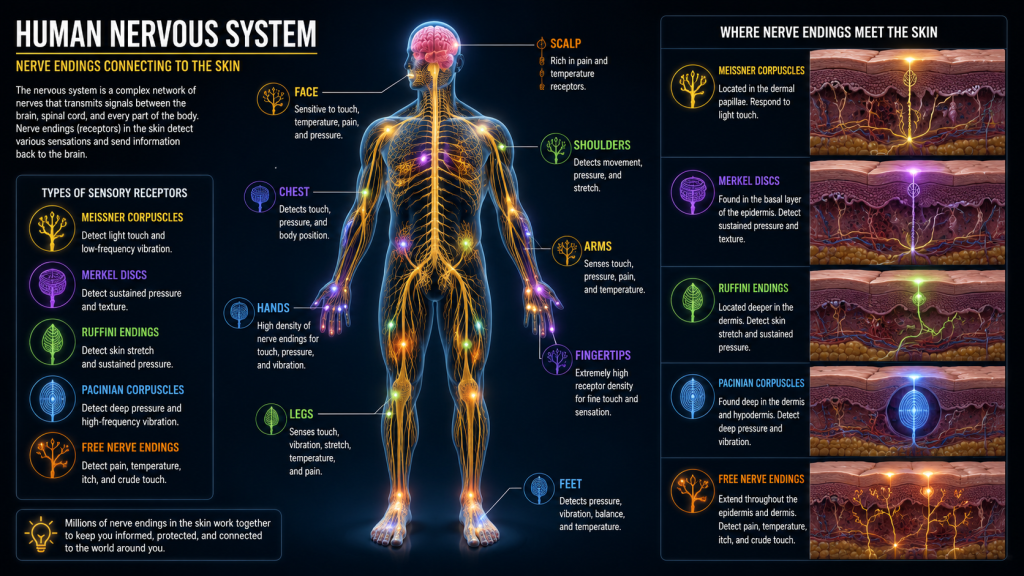
Image ALT Text: Nervous system chart explaining how human body senses send signals to the brain
6. Phenomenons of the Human Body Senses
Our human body senses don’t always operate strictly within their individual lanes. Sometimes, the brain wires things differently, resulting in extraordinary sensory phenomena.
Synesthesia: When Senses Collide
Imagine being able to taste the word “hello,” or seeing a burst of purple color every time you hear a piano play a C-chord. This is a neurological condition called synesthesia, which occurs in about 2% to 4% of the population. In people with synesthesia, the pathways of different human body senses cross over in the brain.
When one sense is activated, another sense involuntarily fires alongside it. Famous musicians like Pharrell Williams and Billie Eilish have synesthesia, and they often use these enhanced human body senses to “see” the music they are creating, helping them compose intricate masterpieces.
Phantom Limb Syndrome
When a person loses a limb through amputation, they often continue to feel sensations—including itchiness, pressure, and even severe pain—in the missing limb. This is known as phantom limb syndrome. It occurs because the brain region dedicated to mapping that specific body part is still fully active. Desperate for input, the brain sometimes “cross-wires” with neighboring sensory maps (like the face), causing the person to feel their missing hand being touched when someone touches their cheek. It is a profound demonstration of how our human body senses are ultimately generated in the brain, not just the physical appendages.
7. How to Protect and Improve Your Human Body Senses Naturally
Just like muscles, your human body senses can degrade over time due to aging, poor diet, and environmental damage. However, through neuroplasticity and proper care, you can actively protect, heal, and even sharpen your sensory perception. Here is a comprehensive guide to boosting your sensory health.
1. Eat a Sensory-Boosting Diet
What you eat directly impacts the neurological health of your human body senses.
- For Vision: Consume foods high in Lutein and Zeaxanthin, such as spinach, kale, and eggs. These antioxidants protect the macula of the eye from harmful UV rays and blue light damage. Vitamin A (found in carrots and sweet potatoes) is also critical for maintaining the cornea.
- For Hearing: Potassium and Magnesium are vital for hearing health. The fluid in your inner ear relies on potassium to transmit electrical impulses to the brain. Bananas, avocados, and dark chocolate are excellent choices.
- For Smell and Taste: Zinc deficiency is the number one cause of losing your sense of taste and smell. Incorporate zinc-rich foods like pumpkin seeds, lentils, chickpeas, and cashews into your diet.
2. Practice Sensory Deprivation and Mindfulness
We live in an incredibly overstimulating world. The constant glare of screens, the roar of traffic, and the bombardment of synthetic smells can fatigue your human body senses.
Practicing sensory deprivation—such as lying in a dark, silent room or using a professional float tank—forces your brain to reset. Furthermore, practicing mindfulness (like taking a walk in nature and actively trying to identify five distinct sounds, four colors, and three smells) strengthens the neural pathways between your sensory organs and your brain’s processing centers.
3. Protect Your Receptors from Environmental Damage
- Volume Control: The tiny stereocilia hairs in your ears do not regenerate in humans. Once they are damaged by loud noises, they are gone forever. Always wear earplugs at concerts, and follow the 60/60 rule for headphones: no more than 60% volume for no more than 60 minutes at a time.
- Skin Health: Protect your largest sensory organ by staying hydrated and wearing sunscreen. Chronic UV damage destroys the elasticity of the skin and degrades the sensitivity of surface mechanoreceptors.
- Nasal Health: Avoid smoking, as it physically burns and dulls the olfactory receptors in your nasal cavity. Regular use of a saline nasal rinse can keep the olfactory cilia clean and highly receptive to environmental scents.
4. Brain Training for Neuroplasticity
Because your human body senses are ultimately processed in the brain, keeping your brain sharp is non-negotiable. Learning a new language, playing a musical instrument, or engaging in hand-eye coordination sports like tennis or ping-pong forces your brain to build new neural connections, keeping your sensory processing speeds incredibly fast.
8. The Future of Human Body Senses: Cyborgs and Biohacking
As technology advances, humanity is moving closer to an era where we can artificially upgrade our human body senses.
Magnetoception: The Magnetic Sense
Many animals, like homing pigeons, sea turtles, and monarch butterflies, possess magnetoception—the ability to detect the Earth’s magnetic fields to navigate across the globe. Interestingly, some scientists believe humans may have a dormant, subconscious sense of magnetoception. We have magnetic proteins (cryptochromes) in our eyes.
Today, biohackers are artificially mimicking this by implanting tiny, biocompatible neodymium magnets into their fingertips. These individuals report developing a new sense where they can “feel” electromagnetic fields vibrating around microwaves, hard drives, and live wires!
Bionic Eyes and Cochlear Implants
Medical technology is already actively restoring lost human body senses. Cochlear implants bypass damaged ear parts to directly stimulate the auditory nerve, allowing the deaf to hear. Currently, scientists are developing bionic eyes—microchip retinal implants that capture video from a camera mounted on glasses and convert it into electrical pulses sent directly to the optic nerve. In the next few decades, we may not only restore sight but enhance it, allowing humans to see infrared heat or ultraviolet light.
(Curious about more futuristic topics and exciting lifestyle articles? Browse our Entertainment section for more amazing reads!)
9. Conclusion: Appreciating the Miracle of Your Human Body Senses
Your body is not just a biological machine; it is a highly evolved, sensory-rich antenna interacting with the cosmos. From the photons entering your retina to the chemical molecules binding to your olfactory bulb, your human body senses weave together to create the beautiful, vibrant tapestry of your reality.
Understanding that you have far more than just five senses opens up a world of respect for human anatomy. By protecting your proprioception, cherishing your vestibular system, and feeding your neuro-pathways with healthy foods and new experiences, you can keep your biological superpowers sharp for a lifetime.
The next time you enjoy a delicious meal, listen to your favorite song, or successfully walk down a dark hallway without tripping, take a moment to thank the complex, miraculous network of your human body senses.
Thank you for reading this ultimate guide on Jivan Jarurat! We are dedicated to providing you with the best health, news, and lifestyle tips to improve your daily life. If you found this article fascinating, be sure to bookmark our site and share it with your friends to spread the wonder of the human body!