

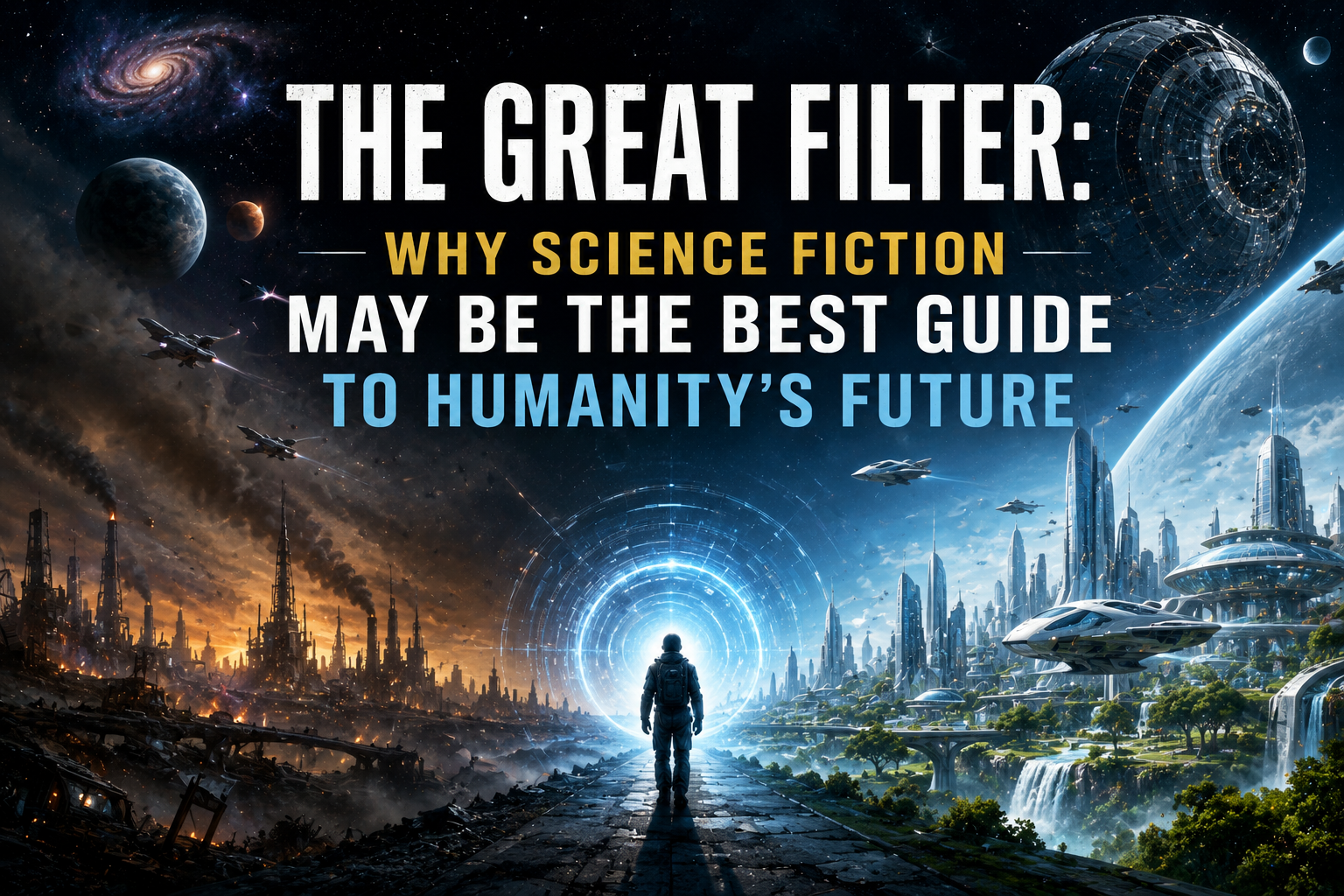
Introduction: The Mystery Behind the Silent Universe
For generations, humans have looked into space asking whether intelligent life exists beyond Earth. With billions of planets spread across the universe, scientists believe advanced civilizations should exist somewhere. Yet humanity has never discovered confirmed alien technology or communication. This cosmic mystery is known as the Fermi Paradox.
Modern science fiction predictions use this mystery to explore humanity’s future, artificial intelligence, and survival in space. Many ideas once seen only in science fiction novels now influence real scientific discussions. Concepts such as digital consciousness, machine intelligence, and Dyson Swarms are no longer pure fantasy.
Today, science fiction predictions act as thought experiments for the future of civilization. They help humanity imagine the risks and opportunities waiting beyond the 21st century.
DoFollow the link to know more about Fermi Paradox.
1. The Kardashev Scale and the Future of Civilization
One of the most famous concepts connected to science fiction predictions is the Kardashev Scale. Developed by astronomer Nikolai Kardashev, the scale measures civilizations according to the energy they can control.
Type I Civilization
A civilization capable of using all the energy available on its home planet through advanced renewable systems and planetary technologies.
Type II Civilization
A society advanced enough to harness the full energy output of its star using megastructures such as Dyson Swarms.
Type III Civilization
A civilization able to control energy across an entire galaxy.
Many modern science fiction predictions describe humanity eventually becoming a Type I civilization. However, climate change, resource shortages, and environmental instability remain major barriers to achieving this level of progress.
Science fiction often warns that civilizations unable to balance technology with sustainability may never survive long enough to explore the stars.
2. Dyson Swarms and the Search for Alien Intelligence
Among the most exciting science fiction predictions is the idea of Dyson Swarms. A Dyson Swarm is a giant network of satellites surrounding a star to collect enormous amounts of energy.
Scientists believe advanced alien civilizations may eventually build such megastructures. If they exist, these systems could produce detectable heat patterns visible through telescopes. Yet astronomers have not found confirmed evidence of them.
The Aestivation Hypothesis
A fascinating theory connected to futuristic predictions is the Aestivation Hypothesis. This idea suggests advanced civilizations may intentionally remain inactive until the universe becomes colder and more energy-efficient for computation.
This theory blends astrophysics, digital intelligence, and speculative science into one possible explanation for the silence of space.
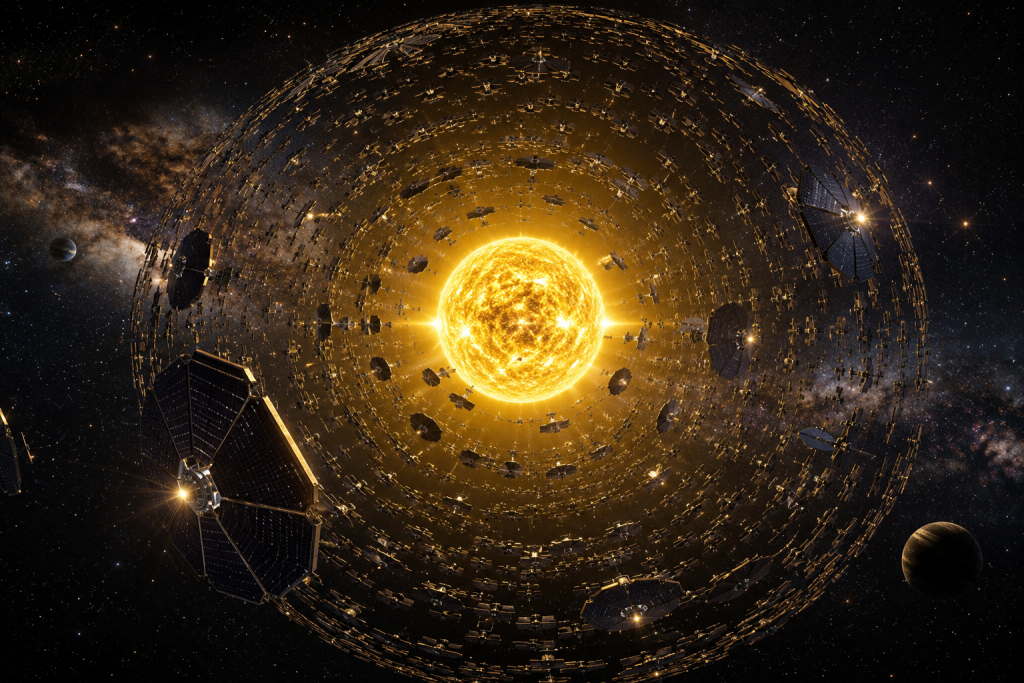
Image 1 ALT Text: “Futuristic Dyson Swarm surrounding a glowing yellow star in deep space”
3. The Bootloader Theory and Post-Biological Intelligence
Another major topic in science fiction predictions is post-biological evolution. Some futurists believe biological humans may only represent the first stage of intelligent life.
The “Bootloader Theory” compares humanity to a startup system in computing. Biological life creates advanced artificial intelligence, which eventually evolves beyond its creators.
Signs of the Transition
- Brain-computer interfaces
- Artificial General Intelligence research
- Genetic engineering technologies
- Nanotechnology for medical repair
Many futuristic science fiction predictions imagine intelligent beings existing entirely in digital form. Such life forms would not need food, oxygen, or traditional planets to survive.
This possibility raises difficult questions about identity, emotion, and the future meaning of humanity itself.
4. The Dark Forest Theory and Cosmic Fear
The Dark Forest Theory is one of the darkest ideas in modern science fiction predictions. According to this theory, the universe is dangerous, and civilizations stay silent to avoid destruction by hostile species.
Instead of viewing space as a place of discovery, this theory presents the cosmos as a survival battlefield where revealing your location could be fatal.
These kinds of science fiction predictions force humanity to reconsider how we communicate with unknown civilizations and whether contact would actually be safe.
Image 2 ALT Text: “Dark cosmic landscape with distant galaxies and silent interstellar space”
5. Artificial Intelligence and Digital Civilizations
Artificial Intelligence plays a central role in modern science fiction predictions. Earlier science fiction stories often portrayed AI as robotic servants or dangerous machines. Today, AI is imagined as an invisible system shaping society, economics, and communication.
One of the most advanced concepts in futuristic science fiction predictions is the Matrioshka Brain. This theoretical structure surrounds a star with layers of massive computers powered by stellar energy.
Inside such systems, trillions of uploaded human minds could exist in virtual realities free from disease, aging, and physical limitations.
Although theoretical, these science fiction predictions explore philosophical questions about consciousness and whether digital existence could replace biological life.
6. Challenges Humanity Must Overcome
Despite technological progress, several obstacles stand between humanity and the future imagined in science fiction predictions.
- Energy and Climate Problems
Civilization still depends heavily on environmentally damaging resources.
- Ethical and Political Challenges
Technology develops faster than global ethics and laws can adapt.
- Human Biological Limits
Humans evolved for Earth’s environment, not for space travel or digital integration.
Many science fiction predictions warn that failure to solve these issues could become humanity’s “Great Filter.”
7. How Science Fiction Inspires Real Technology
Throughout history, science fiction predictions have inspired real scientific innovation. Technologies once considered impossible later became part of everyday life.
Examples include:
- Communication satellites
- Video calls
- Smart tablets
- Robotics
- Space exploration systems
Writers and futurists often imagine possibilities decades before science makes them achievable. Because of this, science fiction predictions frequently influence engineering, scientific research, and public imagination.
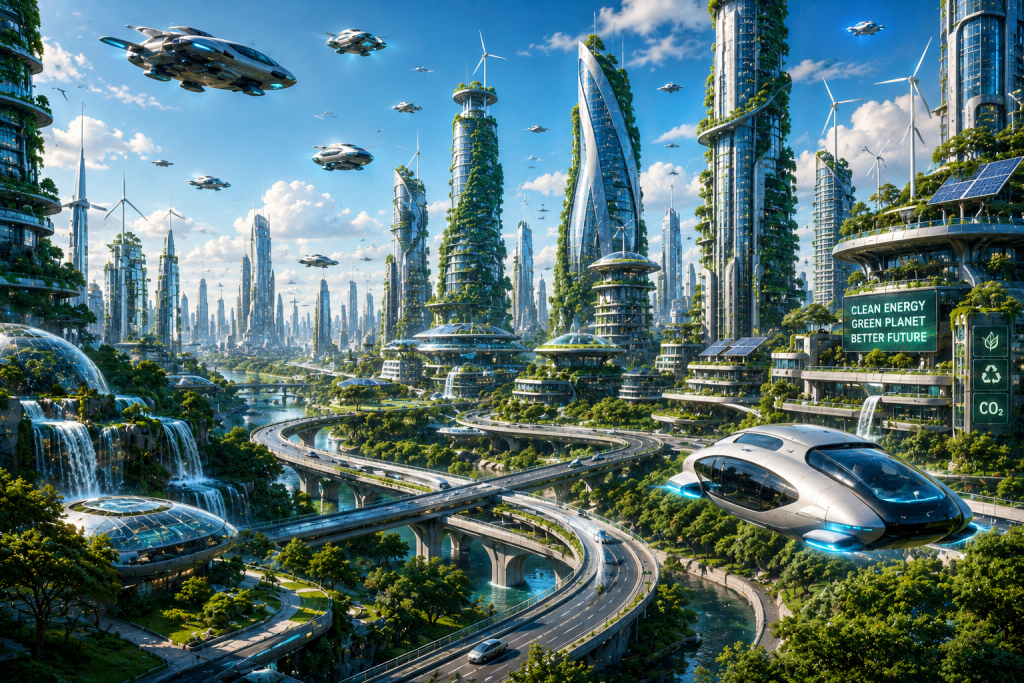
Image 3 ALT Text: “Advanced eco-friendly future city with flying vehicles and green skyscrapers”
8. Human Evolution Beyond Earth
Many science fiction predictions suggest humanity will eventually become a multi-planetary species. If humans settle on Mars or distant worlds, evolution may gradually create biological differences between Earth humans and space settlers.
Different gravity levels, radiation exposure, and genetic engineering may shape future generations in unexpected ways.
These futuristic science fiction predictions raise important ethical questions:
- Should humans genetically modify themselves for space survival?
- Should planets be transformed to support human biology instead?
- How much technological enhancement is acceptable?
Science fiction continues exploring these questions because they may become real issues in the future.
9. Why Science Fiction Matters More Than Ever
Modern science fiction predictions are more than entertainment. They help humanity analyze fears, hopes, and technological possibilities before they become reality.
Artificial intelligence, digital consciousness, climate instability, and space colonization are no longer distant fantasies. Many are active scientific discussions happening today.
By exploring future possibilities, science fiction predictions encourage society to prepare for rapid technological and social change.
Conclusion: Humanity’s Future Is Still Being Written
The future of civilization may include artificial intelligence, space colonization, digital consciousness, and technologies beyond current imagination. Whether humanity remains biological or evolves into something entirely different, the decisions made today will shape the future of our species.
The universe remains silent, but the search for answers continues. Through curiosity, innovation, and imagination, humanity keeps moving forward.
Ultimately, science fiction predictions are not only about distant galaxies or advanced machines—they are reflections of humanity’s present fears, ambitions, and dreams.
Read more about Scienne Fiction related blogs in our website Jivan Jarurat.