

It makes up 27% of the entire universe — yet no one has ever seen it, touched it, or directly detected it. Dark matter is the ultimate mystery of modern physics, and science fiction has been obsessed with it for decades. Here’s everything you need to know.
📡 Table of Contents
- What Is Dark Matter? A Beginner’s Guide
- The Scientific Evidence: Why We Believe Dark Matter Exists
- Dark Matter in Science Fiction: A Historical Timeline
- Notable Science Fiction Works Featuring Dark Matter
- Dark Matter in Films and Television
- How Sci-Fi Compares to Real Dark Matter Science
- The Future of Dark Matter: In Science and in Story
- Conclusion: Why Dark Matter Captivates Us
What Is Dark Matter? A Beginner’s Guide
Imagine the entire observable universe — every star, planet, galaxy, nebula, and black hole you’ve ever seen in photographs. Now imagine that everything you just pictured accounts for less than 5% of what actually exists. The rest? A cosmic fog of invisible substance that neither emits, absorbs, nor reflects light. Scientists call it dark matter, and it is arguably the greatest unsolved mystery in modern physics.
Dark matter does not interact with the electromagnetic force that governs light, which is precisely why it is “dark” — it is completely invisible to our telescopes and instruments. Yet we know it is there because of the profound gravitational effects it has on the visible universe. Galaxies spin at speeds they shouldn’t be able to sustain based on their visible mass alone. Galaxy clusters bend light in ways that defy explanation without an invisible scaffold of extra mass holding everything together.
To put it simply: dark matter is the skeleton of the universe. Visible matter — stars, gas, dust, planets, you and me — is just the flesh draped over a vast invisible framework. Without dark matter, galaxies as we know them could not have formed. Structures in the cosmic web would not exist. The universe would look radically different.
“Dark matter is not the absence of something. It is the presence of everything we cannot yet comprehend.”— Paraphrase of a common cosmological perspective
Science fiction has long recognized the narrative and philosophical power of dark matter. A substance that shapes the universe without ever being seen? That interacts with our world through gravity alone but remains fundamentally untouchable? For storytellers, dark matter is a blank canvas — simultaneously terrifying and wondrous, a placeholder for the unknown that invites endless speculation.
The Scientific Evidence: Why We Believe Dark Matter Exists
Before we dive into how science fiction has handled dark matter, it’s worth understanding the real scientific case for its existence. This context makes the fictional explorations all the more compelling — and allows us to judge where sci-fi got things right and where it took liberties.
Fritz Zwicky and the Coma Cluster (1933)
The first scientific hint of dark matter came from Swiss astronomer Fritz Zwicky in 1933. Studying the Coma Cluster — a massive collection of galaxies — Zwicky calculated that the galaxies were moving far too fast to be held together by the visible mass of the cluster. Something else had to be providing the gravitational glue. He called it dunkle Materie — dark matter. For decades, his observation was treated as an anomaly.
Vera Rubin and Galaxy Rotation Curves (1970s)
The decisive evidence came from astronomer Vera Rubin in the 1970s, whose work on galaxy rotation curves changed cosmology forever. According to Newtonian physics and the laws of gravity, stars at the outer edges of spiral galaxies should orbit more slowly than stars near the center — just as outer planets in our solar system orbit more slowly than inner ones. But Rubin found the opposite: stars at galactic edges moved at roughly the same speed as those near the center. The galaxies were wrapped in enormous invisible halos of additional mass — dark matter halos — that provided the extra gravitational force.
Gravitational Lensing
Another powerful line of evidence comes from gravitational lensing — the way massive objects bend light passing near them. When astronomers observe light from distant galaxies being bent around galaxy clusters, the degree of bending consistently requires far more mass than is visible. The Bullet Cluster, a pair of galaxy clusters that have collided, provides one of the most dramatic demonstrations: the visible matter (gas, stars) was slowed by the collision, but an invisible component passed straight through — the dark matter — producing a distinct separation that can be mapped via lensing.
🔭 Current Dark Matter Candidates
- WIMPs (Weakly Interacting Massive Particles) — The leading theoretical candidate for decades, though none have been detected yet.
- Axions — Ultra-light particles first proposed to solve a different physics problem; now a major dark matter candidate.
- Sterile Neutrinos — Hypothetical “heavy” neutrinos that interact only via gravity.
- Primordial Black Holes — Black holes formed in the early universe before any stars existed.
- Dark Photons — Hypothetical particles that would constitute a “dark electromagnetism,” forming a hidden sector of physics.
Dark Matter in Science Fiction: A Historical Timeline
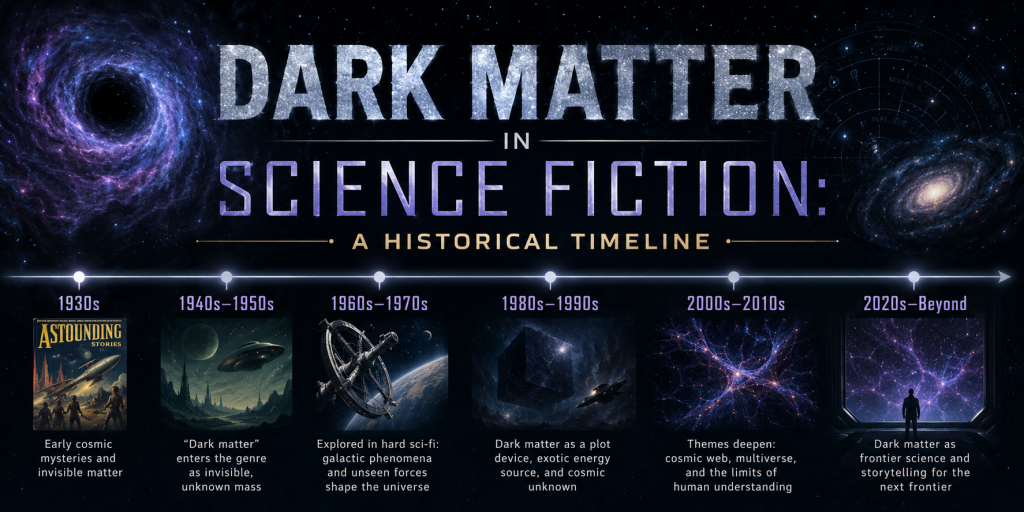
Science fiction’s engagement with dark matter mirrors the history of the science itself — beginning with speculative whispers in the mid-twentieth century and exploding into a full-blown narrative obsession as cosmology advanced.
In the early decades of science fiction — the pulp era of the 1930s through 1950s — the concept barely existed by name. Writers of the time were fascinated by invisible matter and hidden forces, but lacked the scientific vocabulary for dark matter specifically. Stories about invisible aliens, hidden dimensions, and “ether” science filled the gap. These were proto-dark-matter narratives: stories built on the premise that the universe contained vast invisible components shaping everything we see.
By the 1960s and 1970s, as Vera Rubin’s work began circulating and the concept of dark matter became more established in academic circles, science fiction writers started incorporating it more explicitly. The genre’s golden age had trained readers to expect rigorous engagement with real physics, and dark matter — mysterious, powerful, invisible — was irresistible.
The 1980s and 1990s brought dark matter into mainstream science fiction as the term itself became culturally familiar. Writers like Greg Bear, Alastair Reynolds, and Peter F. Hamilton began weaving dark matter into their cosmologies not as a background detail but as an active element of plot and world-building. Dark matter became shorthand for the incomprehensible — the universe’s hidden architecture that humanity was only beginning to glimpse.
The 2000s and 2010s saw an explosion of dark matter fiction, coinciding with major experimental efforts to detect it directly. As physicists built ever-larger underground detectors and ran experiments at CERN, dark matter remained stubbornly undetected — and that failure became itself a source of narrative tension. What if dark matter couldn’t be detected because it didn’t interact with us at all? What if it formed its own parallel universe of dark atoms, dark stars, dark life?
Notable Science Fiction Works Featuring Dark Matter
The Dark Matter Trilogy — Blake Crouch
Perhaps no recent science fiction work has done more to popularize dark matter in mainstream consciousness than Blake Crouch’s 2016 thriller Dark Matter. A bestselling novel that spent weeks on the New York Times list, it uses quantum mechanics and the many-worlds interpretation — closely linked to dark matter discussions in theoretical physics — to spin a breathless thriller about a physicist who wakes up in a life he doesn’t recognize.
Crouch’s use of “dark matter” is largely metaphorical — the title refers as much to the hidden, unlived lives within each person as to actual cosmic dark matter. But the novel brought the concept to millions of readers who had never thought about cosmology, and its success spawned a television adaptation that reached an even larger audience. Crouch followed it with Recursion and Upgrade, cementing his reputation as the leading popularizer of physics-based thriller fiction.

Revelation Space Series — Alastair Reynolds
Alastair Reynolds, a former ESA astrophysicist turned science fiction author, is widely regarded as one of the hardest hard-SF writers working today. His Revelation Space universe engages extensively with dark matter and its cosmological implications. Reynolds treats dark matter not as a convenient plot device but as a genuine cosmological puzzle that his characters must grapple with — one with implications for the Fermi Paradox and the long-term fate of civilizations.
In Reynolds’ universe, the hidden nature of dark matter is connected to the mystery of why the galaxy appears empty of intelligent life. The idea that dark matter might constitute a hidden substrate of reality — one that advanced civilizations could potentially exploit — runs through his work as a recurring thread.
Blindsight — Peter Watts
Peter Watts’ Blindsight (2006) is frequently cited as one of the most scientifically rigorous science fiction novels ever written. While not primarily a dark matter story, it engages deeply with the nature of consciousness, intelligence, and the hidden forces shaping evolution and cognition. Watts treats the universe’s invisible components — dark matter included — as part of a cosmos that is fundamentally alien to human intuition, a theme that resonates throughout his work.
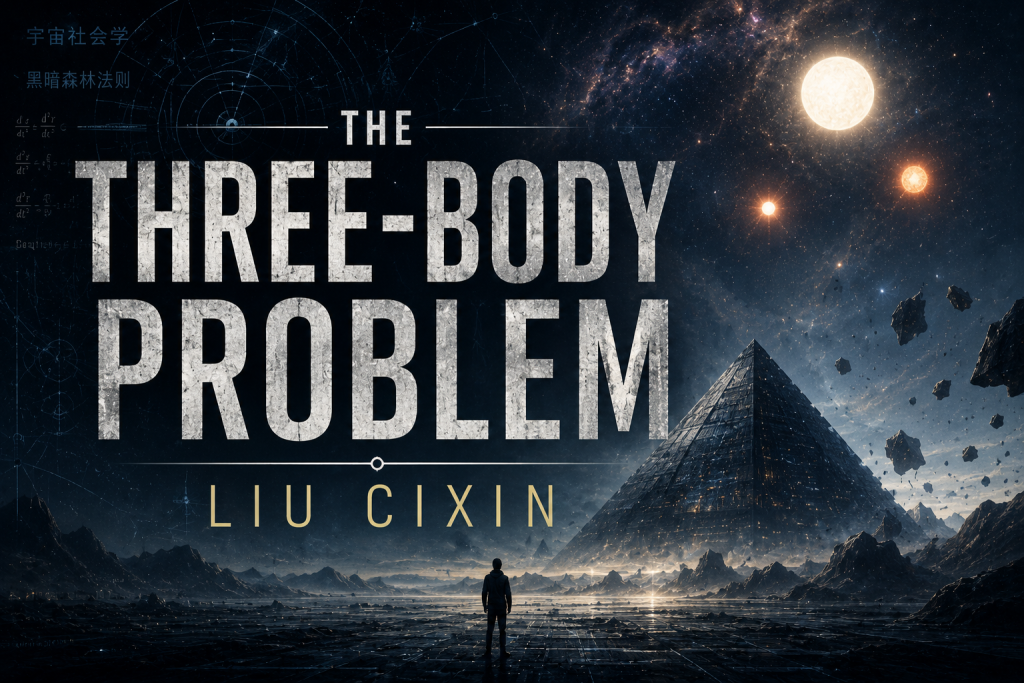
The Three-Body Problem — Liu Cixin
Chinese science fiction phenomenon Liu Cixin’s trilogy, which begins with The Three-Body Problem and culminates in Death’s End, includes one of the most audacious uses of dark matter in fiction. Without spoiling the details, Liu postulates that dark matter is connected to the mechanisms by which advanced civilizations hide themselves — and destroy others. His use of theoretical physics is breathtakingly ambitious, and dark matter plays a central role in the universe’s cosmological architecture.
The trilogy became the first Asian science fiction work to win the Hugo Award for Best Novel, and its treatment of dark matter as an element of cosmic-scale conflict has influenced an entire generation of science fiction writers.
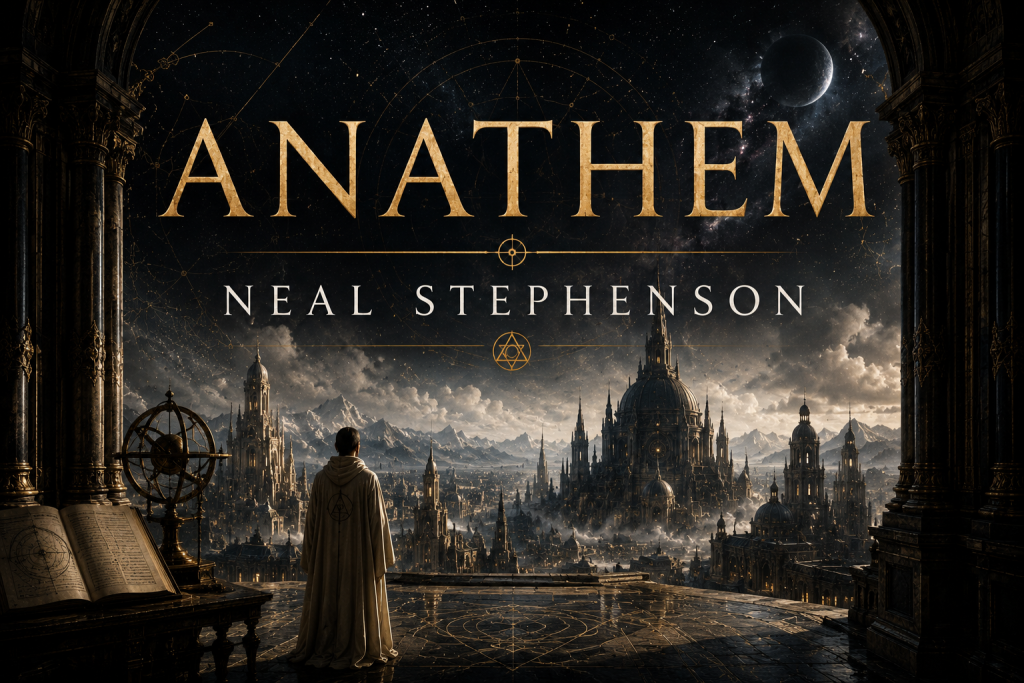
Anathem — Neal Stephenson
Neal Stephenson’s mammoth novel Anathem (2008) uses dark matter as a plot element in a story that is ultimately about the nature of consciousness and the relationship between mathematics and physical reality. Stephenson, who is known for his exhaustive research, engages with dark matter through the lens of a fictional philosophical tradition that maps closely onto real-world debates in physics and philosophy of science.
Dark Matter in Films and Television
While novels have provided the deepest explorations of dark matter in fiction, film and television have brought the concept to the broadest audience — often sacrificing scientific precision for narrative accessibility.
Dark Matter (Syfy / Apple TV+)
The television adaptation of Blake Crouch’s Dark Matter novel, produced for Apple TV+ in 2024, brought quantum dark matter concepts to a streaming audience. The show’s visual effects team worked to depict the “quantum superposition box” at the heart of the story — a device that exploits dark matter and quantum mechanics to navigate between parallel worlds. While the science is heavily dramatized, the show sparked genuine public interest in both dark matter and quantum physics.
Interstellar (2014)
Christopher Nolan’s Interstellar doesn’t name dark matter explicitly, but the film’s central premise — that human beings must find a way to understand and exploit gravitational anomalies across dimensions — touches on the same physics that makes dark matter so mysterious. The film’s scientific advisor, Nobel laureate Kip Thorne, ensured that the gravitational physics depicted was grounded in real theory, and dark matter forms part of the invisible scaffolding that makes the film’s universe work.
Dark Season (BBC)
The German Netflix series Dark — not to be confused with Crouch’s novel — uses quantum entanglement, wormholes, and the hidden structure of spacetime as narrative foundations. While dark matter isn’t the explicit focus, the show’s treatment of invisible forces that connect times, places, and lives resonates strongly with cosmological dark matter metaphors. Its labyrinthine plotting mirrors the way dark matter structures the universe: invisible threads connecting everything.
Annihilation (2018)
Alex Garland’s Annihilation, based on Jeff VanderMeer’s novel, depicts an alien presence that fundamentally rewrites the rules of biology and physics within its influence zone. The “Shimmer” can be read as a dark matter narrative: an invisible substrate of alien physics that has overlaid our world, following rules we cannot perceive or predict. The film’s refusal to explain or rationalize the phenomenon is one of its greatest strengths — and one of its most scientifically honest choices.
How Sci-Fi Compares to Real Dark Matter Science
Science fiction’s relationship with dark matter science is complicated. At its best, the genre anticipates and illuminates real scientific ideas. At its worst, it uses “dark matter” as a catch-all explanation for impossible technology — a kind of narrative shorthand that science fiction critics sometimes call “physics hand-waving.”
Where Sci-Fi Gets It Right
The best dark matter science fiction shares several features with genuine scientific thinking. First, it treats dark matter as something that cannot be directly interacted with through ordinary means — only through gravity. This is one of the defining features of real dark matter candidates like WIMPs and axions, and good fiction respects it. Stories that have dark matter “powering” spaceships or being “harvested” by energy collectors almost certainly violate this constraint.
Second, the best sci-fi engages with dark matter’s cosmological scale. Dark matter doesn’t affect individual humans or even solar systems in any directly perceptible way — its effects are visible only at galactic scales and above. Fiction that situates dark matter as part of the large-scale structure of civilization, interstellar conflict, or cosmic fate is closer to the science than stories that bring it down to human scale.
Where Sci-Fi Takes Liberties
The most common fictional distortion of dark matter is treating it as a versatile exotic material — something that can be refined, weaponized, used as fuel, or manipulated by sufficiently advanced technology. In reality, dark matter’s defining characteristic is precisely that it cannot be manipulated this way. It interacts via gravity and nothing else (as far as we know), which means building a dark matter reactor is about as plausible as building an engine that runs on time.
A secondary distortion is treating dark matter as something mysterious in isolation, rather than recognizing that it is fundamentally linked to dark energy (the force driving the universe’s accelerating expansion) and the overall architecture of spacetime. The best science fiction is beginning to incorporate this fuller picture; older works often treat dark matter as a standalone mystery rather than part of a connected cosmological puzzle.
“The most honest thing science fiction can do with dark matter is what the best scientists do: sit with the mystery rather than resolve it prematurely.”— JivanJarurat Editorial
The Future of Dark Matter: In Science and in Story
We stand at a fascinating juncture in both dark matter science and dark matter fiction. On the scientific side, decades of increasingly sensitive experiments have failed to detect WIMPs — once the consensus favorite candidate for dark matter. This null result has forced physicists to broaden their search significantly, considering particle candidates and detection strategies that would have seemed fringe just twenty years ago.
The axion has emerged as a leading alternative candidate, and new experiments like ADMX (Axion Dark Matter Experiment) are specifically designed to detect them. Meanwhile, the concept of self-interacting dark matter — dark matter that interacts not just gravitationally but through its own “dark forces” — has gained theoretical traction. If dark matter has its own internal physics, forming “dark atoms,” “dark molecules,” and potentially even “dark stars,” the implications for science fiction are staggering.
Imagine a universe in which, alongside the visible cosmos of stars and planets and life, there exists a parallel shadow cosmos of dark matter structures — invisible galaxies, invisible stars, perhaps even invisible biology — all occupying the same space as the universe we know but forever unreachable, perceivable only through its gravitational whisper. This is not pure fantasy. It is a genuine scientific hypothesis. And science fiction has barely begun to explore it.
The Next Wave of Dark Matter Fiction
The most exciting dark matter fiction of the coming decades will likely engage with three emerging scientific ideas. The first is dark matter self-interaction — the possibility of an entire hidden sector of physics running parallel to our own. The second is the connection between dark matter and the Fermi Paradox — could advanced civilizations have “migrated” into dark matter structures, becoming invisible to us precisely because they no longer inhabit visible matter? The third is the relationship between dark matter and the multiverse — in many-worlds quantum mechanics, dark matter might be understood as gravitational leakage from adjacent branches of reality.
These are the ideas that the most ambitious science fiction of the next generation will explore. Writers who take the science seriously — who do the reading, engage with the physicists, and resist the temptation to use dark matter as lazy shorthand — will produce stories that not only entertain but genuinely illuminate the cosmic mystery at the heart of our existence.
📖 Recommended Reading: Dark Matter Science Fiction
- Dark Matter by Blake Crouch — Accessible quantum thriller; mainstream gateway drug for dark matter fiction.
- Revelation Space by Alastair Reynolds — Rigorous hard SF with dark matter woven into a rich galactic cosmology.
- The Three-Body Problem by Liu Cixin — Epic scale, audacious physics, dark matter as cosmic weapon.
- Anathem by Neal Stephenson — Dense but rewarding; dark matter through the lens of philosophy of mind.
- Blindsight by Peter Watts — The hardest of hard SF; a universe that cares nothing for human intuition.
- A Fire Upon the Deep by Vernor Vinge — Zones of thought as a proxy for dark matter and the hidden structure of physics.
Conclusion: Why Dark Matter Captivates Us
There is something profoundly moving about dark matter — not as a scientific concept alone, but as a metaphor for the human condition. We live in a universe where the vast majority of what exists is invisible to us. The matter that makes up our bodies, our cities, our stars is a thin luminous minority floating in an ocean of dark, unknowable substance. We are, in a very real sense, the exception rather than the rule.
Science fiction has always been drawn to this kind of humbling perspective. The best science fiction doesn’t just tell stories about heroes and villains — it tells stories about humanity’s place in a cosmos that is far stranger, far larger, and far more complex than our intuitions suggest. Dark matter is the ultimate expression of that strangeness. It is the universe refusing to be fully known.
What makes dark matter so endlessly compelling as a narrative subject is precisely its resistance to resolution. Science fiction that resolves the dark matter mystery — that finds it, captures it, weaponizes it, understands it — misses the point. The real power of dark matter as a story element lies in its irreducibility, its persistence as mystery even in the face of all our instruments and all our intelligence.
As a civilization, we are only at the beginning of our engagement with dark matter. We have mapped its distribution across the cosmos. We have inferred its mass. We have watched it shape galaxies across billions of years. But we have not touched it. We have not seen it. We do not know what it is. And there is every possibility that we are not the only things it has shaped — that within the dark matter halos surrounding our galaxy, histories we cannot imagine have unfolded, governed by physics we have not yet conceived.
That is the gift that dark matter gives to science fiction: an honest, scientifically grounded invitation to imagine the truly unimaginable. And the greatest dark matter stories — the ones that will still be read a century from now — will be those that accept that invitation with courage, curiosity, and a willingness to sit quietly in the dark, listening to the gravitational whisper of a universe that will always know more than we do.