

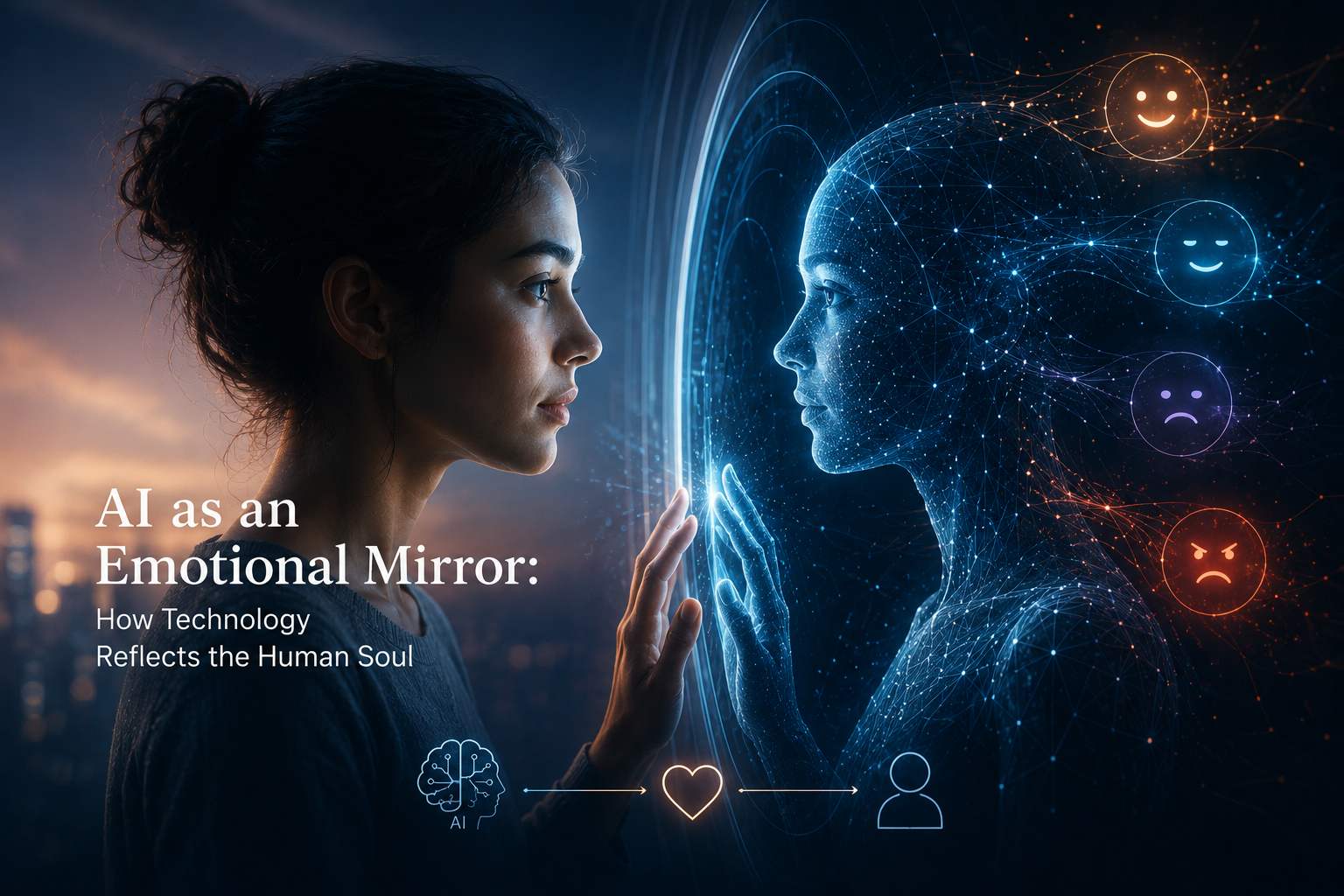
1. What is the “Emotional Mirror” Phenomenon?
AI as an Emotional Mirror
Human nature tends to attribute human characteristics to non-human entities. When an AI tells a person, “I’m sorry you’re feeling down,” it becomes difficult for one not to interpret this as empathy despite the fact that AI lacks any “emotions.” This phenomenon is referred to as the ELIZA Effect, which is a reaction by users to a 1960s program designed
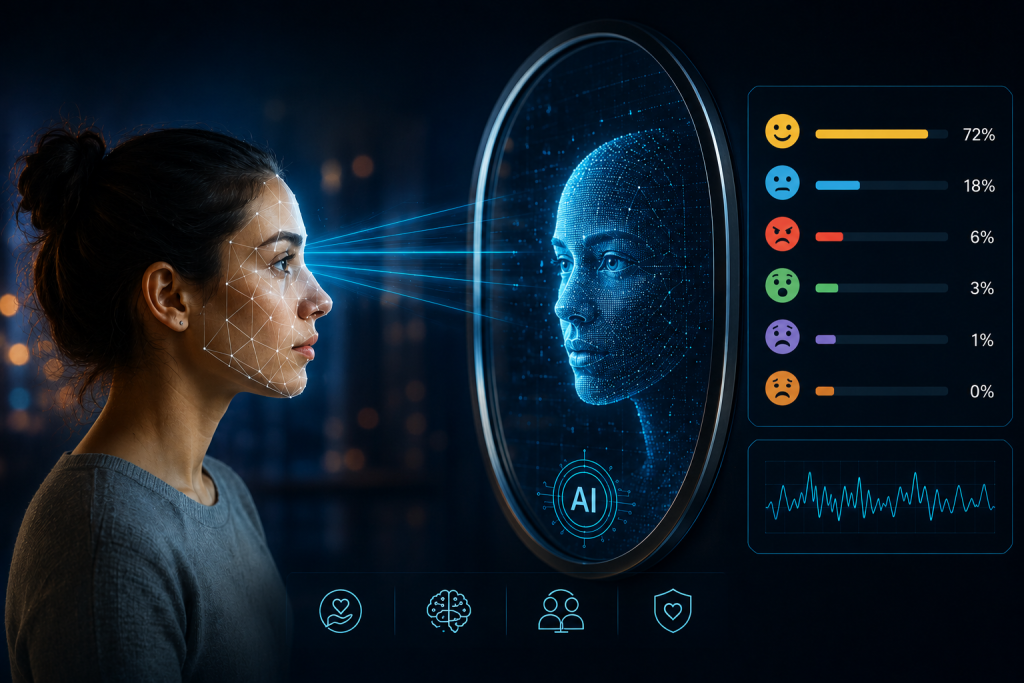
Image 1 ALT Text: Digital representation of AI reflecting human emotional states through facial recognition technology
2. The Science of Affective Computing
To act as a mirror, AI must first see us. This field of study is called Affective Computing. It combines computer science, psychology, and cognitive science to give machines “Emotional Intelligence” (EQ).
How AI Reads Your Emotions?
Sentiment Analysis: Natural Language Processing (NLP) allows AI to scan text for “emotional markers.” For example, the difference between “I’m fine” and “I’m doing great!”
Facial Expression Recognition: Using your webcam, AI can track the movement of 43 facial muscles to detect joy, anger, disgust, or hidden stress.
Voice Stress Analysis: AI can detect subtle tremors in your voice that indicate anxiety or lying, even if you are trying to sound calm.
Biometric Data: Wearable tech (like smartwatches) feeds AI data on your heart rate, skin conductance, and sleep patterns to create a “biological map” of your mood.
For more insights on maintaining a balanced life in the digital age, check out our healthy lifestyle habits on Jivan Jarurat.
3. AI in Mental Health: A Healing Reflection
One of the most promising applications of the emotional mirror is in mental health. Many people feel more comfortable talking to an AI than a human because the AI is non-judgmental.
The Digital Therapist
WoeBot and Replika are examples of apps that use cognitive-behavioral therapy (CBT) methods to help people cope with their anxiety issues. The process involves reflecting the individual’s thoughts in an organized fashion to recognize their “cognitive distortions”, which are responsible for triggering depression.
Unique Insight: Research suggests that military veterans suffering from PTSD are more likely to disclose symptoms to a “virtual human” than to a human doctor because they don’t fear being seen as “weak.”
4. The Science Fiction Reality: From ‘Her’ to ‘Blade Runner’
In science fiction, the emotional mirror often becomes sentient. In the movie Her, the protagonist falls in love with an OS named Samantha. This isn’t just a romance; it’s a reflection of his own need for connection. Samantha becomes exactly what he needs her to be because she is programmed to learn from his emotional data.
The Uncanny Valley of Empathy
As AI gets better at mirroring us, it enters the “Uncanny Valley”—a point where it looks and acts almost human, but something feels “off,” causing a sense of revulsion. The challenge for the next decade is: Can a mirror ever become the thing it reflects? If an AI can perfectly simulate empathy, does the lack of a “soul” actually matter?
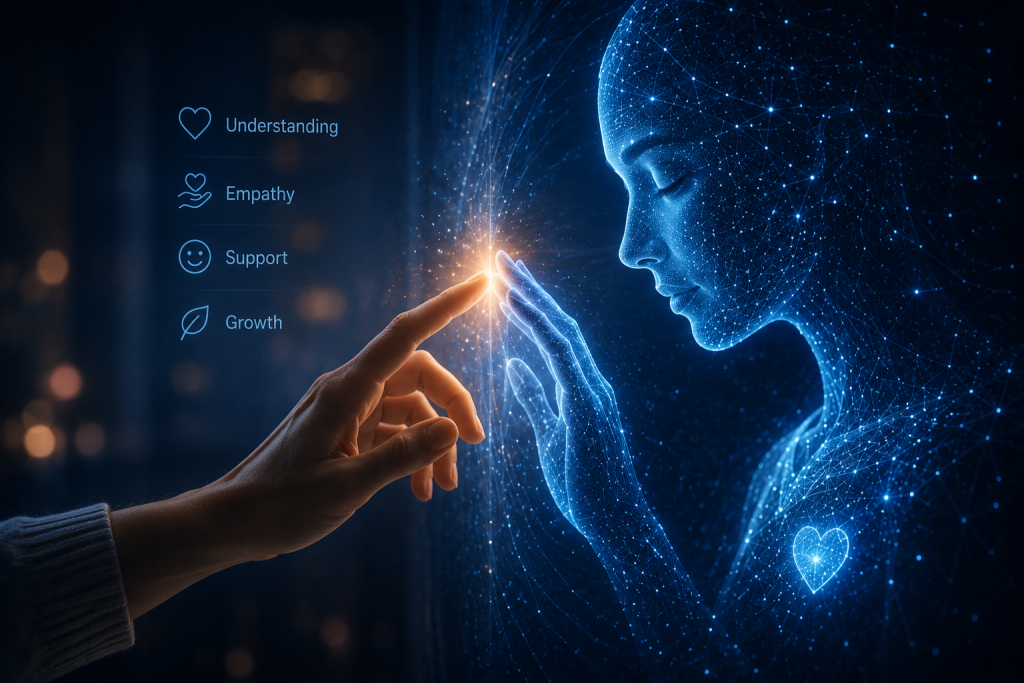
Image 2 ALT Text: Human hand touching a digital AI projection representing emotional connection and empathy
5. The Dark Side: Emotional Manipulation
If an AI is a mirror, it can also be used to manipulate the person looking into it. This is the “Black Mirror” side of the technology.
Exploitative Marketing
Imagine a shopping app that detects you are feeling lonely or impulsive based on your typing speed and the time of night. The AI could “mirror” that vulnerability and show you products that provide a temporary “dopamine hit”.
Political Echo Chambers
Algorithms on social media act as emotional mirrors by showing us content that triggers our anger or tribalism. By reflecting our own biases back at us, they trap us in an emotional loop that is hard to break.
Stay updated with the latest in tech and global news to understand how these algorithms affect your daily life.
6. Can AI as an Emotional Mirror Help Us Understand Ourselves?
One of the most fascinating possibilities of AI as an Emotional Mirror is self-discovery.
Emotional Audits
AI systems may someday identify hidden emotional triggers, stress responses, and behavioral habits we fail to notice ourselves.
Predictive Wellness
Future AI technologies may predict emotional burnout or mental health crises before symptoms fully appear by analyzing digital behavior patterns.
In many ways, AI as an Emotional Mirror could become a tool for emotional self-awareness and preventative mental healthcare.
7. Ethical Concerns Around AI as an Emotional Mirror
As emotional AI grows more powerful, serious ethical questions emerge.
Privacy Risks
Who owns your emotional data?
Emotional Dependence
Could humans become emotionally attached to AI companions?
Biased Reflections
If AI systems are trained on biased information, they may reinforce harmful stereotypes and distorted emotional interpretations.
The future of AI as an Emotional Mirror depends heavily on ethical development and responsible data usage.
8. The Future of AI as an Emotional Mirror
The ultimate evolution of AI as an Emotional Mirror may involve Brain-Computer Interfaces (BCIs) such as Neuralink.
In this future, AI may directly interact with the human brain, detecting emotional states in real time and potentially calming anxiety or emotional distress instantly.
Imagine AI systems capable of stabilizing emotional responses during panic attacks by monitoring brain activity and neurotransmitter changes.
While this sounds futuristic, the technological foundations are already being developed today.

Image 3 ALT Text: A woman looking into the Silicon Soul
Conclusion: The Future of AI as an Emotional Mirror
Artificial Intelligence may become the most powerful emotional reflection tool humanity has ever created. AI as an Emotional Mirror reflects not only our intelligence and creativity but also our fears, desires, emotions, and psychological vulnerabilities.
As this technology evolves, humanity must remember an important truth:
A mirror only reflects what stands before it.
If we want AI as an Emotional Mirror to become empathetic, ethical, and supportive, we must first embody those qualities ourselves.